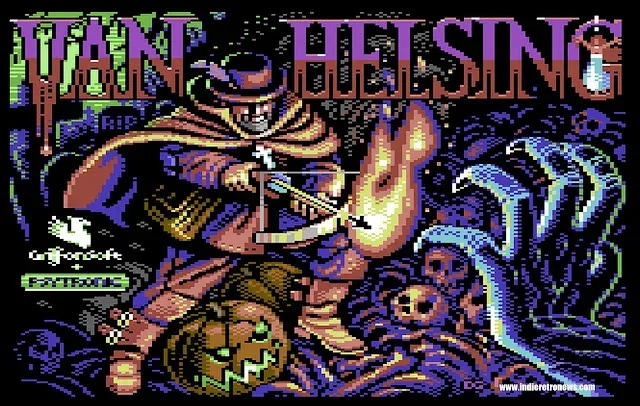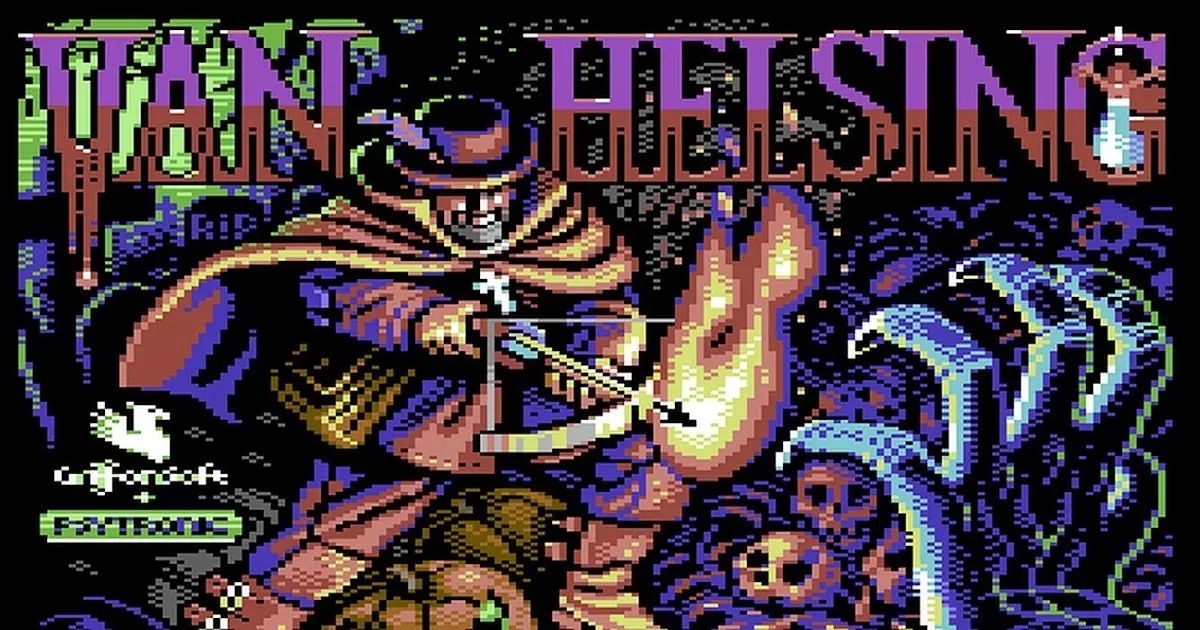
Van Helsing has launched for Commodore 64, bringing a new gothic side-scroller to the venerable home computer. Developed by GriffonSoft and published by Psytronik Software, the game casts players as the famed monster hunter in a pursuit through Dracula’s territory, with eight scrolling levels and an emphasis on combat against the Count’s forces.
The setup draws on familiar Dracula characters and imagery while establishing a brisk reason for the hunt. It is autumn 1893, and the Harker household is celebrating Jonathan Harker’s return from Transylvania when the gathering is violently interrupted. A winged creature bursts through the balcony, abducts Lucy Westenra and leaves Van Helsing to follow its bloody trail into Dracula’s domain.
That premise is well suited to the format. Side-scrollers are games where play proceeds horizontally through a continuously moving or shifting environment, rather than being confined to one fixed screen. Here, the journey is framed as a direct chase into increasingly dangerous territory: a simple, readable goal for a platform-action game, but one that gives the eight-level structure a useful dramatic spine.
A new C64 production built around action
GriffonSoft describes Van Helsing as its most ambitious project so far. The supplied details point to a game designed around moment-to-moment responsiveness: its protagonist is described as smoothly animated, while the control approach puts particular weight on separating jumping and attacks.
Native two-button joystick support means firing and jumping can be assigned to separate buttons. That may sound like a small specification, but it can make a major practical difference in an action-platformer. When one button has to handle multiple actions, players can be forced to use awkward directional combinations or time inputs around a shared command. Splitting those actions should make it easier to attack while navigating hazards, and to make precise jumps without sacrificing an immediate response to enemies.
The game also promises collectible weaponry for fighting Dracula’s forces. “Collectible” in this context refers to weapons picked up during play, not physical collectible items. The available information does not identify individual weapons, how long they remain in the player’s possession, or how progression is structured, so those details remain to be seen. What is clear is that combat is meant to offer more than a single default attack throughout the adventure.
PAL and NTSC support matters for a machine with regional quirks
One of the more useful technical points is native compatibility with both PAL and NTSC systems. These are television and video standards historically associated with different regions, and Commodore 64 software can be affected by the distinction because the systems operate at different refresh rates. A game developed around one timing standard may otherwise run at an unexpected speed or display poorly on the other.
Native PAL and NTSC support is therefore meaningful for owners using original hardware in different territories. It also broadens the game’s potential audience among people with contemporary C64-compatible devices. Van Helsing is stated to work on the Commodore 64 as well as the C64 Mini, C64 Maxi and C64 Ultimate.
Related coverage includes Van Helsing Brings Gothic Side-Scrolling to Commodore 64.
Compatibility alone does not tell players everything about how they may choose to run a game, but it reduces a familiar source of uncertainty in retro releases. For someone setting up a newly purchased title, the relevant practical question is often not merely whether a game starts, but whether it was built to respect the timing and display expectations of the machine in front of them. The stated cross-standard support is a strong accessibility feature for that reason.
Digital extras for fans who want a shelf-ready look
The deluxe digital download bundle includes the full game, its official soundtrack, promotional artwork, and printable disk labels and sleeves. That is a notably different proposition from a conventional boxed physical edition. Buyers receive digital materials that can be printed and assembled, rather than being promised a pre-made physical package.
For Commodore 64 enthusiasts, printable labels and sleeves can still be appealing. They offer a way to give a downloaded game a more period-appropriate presentation, whether it is being kept alongside existing software or simply displayed as part of a home setup. The artwork also places visual presentation alongside the game itself, while the soundtrack gives Saul Cross’s audio work a separate place in the bundle.
Anyone interested specifically in physical editions should read the bundle description carefully: the supplied information identifies it as a digital download package with printable elements. It does not establish the contents, format, price or availability of a separate boxed release.
The team behind the hunt
Van Helsing credits Ola Zandelin for code, Saul Cross for music and sound effects, and Dennis Gustafsson for graphics and inlay artwork. Richard Bayliss is credited for tape loading and cartridge intro music, as well as tape mastering; Martin Piper supplied the tape loader source. Mike Robertson handled cartridge coding and the disk loader, while Jason “Kenz” Mackenzie is credited for packaging.
The testing credits name Daniel Zandelin, Mikael Linusson, Dan Saedén, Åke Forslund and Ditlew. The extensive division of roles is a reminder that a contemporary release for a classic platform can involve separate work for the game itself, loading systems, cartridge support, disk loading, tape preparation, audio and presentation.
- Code: Ola Zandelin
- Music and sound effects: Saul Cross
- Graphics and inlay artwork: Dennis Gustafsson
- Tape loading and cartridge intro music: Richard Bayliss
- Cartridge coding and disk loader: Mike Robertson
- Packaging: Jason “Kenz” Mackenzie
Why this release is worth watching
The supplied feature list makes no claim that Van Helsing has reinvented the C64 action game. Nor does it provide enough detail to judge level design, weapon balance or difficulty. But its ambitions are concrete: eight large scrolling stages, a Dracula-focused chase, weapon pickups, dedicated two-button control and support for both major C64 video standards.
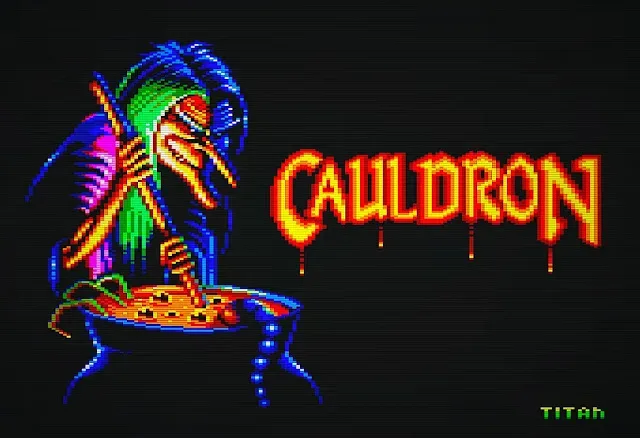
Those choices target the realities of playing on original and modernized Commodore equipment rather than treating the platform purely as a nostalgic display piece. The visual and technical goals also place it among a continuing stream of new games that are designed around the character of older machines. For another recent example of a classic-computer title receiving fresh attention, see Cauldron: Halloween Edition and its updates for the Amstrad CPC original.
With no gameplay video included in the supplied material, the final feel of its controls and the scale of its levels cannot yet be assessed here. Still, the fundamentals are clearly outlined: Van Helsing is headed into Dracula’s domain, and Commodore 64 players have a new, purpose-built gothic quest waiting at the edge of the balcony.