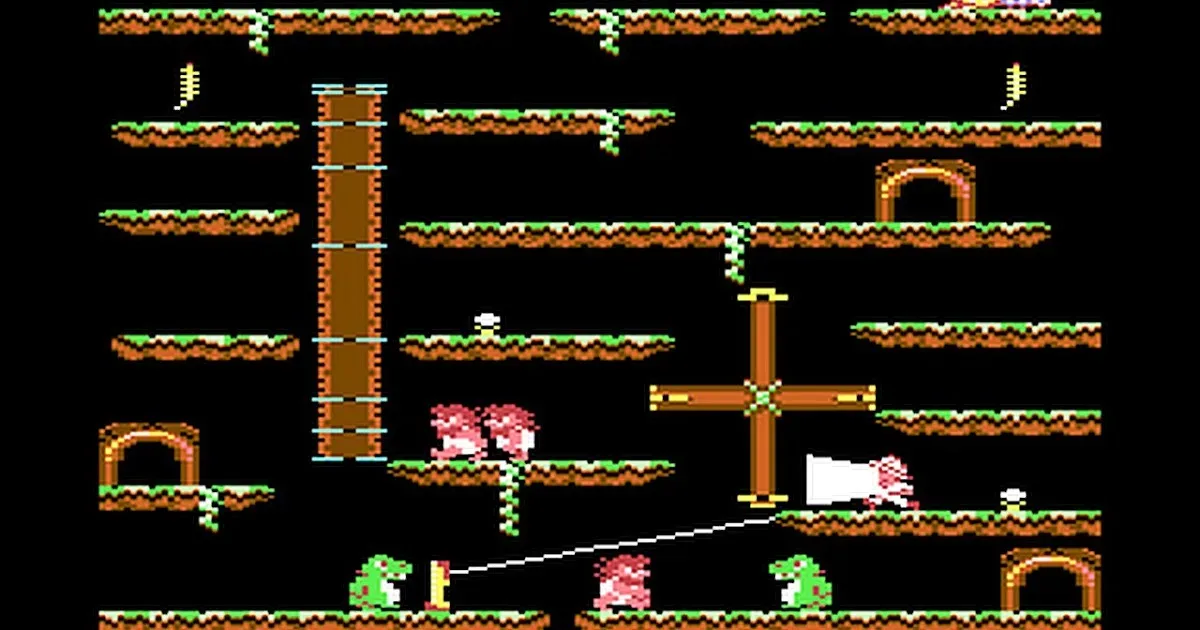
A new Commodore 64 conversion project is taking on Roc’n Rope, Konami’s 1983 arcade climbing game. The goal is not merely to borrow the premise of a precarious ascent, but to recreate its distinctive combination of rope placement, vertical routes, hostile creatures and high-score pressure on the C64.
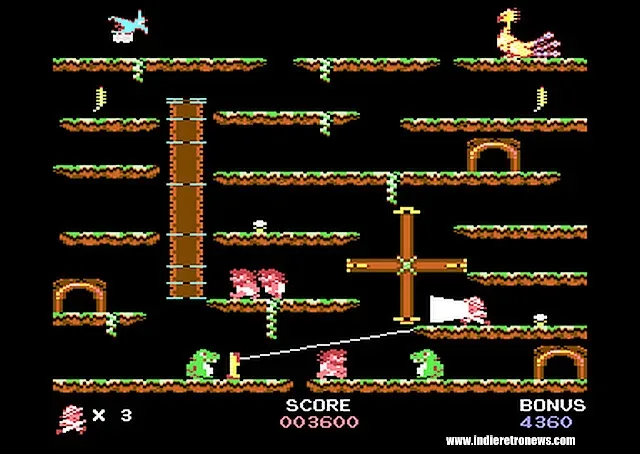
Roc’n Rope gives the player a harpoon gun rather than a conventional firearm. It is a movement tool first: shoot an anchor point, establish a rope across a gap, then climb toward higher ground. The climb leads through multi-tiered stages toward a phoenix, but the route is far from a peaceful mountain hike. Falling rocks, dinosaurs and cavemen turn each screen into a timing problem, where getting upward quickly has to be balanced against selecting a safe place to anchor.
The project credits Antonio Savona for code, Steve Day for graphics, and Aldo Chiummo for music and sound. Its creators also state that the conversion is being produced without AI.
A game built around making the next foothold
Vertical arcade games can look straightforward in a screenshot: start low, travel high, avoid what is in the way. Roc’n Rope complicates that simple direction by making the player actively create parts of the route. A harpoon placement determines where a rope can be used, so movement is shaped by both immediate danger and the terrain overhead.
That makes rope use a tactical decision. An anchor can offer an escape from enemies below, but firing at the wrong moment or committing to an exposed route can leave the climber vulnerable. The source material describes gaps, crowded prehistoric threats and falling rocks, all of which make timing central rather than incidental. Progress depends on judging when to shoot, when to climb, and when a safer lower ledge is preferable to a risky shortcut.
The player is not entirely defenseless while navigating the ascent. A flashlight can blind opponents, while power pills and feathers offer advantages. The game also rewards linked actions through a high-score bonus that continues while the player keeps a chain going. In practical terms, that encourages decisive play: simply surviving may not be the same as playing efficiently enough to preserve the score opportunity.
The conversion is planned around four environments: jungle ledges, icy caves, spinning wheels and a tall waterfall. Those settings matter because Roc’n Rope’s action is tied to the geometry of each stage. A change in backdrop is also a change in the obstacles and climbing spaces the player must read. The C64 version is intended to use the machine’s palette across all four worlds.
Why the rope system is the conversion’s key challenge
The central technical problem is not just displaying a rope on screen. In a climbing game, the rope has to feel dependable. A player needs to understand where it begins and ends, how it relates to platforms, and whether an attempted climb will carry the character away from danger or toward it. If the rope appears late, moves unevenly, or becomes visually confused with the background, the underlying arcade rhythm breaks down.
Related coverage includes Roc’n Rope Climbs Onto Commodore 64 With a New Conversion.
This project describes dynamic rope mechanics intended to keep climbing fluid. It also says that anchored rope segments can be shifted into bitmap data when the screen is busy with enemies. Put simply, bitmap data is image information used to draw graphics. Moving some rope visuals into that form is presented as a way to manage a crowded playfield without losing the visible route that the player needs to follow.
That is a sensible focus for a game in which the route is not fixed. A ladder game can rely on static climbable objects built into a level. Roc’n Rope instead asks the system to accommodate player-created rope placements alongside enemies, hazards and the stage itself. The conversion’s stated approach is meant to preserve that flexibility even when the action becomes dense.
A wider playfield, with the score kept out of the climb
The presentation is set to use full-screen overscan for a 320×248-pixel playfield that extends into the Commodore 64’s border area. Overscan is the display region around a conventional screen image that many systems do not normally use for gameplay. Using it here is intended to give the action more room while keeping the HUD below the main play area.
HUD is short for heads-up display: the score and other status information that needs to remain visible to the player. Putting it beneath the action has a practical benefit in a game based on reading upward routes. It avoids placing status text over cliffs, ropes, enemies or the next place where a harpoon might need to land.
The quoted 320×248 dimensions are also notable in context because the conversion is deliberately treating the border as part of the composition. The intended result is not simply a larger-looking image. It is a screen arranged around the needs of a vertical arcade challenge: the route remains the focal point, while the score information occupies its own area.
For another recent example of new work on the format, see Van Helsing’s eight-level Commodore 64 hunt.
PAL timing and the meaning of “feel”
The conversion also uses sub-pixel positioning and frame timing tailored for PAL refresh rates. These are technical terms, but they point to a very player-facing concern: responsiveness.
Sub-pixel positioning means an object’s internal location can be calculated with finer precision than the individual pixels seen on screen. Rather than forcing movement to jump only from one whole pixel position to the next, the game can track smaller increments and render motion at appropriate visible positions over time. For a character who moves between ledges and along ropes, that can help make travel appear smoother and can make speed adjustments more controlled.
Frame timing concerns how game actions are scheduled from one displayed frame to the next. The project says its timing has been tuned to PAL refresh behavior in pursuit of the original cabinet’s feel. This is important language to take carefully: “feel” is not a single measurable feature. It is the combined result of movement speed, animation cadence, input response, enemy motion and how long a player has to react to hazards.
In Roc’n Rope, those variables meet at the harpoon. If the shot, rope appearance and climb timing do not work together, the player’s decisions can feel disconnected from the result. By contrast, when those elements are coherent, the game can make a high-risk climb feel intentional—even when it ends with a falling rock or an unfriendly dinosaur ruining the plan.
The stated PAL focus also makes clear that this is not being framed solely as a graphical recreation. The project is paying attention to how the arcade game’s rhythm translates to the target hardware. That is especially relevant for an arcade design in which small delays or changes in movement can alter whether a route appears possible.
What players should watch for
The most revealing aspects of the conversion will be how its systems support one another. The four environments and expanded display area may provide the immediate visual appeal, but the experience will stand or fall on whether ropes remain easy to place and follow amid hazards. The project’s use of a clean lower HUD, dynamic rope handling and fine-grained movement all addresses that same underlying requirement: the player must be able to make fast, confident choices while climbing.
It is also worth keeping expectations appropriately specific. The available details describe the project’s features and technical approach, including its effort to reproduce the arcade cabinet’s behavior. They do not establish a release date, a price, supported media formats, or a definitive account of how every stage and scoring rule will compare with the original. Those are details that will need to come from the project itself.
What is clear is the appeal of the assignment. Roc’n Rope is a game where hardware technique is not separate from the design. A broader playfield, stable ropes, crowded enemy scenes and carefully paced motion all serve the same purpose: preserving the tense little pause before firing a harpoon at the next ledge and committing to the climb.