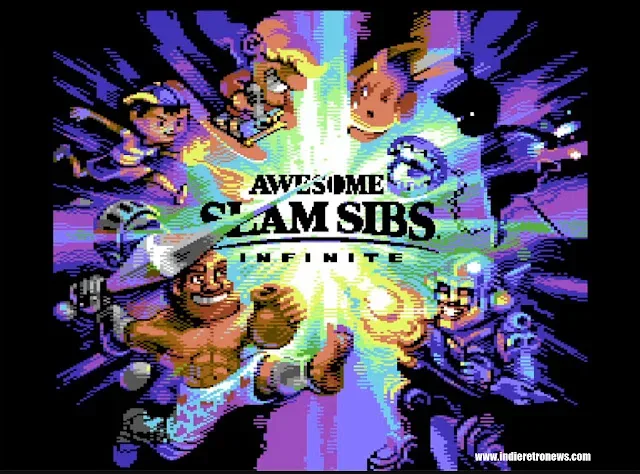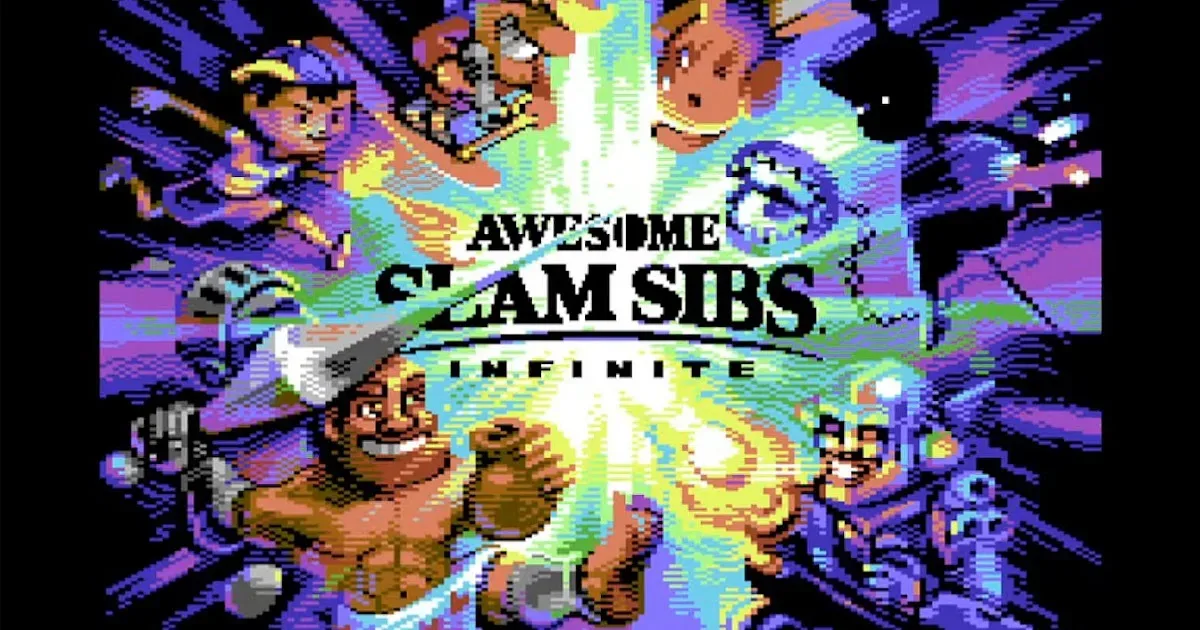
The Commodore 64 has received a new multiplayer fighting game with an admirably unreasonable mission: squeeze the spirit of a modern, character-driven platform brawler into a machine defined by 64 kilobytes of memory. Awesome SlamSibs Infinite, developed by Søren Trautner Madsen with contributions from Jesper Rune Larsen, Jarkko Salminen and a wider community, is a passion project that embraces that challenge rather than attempting to disguise it.
Madsen describes the game as a nostalgic love letter to Super Smash Bros. Ultimate. Its premise is direct: choose a fighter, take hold of a joystick, and face either another player or a computer-controlled opponent. The game combines characters, references to classic games and vintage-styled music in a chaotic brawler built for the Commodore 64.
That setup sounds simple because fighting games are supposed to get to the point quickly. Yet the technical reality behind a C64 game is anything but simple. Awesome SlamSibs Infinite had to make room for character sprites, animation states, stages and their visual effects inside the platform’s strict memory budget. The project’s significance is not that it pretends those restrictions do not exist; it is that the restrictions are central to why creating this kind of game on the hardware is compelling in the first place.
A modern brawler idea on vintage hardware
Platform fighters are fighting games where movement through an arena matters alongside attacks. Rather than framing every confrontation as two characters standing at opposite ends of a flat stage, the format encourages jumping, positioning and adapting to the space around each competitor. Awesome SlamSibs Infinite draws inspiration from that broad style while being made for a computer whose original joystick interface makes immediate local competition a natural fit.
The game supports a match against a friend as well as a computer opponent. That distinction matters. A computer opponent gives a solo player a way to engage with the game, but its stated ideal is the older social ritual of two people playing beside one another. There is no need to infer a larger online component from the available details. The focus here is plainly local play: people sharing a room, reacting to a round in real time and passing no responsibility for the fun to matchmaking systems, patches or distant servers.
For retro-game players, that makes the joystick part of the design rather than a decorative throwback. The control method connects the game’s technical platform, its intended multiplayer setting and its creator’s goal of preserving a hands-on tradition. It is a useful reminder that “retro” does not only refer to pixels or synthesized music. It can also describe a particular way people gather to play.
Why 64KB is more than a number
The Commodore 64’s 64 kilobytes of memory is the central practical constraint cited for the project. A kilobyte is a unit of digital storage; in this context, it is the limited workspace available for the game’s program code and audiovisual material. A fighting game needs a great deal of coordination within that finite space. It must account for the fighters’ appearances, their changing animation frames, player input, opponent behavior, stage presentation, sound and the rules that determine how a match unfolds.
Sprites are small graphic elements used to display objects such as fighters or other moving parts of a game scene. Animation is the ordered sequence of visual states that makes a character appear to walk, jump or attack. Stage effects are the visual elements associated with the arena and its activity. Each component competes for memory, and a fast-moving multiplayer game increases the pressure because these parts have to work together convincingly during play.
The available information does not specify the exact techniques used to solve those problems, and it would be a disservice to invent them. What is clear is that Madsen and the team had to find creative workarounds to fit the game’s sprites, animations and stage effects into the C64’s limitations. That is a familiar kind of engineering puzzle in retro development: a feature is not only judged by whether it would be enjoyable in isolation, but also by whether it can coexist with every other necessary feature on the target machine.
Modern development usually offers far more storage, memory and tooling. On this project, limitations became a defining part of the creative process. Madsen has acknowledged that constructing a game this way is highly inefficient by contemporary standards, but has also identified that very friction as part of the platform’s appeal. The obstacle is not incidental; overcoming it is a form of the hobby’s reward.
A deliberately handcrafted production
Awesome SlamSibs Infinite was made through an intentionally manual process. Madsen created the code, sprites and animations by hand, avoiding modern AI tools during development except for minor bug-hunting at the end. That statement is best understood as a description of this project’s chosen workflow, not a universal argument about how every game should be made.
For a retro passion project, manual work has a particular connection to the hardware. Writing code and producing individual sprite and animation assets by hand means decisions are continually filtered through the system’s hard boundaries. The process may be slower, but it keeps the creator close to each compromise: what can fit, what can move, what needs simplifying and what visual idea needs a different implementation.
Bug-hunting, meanwhile, is the task of locating and correcting faults in software. The reported limited use of AI-assisted help at that late stage is distinct from the core production of the game’s code and art. Separating those roles is important because it preserves the actual claim: the project’s main creative and technical assets were handcrafted, while modern assistance was used only in a narrow final debugging capacity.
There is also a broader collaborative dimension. Larsen helped with the menu system and additional code, while Salminen designed the menu graphics. Community contributors supplied pixels and music. A menu system may seem secondary to a fighting game’s action, but it is the layer that guides a player from startup into character selection and matches. Its contribution helps turn a collection of combat systems and artwork into a navigable game.
The wider community’s role also undercuts the idea of the solo retro developer as the only meaningful model. Madsen did not work entirely alone, and the credits matter. Pixels, music, menu art and code each shape how a game feels before and during a match. In a project with such a confined technical footprint, every contribution can have an outsized effect.
What players should take from the project
The practical appeal of Awesome SlamSibs Infinite is straightforward: it offers a new C64 brawler for players who want a joystick-led contest against another person or a computer opponent. Its more unusual appeal is the perspective it provides on present-day retro development. This is not simply an old game being revisited. It is a new work designed around an old machine’s constraints and around a social style of play associated with it.
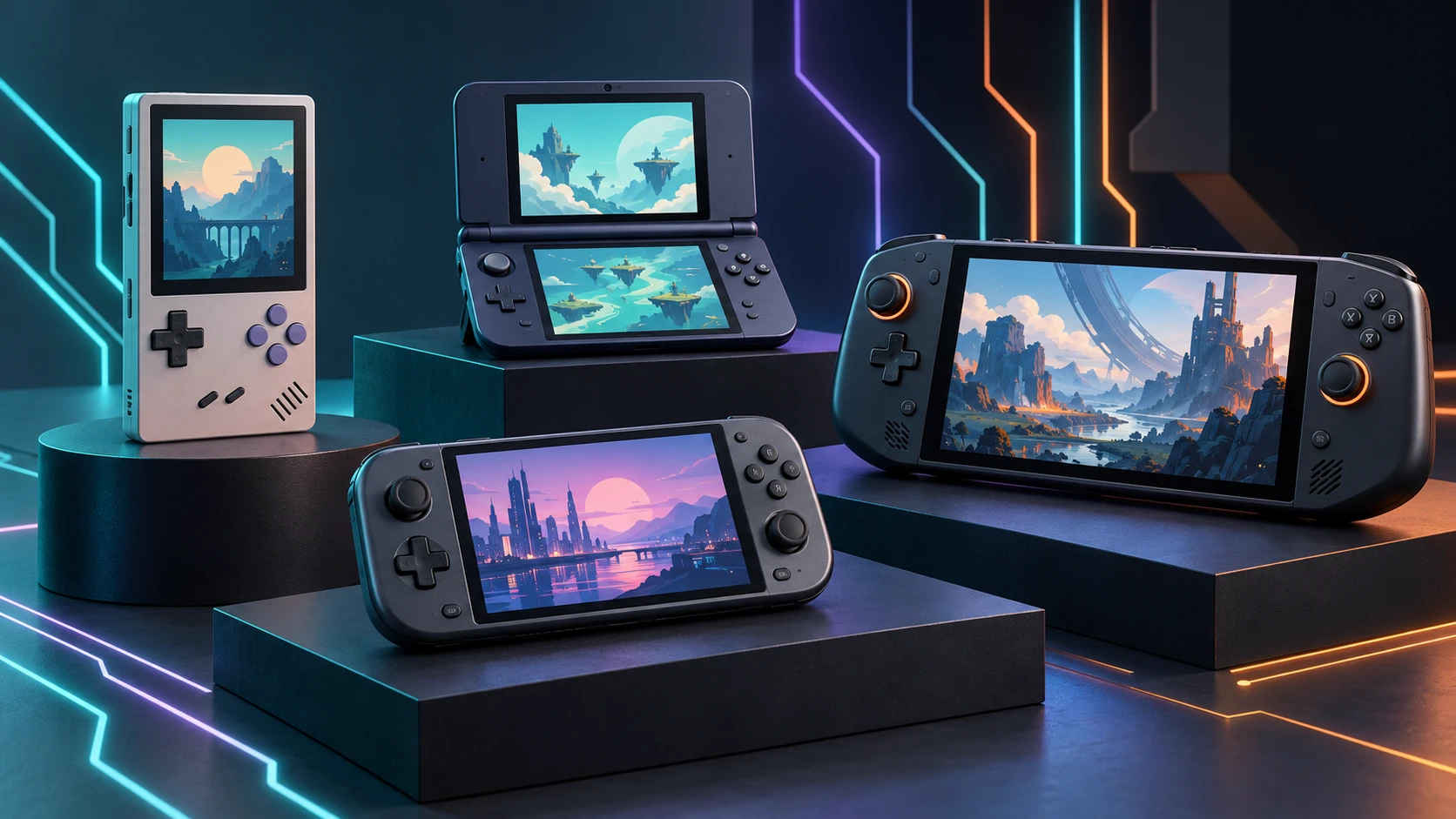
Anyone interested in the current range of legacy-game hardware can also compare that physical-machine focus with the different route offered by modern emulation handhelds. Those devices and a Commodore 64 project solve different problems: one expands access to older software across newer hardware, while the other creates something new for the original platform. Both approaches speak to continued enthusiasm for older game systems, but Awesome SlamSibs Infinite is specifically rooted in designing within the C64 itself.
Its inspiration from a well-known contemporary brawler provides an accessible shorthand, but the story is not about reproducing modern scale. It is about translating a recognizable kind of competitive chaos into a much tighter technical environment. That translation requires selection: deciding which ideas are essential, which assets can be represented efficiently and which flourishes are worth the memory they occupy.
Awesome SlamSibs Infinite therefore stands as both a fighting game and a preservation-minded act of making. Madsen’s stated preference is not merely that players launch it, but that they sit next to someone, plug in joysticks and play together. For a project built around a vintage computer’s limitations, that is a fitting ambition: use old constraints to create a new reason for an old kind of play session.