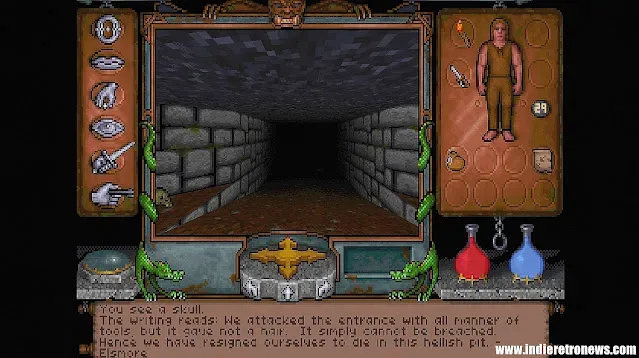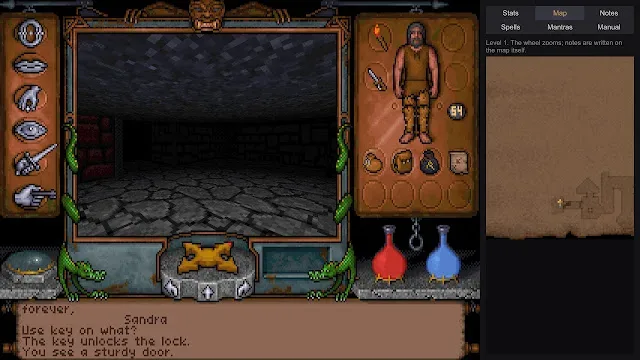
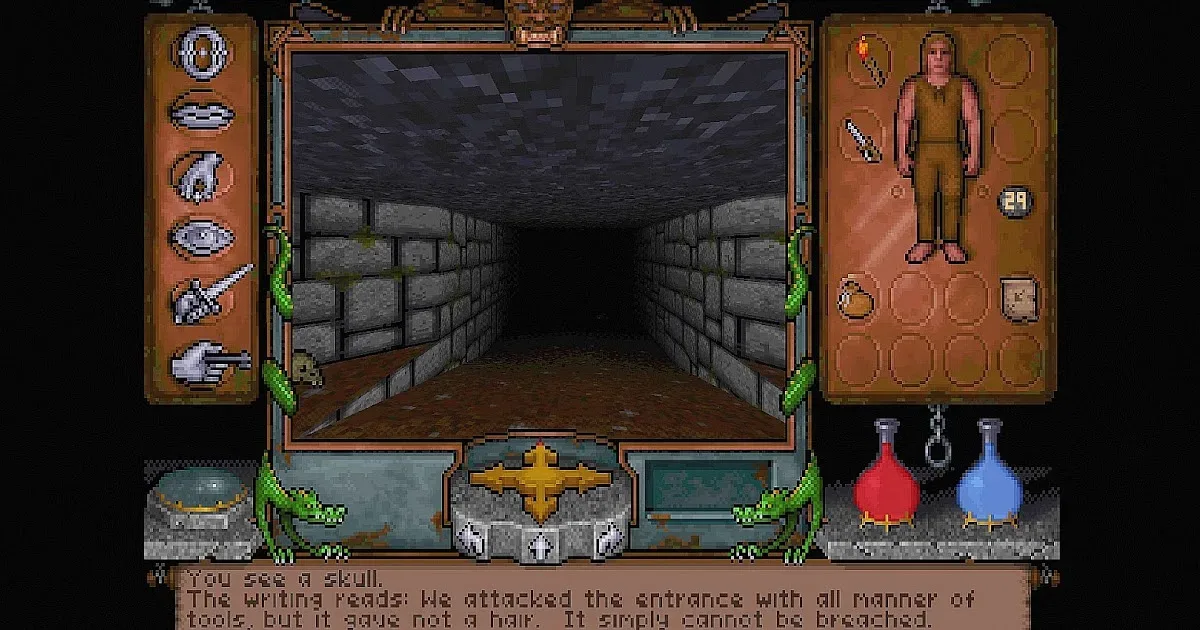
Underworld Revisited is an open-source Unity reimplementation project for Ultima Underworld: The Stygian Abyss and Ultima Underworld 2: Labyrinth of Worlds. Its stated goal is unusually ambitious: preserve the original games’ underlying behaviour while making them more practical to run and control on a modern PC.
Rather than asking players to run the original releases through DOSBox, the project reads game data from an existing installation obtained through GOG, Steam or the EA app. That distinction matters. This is not described as a newly authored dungeon crawler inspired by the Underworld games, nor as a package that includes their original content. It is a replacement engine that relies on the player’s installed game files.
The first game is reported to be playable from character creation through the ending credits. The sequel is further behind, but an early preview is available for testing. Its remaining tasks are listed as cutscenes, the ending sequence and a complete playthrough before an official beta stage.
Aiming for preservation without forcing old limitations
The central attraction is fidelity. Underworld Revisited is built to execute the original bytecode for systems including dialogue and trading. In simple terms, bytecode is a compact form of instructions that software can execute. Retaining that original logic can be more meaningful than merely recreating menus, maps or visuals: conversations, transactions and other game rules are intended to behave as they did in the DOS versions.
The project also advertises two-way save compatibility with the classic DOS release. That means it is intended not only to load an existing DOS save, but also to write saves that can return to the original version. For preservation-minded players, that is a valuable promise. A long-running character need not be permanently locked to one executable simply because the player tries a newer way to run the game.
Compatibility claims still carry practical caveats. Save files can encode a great deal beyond a hero’s inventory: quest state, object placement, characters’ conditions, world flags and other details may all be involved. The point of a two-way system is that it seeks to preserve those details across both environments. Players with an irreplaceable old save would nevertheless be wise to keep copies before experimenting with any alternate engine or mod setup.
For players who want the closest possible presentation to the old experience, Underworld Revisited includes authentic Palette lighting and fixes for game-breaking bugs from 1992. Palette lighting refers to the limited colour-based lighting style associated with the original presentation. Keeping it available acknowledges that technical modernization and historical appearance are separate choices. A remake that changes every visual rule may be easier on modern eyes, but it no longer provides the same atmosphere or visual language.
That approach places the project in a useful middle ground. It does not frame classic limitations as mandatory badges of honour, but neither does it insist that the past must be overwritten. The player can choose an older-looking mode while benefiting from fixes that prevent progression-ending problems.
Related coverage includes Underworld Revisited Brings Ultima Underworld 1 and 2 Back in Unity.
Modern options are optional, not a replacement for the original feel
Underworld Revisited’s feature list includes widescreen support, modern mouse-look, gamepad controls and a live map. These are the kinds of changes that can substantially alter how approachable an early first-person role-playing game feels, especially for players who know the series by reputation rather than muscle memory.
Mouse-look generally means using the mouse to look around the first-person world more directly, an input convention that became familiar in later PC games. Gamepad support opens the door to a controller-led setup instead of a keyboard-and-mouse arrangement. Meanwhile, a live map can reduce the burden of manually tracking routes through a sprawling dungeon. None of these tools automatically make the underlying game easier, but they can make navigation and camera control less demanding.
There is a trade-off worth recognizing. Navigation friction, limited visibility and unusual interfaces are part of how many older games were experienced. A live map or more fluid camera may change the rhythm of exploration. That is not inherently a flaw; it is exactly why the project’s option-based design is important. Players interested in accessibility and convenience can enable modern aids, while those seeking a more period-minded run can favor the traditional presentation.
A separate Remastered lighting mode adds relief, shadows and glow. These terms describe visual depth and light effects that go beyond a more basic palette-driven approach. Relief can help surfaces appear less flat; shadows give lighting a stronger sense of obstruction and direction; glow makes bright light sources feel more radiant. The stated purpose is not simply sharper resolution, but a different lighting treatment for the same dungeon spaces.
The audio configuration is similarly broad. Players can choose AdLib, General MIDI, emulated MT-32 or custom recordings. Those options represent different ways classic PC game music and sound can be rendered. AdLib and General MIDI evoke familiar PC audio standards, while an emulated MT-32 recreates the output style of Roland’s MIDI hardware in software. Custom recordings offer another route for listeners who prefer an alternative audio presentation. The useful part is the choice: the project treats sound as a configurable part of the experience rather than a one-size-fits-all setting.
Why direct data reading changes the practical setup
By reading files directly from GOG, Steam and EA app installations, Underworld Revisited is designed around the versions people may already own. This avoids making DOSBox the required path to play, while still depending on legitimate original game data. In practical terms, the engine and game assets remain distinct: the open-source reimplementation supplies the modernized runtime, and the installed copy supplies the content it needs to interpret.
That separation is significant for preservation projects. Original game data can remain central even when the technology used to run it changes. It also helps clarify what Underworld Revisited is and is not. The project is not presented as a substitute purchase for either game. A prospective player needs an existing compatible installation from one of the named PC storefront ecosystems.
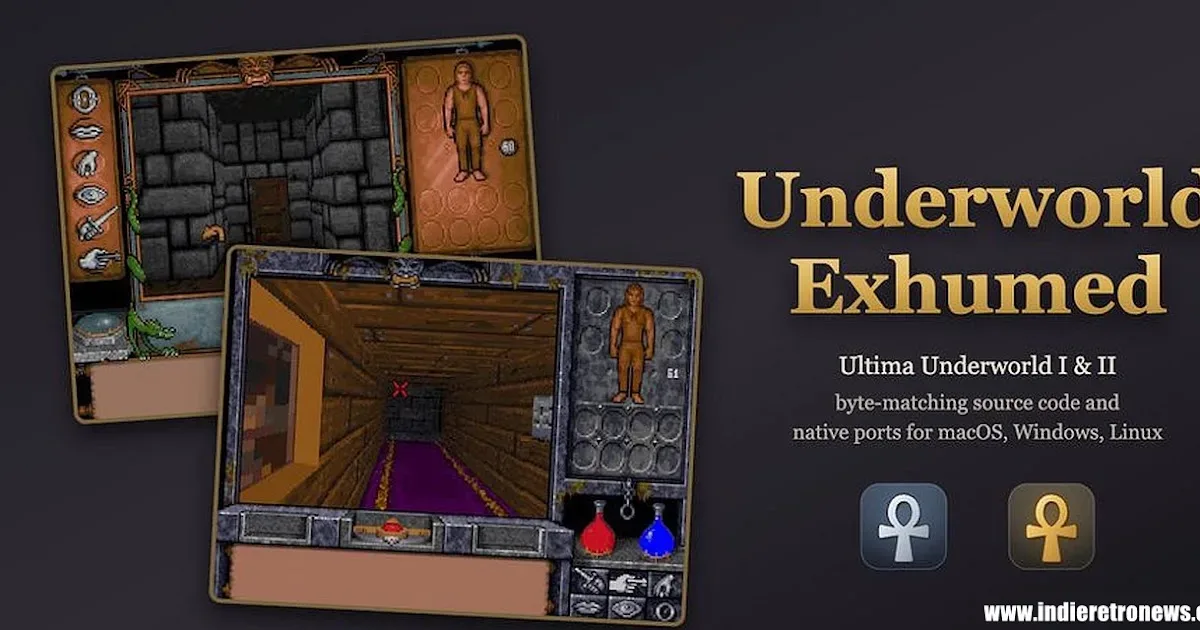
It also belongs to a broader effort to keep the Underworld games usable beyond their original technical surroundings. Readers interested in another route to modern compatibility can compare this work with Underworld Exhumed’s reconstruction work for native modern ports. The projects may share preservation concerns, but their stated approaches should not be treated as interchangeable.
Mod and translation support can extend the project’s usefulness
Underworld Revisited lists full support for Underworld Editor (Avalonia) mods and a community translation kit. Mod support can matter well beyond cosmetic tinkering. Editors and mods give fans tools to adjust or create content, while a translation kit can help communities make the games more accessible in additional languages.
Avalonia is named as part of the Underworld Editor support, identifying the editor ecosystem the project is accommodating. The important takeaway for players is that existing work made through that editor is intended to have a place in the new runtime. For creators, it suggests the reimplementation is being designed as a platform that can coexist with community-made additions rather than a closed, fixed playback tool.
Translation support is particularly relevant to old, text-heavy role-playing games. Dialogue, item descriptions and in-game systems often carry the practical information players need to advance. A community translation kit does not itself guarantee that every language will receive a complete translation, but it supplies a framework for volunteers who want to undertake that work.
A long-paused project resumes with an AI-assisted coding workflow
The project’s history reportedly begins in 2011, when developer PQMarine started the work. Development was put on hold in 2012 and resumed in September. That timeline makes the current update less like a sudden experiment and more like the revival of a long-standing technical undertaking.
PQMarine has described using Claude Code in the renewed development process. The workflow is characterized as AI-assisted rather than fully automated: Claude generates code, while the developer directs the requested features and tests each step against the original source behaviour. That division is important when discussing an effort built around compatibility. Producing code quickly is not the same as demonstrating that the resulting behaviour matches a legacy game.
Testing against the original is the key safeguard in that description. If a reimplementation is intended to retain dialogue rules, trading and save interoperability, each system needs comparison rather than assumption. The stated workflow places the developer in the role of defining goals and validating results, with AI used as a coding aid.
There is also a transparent note of unfinished work: Ultima Underworld 2 remains an early preview, not a finished beta. Cutscenes, its ending sequence and a complete playthrough are still required before that milestone. For fans, that means the sequel’s current build should be approached as a testing opportunity, with the understanding that more validation is needed.
What Underworld Revisited could mean for players
Underworld Revisited’s most compelling idea is not any one modern feature. It is the attempt to let different audiences approach the same games on their own terms. Veterans can select Palette lighting and retain a close relationship with the DOS releases, including save exchange. Newcomers can turn toward widescreen output, controller input, mouse-look, a live map and enhanced lighting. Audio enthusiasts can choose among several presentation paths.
For a game preservation effort, that flexibility is consequential. Old games do not become more valuable only when they are frozen unchanged, and they do not become more accessible only when every old characteristic is removed. A well-designed compatibility project can make room for both priorities. Underworld Revisited is presenting precisely that balance as its purpose, with the original game logic and data at its core and contemporary conveniences layered on as options.
The first Underworld’s reported start-to-finish status gives the project a concrete foundation. The sequel’s early preview, meanwhile, shows that the work is advancing but still needs careful completion. Anyone following the project should keep that distinction in mind: one side is described as playable through its conclusion, while the other remains on the road to beta.