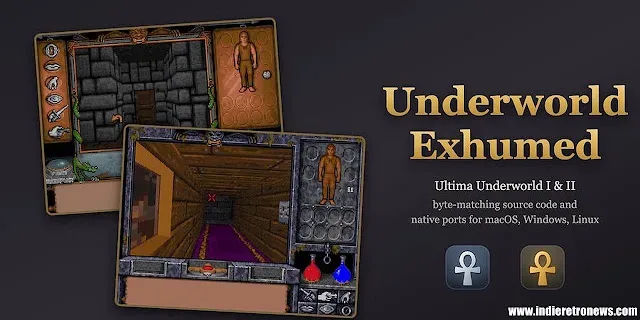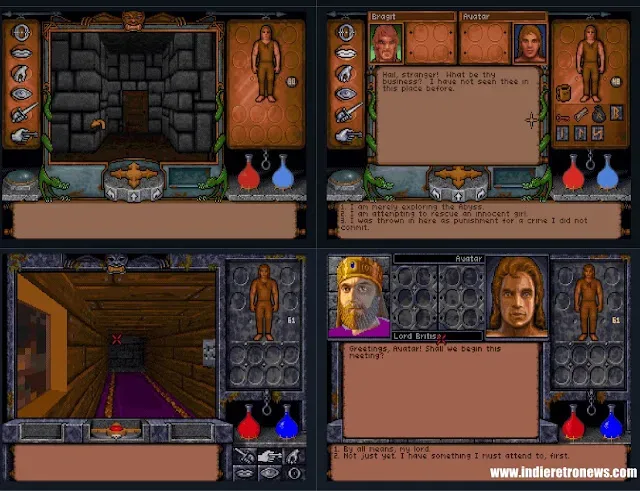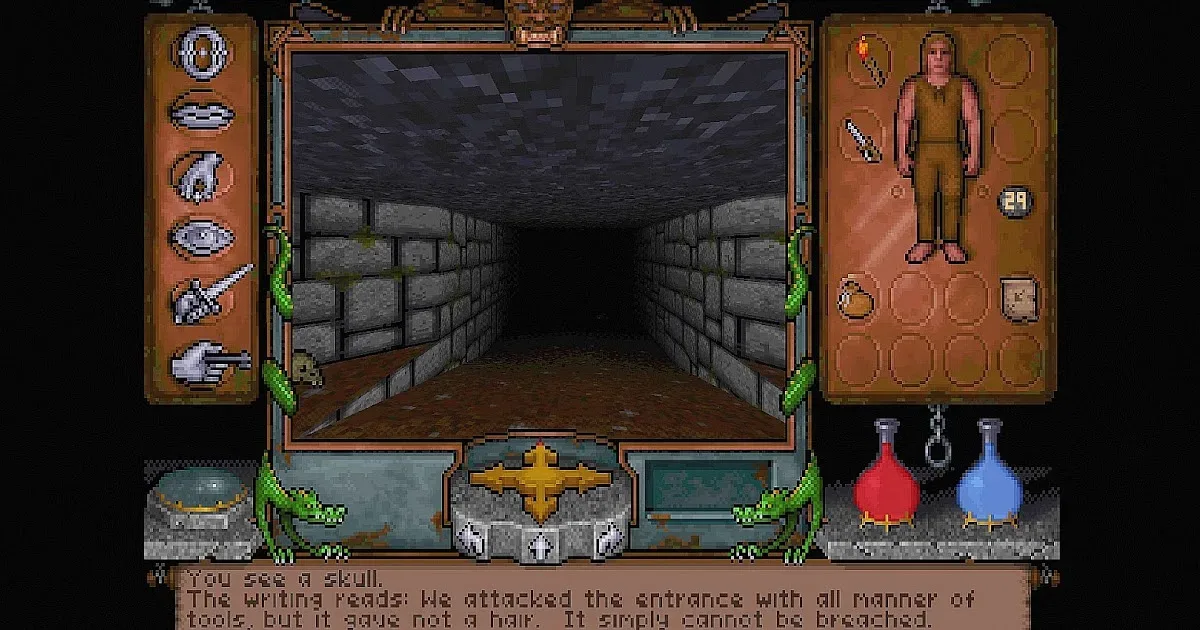
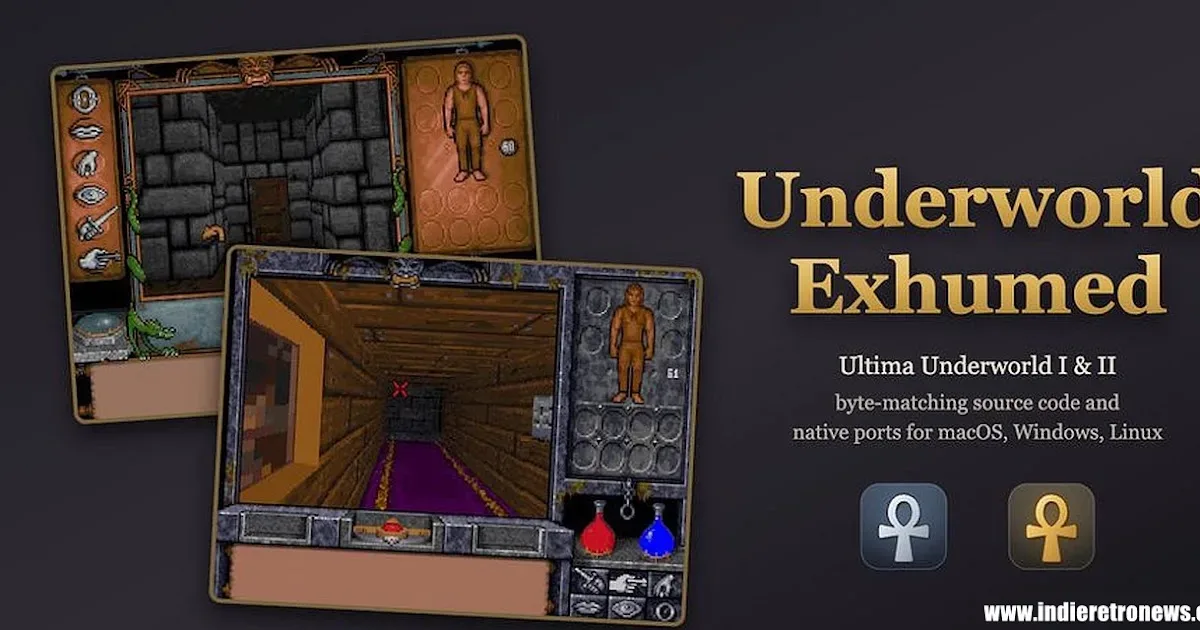
A preservation project called Underworld Exhumed has reconstructed the code behind two foundational DOS role-playing games: 1992’s Ultima Underworld: The Stygian Abyss and 1993 follow-up Ultima Underworld II: Labyrinth of Worlds. Created by developer abedegno through reverse engineering of the original executables, the work is intended to make the games easier to run on current systems without casually rewriting their behavior.
That distinction is the heart of the project. The reconstructed code can be compiled with the original Borland tools into byte-for-byte identical copies of the shipped UW.EXE and UW2.EXE files. In practical terms, that is an unusually rigorous compatibility target: it means the rebuilt source is not simply aiming to resemble the old games in play, but to reproduce the original executable output under the original build setup.
What Underworld Exhumed has rebuilt
Reverse engineering is the process of examining a finished program to determine how it works, then recreating its logic in readable source code. In this case, the starting point was the games’ DOS executables rather than a surviving official codebase. The resulting reconstruction covers both titles and has been organized with readable names, shared headers and file-level documentation.
That organization matters beyond convenience. Old game programs can be difficult to study or preserve when their internal labels are opaque and their components are tightly bound to a particular operating system or development environment. Clearer names and notes can make it substantially easier for technically minded users to understand where particular systems live, how parts of the program relate to one another, and what needs to be preserved when adapting the code to a newer platform.
A header, in programming terms, is commonly a file that declares shared structures, functions or constants so multiple pieces of a program agree on how they communicate. Shared headers can reduce duplication and help keep a large codebase consistent. Documentation that explains individual files serves a different but equally important purpose: it gives future maintainers a map instead of requiring them to rediscover every relationship from scratch.
The project’s fidelity benchmark is especially notable because it is concrete. “Byte-for-byte identical” is stronger than a general claim that a port feels authentic. It refers to a direct comparison of the resulting executable files: every byte in a newly compiled build matches the corresponding byte in the original shipped program. It does not automatically settle every question about every modern build or environment, but it provides a powerful check on the reconstructed DOS code.
Native builds for current desktop systems
Abedegno has also used the reconstructed code to make native ports for Windows, macOS and Linux. The ports run the dungeon-crawling RPGs in a window and retain their original speech, music and sound effects. That is useful for players who want the original audiovisual material and game behavior while avoiding some of the friction associated with running software built for DOS-era PCs.
A native port is a version compiled to run directly on a target operating system. That is different from running an older program unchanged inside a separate DOS environment. Both approaches can have value, but a native build can offer a more direct route to launching an older game on a modern desktop, particularly when the aim is to keep the original game logic while replacing or adapting the operating-system-facing layer.
Related coverage includes Underworld Exhumed Rebuilds Ultima Underworld for Modern Platforms.
Underworld Exhumed’s stated approach is not to treat “modern” as a license for unverified alterations. Changes made for the native ports are checked against recorded DOS gameplay sessions. The goal is total authenticity, with comparison against evidence of the original games’ behavior rather than assumption or memory.
The project pairs modern platform support with a deliberately conservative preservation standard: alterations are verified against recorded DOS play rather than presented as broad redesigns.
That methodology has practical value for games as mechanically dense as these. Small implementation changes can produce unexpected consequences: a timing difference, input quirk, audiovisual trigger or interface behavior may affect how a game is remembered and played. The supplied details do not enumerate individual changes or tests, so it would be wrong to infer support for any specific modern features. What is clear is that the project’s author is treating recorded original play as the reference point for port work.
What players need to supply
The code repository does not include copyrighted game assets. Players need to provide their own game data, with the GOG releases given as an example. Game data generally means the non-code material needed for a complete game experience, such as the original assets used by the program. Keeping those files separate from the reconstructed code is an important boundary: code preservation and distribution of copyrighted game content are not the same thing.
For prospective players, that means this is not presented as a replacement for owning the games. The project creates a new way to run compatible data; it does not package the original commercial materials in its repository. Anyone preparing to use the native versions should therefore expect to need legitimate game files and should consult the project’s own setup material for the applicable steps.
The separation is also meaningful for preservation work. A reconstructed engine or executable can give old software a longer technical life, while the original data remains distinct. It provides a route for maintenance and platform adaptation without claiming ownership of the game’s art, audio, speech or other protected content.
A WebAssembly option, with an important caveat
There is also a browser-based version, compiled to WebAssembly. WebAssembly is a format that allows code to run in a web browser at performance and capability levels suited to applications beyond ordinary page scripting. Here, it provides a no-installation route to exploring both Underworld games from a browser.
“Zero installation” should be read specifically: it means there is no conventional local installation step for the browser build. It should not be taken as an unsupported promise about game-data requirements, ownership or every browser’s behavior. The project’s broader guidance remains that users supply their own game data because copyrighted assets are not hosted in the repository.
Still, the browser build is a meaningful access option. It lowers the barrier for users who do not want to configure a local executable or navigate an older PC environment before reaching the game. It also demonstrates that the reconstruction is not locked to one contemporary operating system. The same recovered logic has become a basis for Windows, macOS, Linux and web delivery.
Why the exact-build result is significant
Old software is often discussed as though preservation ends with making something launch. Launching is important, but it is only one layer of the problem. A program may run while differing from the original in subtle or consequential ways. Underworld Exhumed’s byte-identical DOS compilation claim supplies a much more demanding reference point for the reconstructed source.
It also creates a useful division between two goals:
- Historical reconstruction: recreate source code that can generate the original DOS executables exactly when built with the original Borland tools.
- Practical access: use that reconstruction to build versions that run natively on current operating systems and in a browser.
The first goal concerns confidence in what has been recovered. The second concerns whether people can actually use it now. Pursuing both is more ambitious than merely supplying an emulator configuration, and more disciplined than making broad updates with no stated verification process.
For players, the immediate implication is straightforward: there are fresh ways to revisit The Stygian Abyss and Labyrinth of Worlds on Windows, macOS, Linux or through a browser. For preservation-minded developers, the deeper implication is that readable, documented reconstruction can keep historically important game code understandable as well as runnable.
The timing also offers a useful reminder that PC gaming news is broader than the biggest current release cycle. As the pressure of major-release coverage can crowd out other stories, projects such as Underworld Exhumed show why archival and technical efforts deserve attention: they affect whether classic games remain available in forms that respect the originals.
What has and has not been established
The available project details support several firm points: both Ultima Underworld games have reconstructed source code; the DOS builds can match the original UW.EXE and UW2.EXE files byte for byte under the original Borland toolchain; native ports exist for Windows, macOS and Linux; a WebAssembly browser version exists; original speech, music and sound effects are retained; and users must supply their own game data.
They do not establish a price, a commercial re-release, a new official edition, or a list of gameplay additions. They also do not provide a feature-by-feature account of every platform adaptation. The value of the work lies precisely in its stated restraint: the modern versions are being built from a carefully reconstructed foundation and checked against recorded DOS sessions, not positioned as a newly redesigned take on the games.
For anyone with legitimate data files and an interest in these DOS RPGs, Underworld Exhumed is consequently worth watching as both an access project and a technical preservation effort. Its central achievement is not just placing old games in new windows. It is making their underlying program logic legible, reproducible and portable while holding original behavior as the standard.