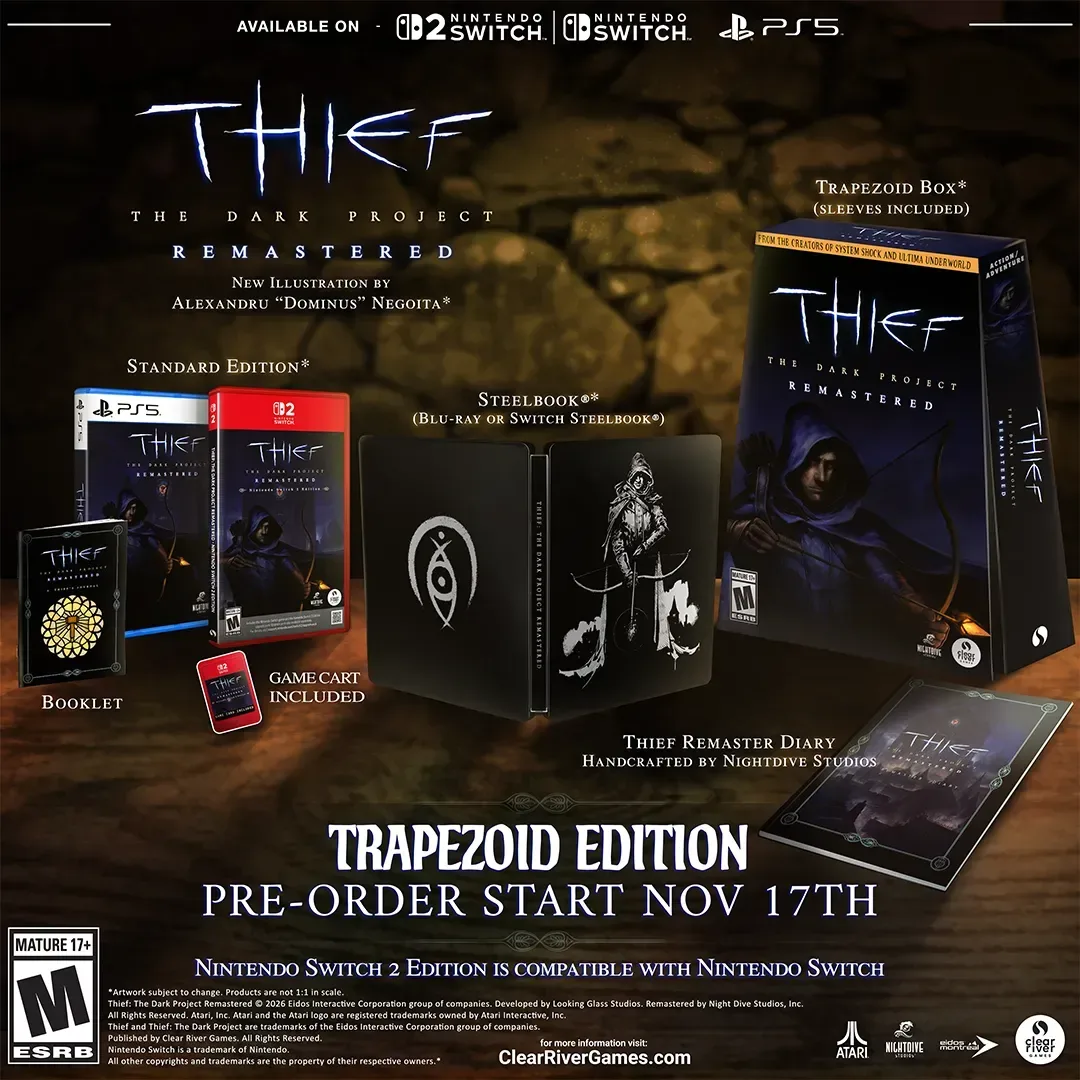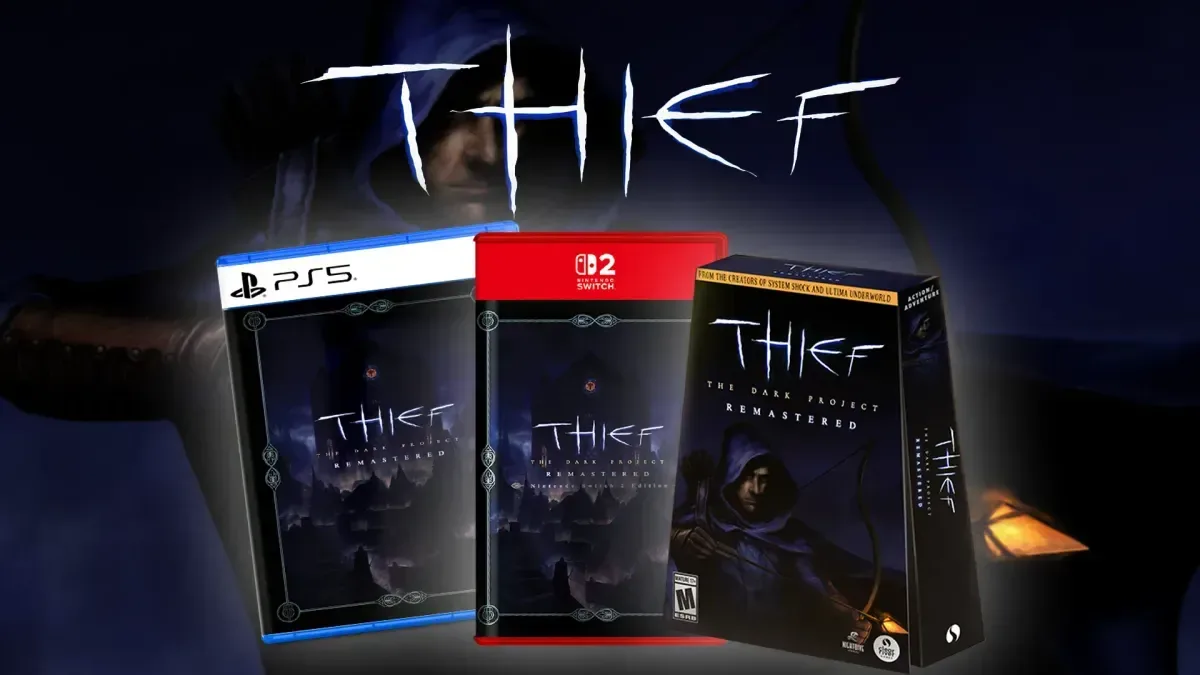
Thief: The Dark Project Remastered is scheduled to launch on December 3 for PC, PlayStation and Xbox platforms, plus Nintendo Switch and Nintendo Switch 2. Alongside the digital release, physical Standard, Steelbook and Deluxe Trapezoid editions are available to pre-order for PlayStation 5 and Nintendo Switch 2.
The remaster brings the 1998 PC stealth game back with updated graphics and features, but its most consequential addition is The Tarnished Mirror, a newly made story campaign. It is intended to connect the original Thief: The Dark Project with Thief II: The Metal Age, and it comes from the team behind Thief: The Black Parade, a fan-made expansion that is also compatible with the remaster as a player-created mod.
A return for a foundational stealth game
When Thief: The Dark Project debuted on PC in 1998, its approach to stealth stood apart because light and sound were not merely atmospheric flourishes. They were core gameplay systems. Darkness could provide cover, while noise could reveal a player’s position. That design pushed players to consider their movement and surroundings rather than treating stealth as a simple on-off state.
In practical terms, this means a stealth game built around awareness. A player is not just asking whether an enemy can see them; they are judging how visible they are in a space and whether their actions may be heard. That premise remains central to the identity of Thief, even as the remaster updates its presentation.
The original was also known for exceptionally dark levels, a characteristic that made its concealment systems feel thematically appropriate but could make scenes difficult to read on some displays. A remaster’s new graphics therefore carry a particular balancing act: improve visual clarity without losing the oppressive darkness that gives sneaking its purpose. The supplied details confirm new graphics and features, but do not specify exactly how lighting, controls or individual missions have been altered.
The Tarnished Mirror is more than a visual restoration
The new campaign is the major reason this release is not simply a repackaging of the 1998 game. The Tarnished Mirror begins with a seemingly ordinary theft, then moves through imprisonment and uneasy alliances before descending into a drowned necropolis described as R’lyeh-like. Its premise points toward otherworldly horror, with new factions, environments and an expanded enemy roster also planned.
“Lovecraftian horror” is a useful shorthand for horror focused on the unsettling, unknowable and cosmic rather than a straightforward monster encounter. Here, the description suggests that the campaign’s threat will widen beyond the initial job into a stranger, more hostile journey. It should not be read as a complete plot outline: the currently available information establishes the setup and tone, not the campaign’s full cast, length or mission count.
The developers describe the expansion as a bridge between the first two Thief games. That is a specific creative aim rather than a promise that players need prior knowledge of either title to understand it. Still, for longtime fans, the placement matters. It frames the campaign as an attempt to inhabit the series’ early continuity and visual language, rather than a separate modern reboot.
Related coverage includes Thief: The Dark Project Remastered Physical Editions Set for December 3.
It is being built with the remaster’s technology and aesthetic, while aiming for a larger scale and atmosphere than the original game could deliver. The project also represents an unusual formal step for a community creation: the creators of The Black Parade are making an officially canonical addition with Nightdive Studios and Eidos-Montréal involved. That does not erase the mod’s independent roots; instead, it places the team’s work directly inside an official release.
Mod support remains part of the package
Thief: The Dark Project Remastered will support player-created mods, including The Black Parade. For PC players especially, mod compatibility can be important because it allows a game to host additional fan-made content beyond its built-in campaign. In this case, the relationship has an added twist: the creators of one supported community expansion are also behind the remaster’s new official campaign.
No further details have been provided here about how mods will be installed, whether all existing projects will work unchanged, or whether mod support extends beyond PC. Players should avoid assuming compatibility rules until those specifics are confirmed. What is clear is that The Black Parade is explicitly named as compatible.
The news arrives amid continued interest in both revivals and new projects based on familiar game histories. For another example of how developers revisit a major classic with a deliberately chosen visual approach, see the Zelda team’s explanation of the Ocarina of Time remake’s puppet-show style. Thief takes a different route: rather than only refreshing its old material, it is adding an officially positioned campaign that seeks to fit between existing entries.
Digital editions and their extras
The Standard Digital Edition is priced at $29.99. A Deluxe Digital Edition costs $34.99 on PC and consoles, adding an art book, the official soundtrack and an excerpt from an upcoming novelisation of Thief: The Dark Project.
The novelisation excerpt is just that—an excerpt rather than confirmation of a completed book’s release date, format or broader contents. Likewise, the art book and soundtrack are listed as Deluxe bonuses, but the information available does not establish their size, delivery method or whether they will ever be sold separately.
Physical editions: what each version includes
Physical editions have been specified for PlayStation 5 and Nintendo Switch 2. The three tiers are:
- Standard Physical Edition — $29.99: the standard game.
- Steelbook Edition — $39.99: the standard game, a Steelbook case and a printed manual.
- Deluxe Trapezoid Edition — $69.99: the standard game, printed manual, Steelbook and a Remaster Diary, packaged in a recreation of the trapezoid-shaped “big-box” style used for the original 1998 release.
The Deluxe Trapezoid Edition is clearly designed for people who appreciate the physical presentation of older PC releases as much as the software itself. “Big-box” packaging refers to the larger retail boxes that commonly accompanied PC games in an earlier era, often leaving room for manuals and other printed materials. Here, the shape is part of the homage: the new package recreates the distinctive trapezoid format associated with the 1998 game.
That presentation should not be confused with a separate gameplay edition. The listed distinctions are packaging and printed extras, not different missions or exclusive mechanical content. The supplied information also identifies the physical editions for PS5 and Switch 2 specifically; it does not detail physical releases for Xbox, PS4, the original Switch or PC.
Platforms, Switch compatibility and release date
The December 3 launch covers PlayStation 5, PlayStation 4, Xbox Series X|S, Nintendo Switch, Nintendo Switch 2 and PC. On PC, the game will be available through Steam, the Epic Games Store and GOG.
There are two Nintendo-specific details worth separating. First, all physical Nintendo Switch 2 versions can be played on the original Nintendo Switch. Second, owners of the Nintendo Switch release can upgrade to the Nintendo Switch 2 Edition at no cost. The information does not outline any technical differences between those editions, so players should not infer performance targets, resolution changes or content additions from the free upgrade alone.
With its original reliance on light, sound and carefully managed movement intact as the series’ defining idea, the remaster has a substantial task: serve a game whose mood depended on darkness while giving it a modern presentation. The December 3 release pairs that restoration effort with a campaign meant to extend the early Thief timeline—and, for physical-media fans, an unusually elaborate box-shaped nod to where it began.