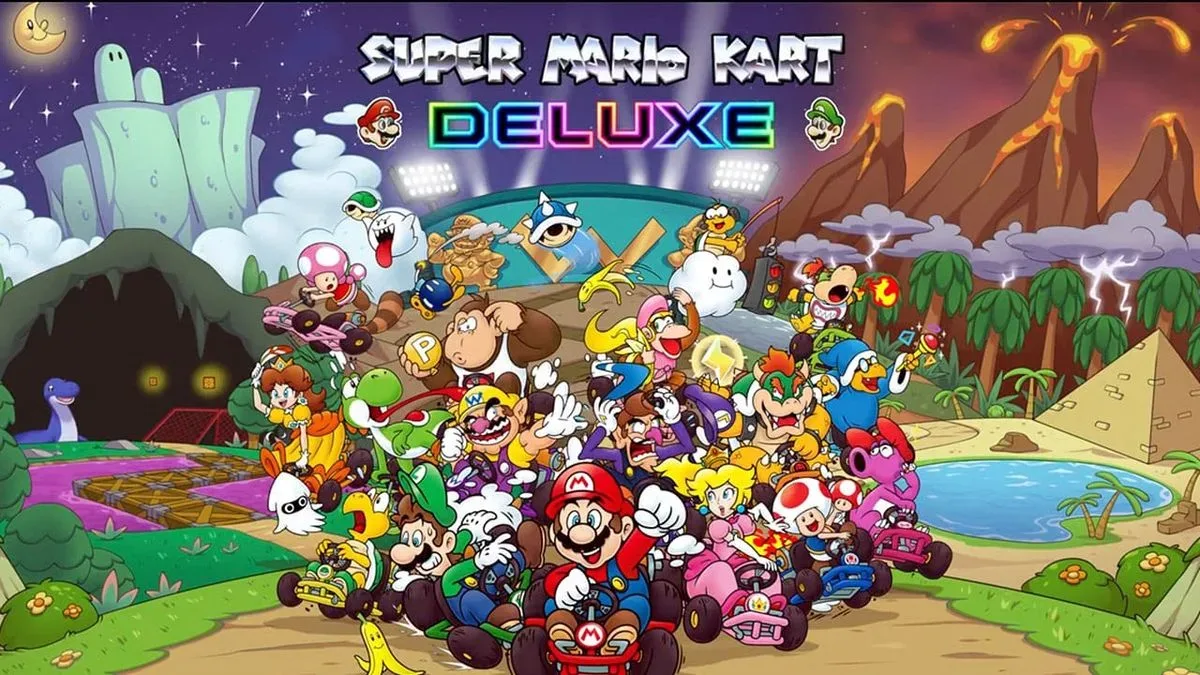
Super Mario Kart Deluxe (SMKDX), an ambitious ROM hack built around the 1992 SNES original, is targeting December 25, 2026. Creators MrL314 and ScouBsmk revealed the date in a teaser, putting a festive finish line in view for a project that has spent years building anticipation among fans of the first Mario Kart.
The headline addition is scale. SMKDX is described as a Deluxe-style expansion of Super Mario Kart, with eight additional playable characters, six extra cups, a replacement soundtrack, extra multiplayer modes, faster speed classes and several distinct ways to race. It is not being framed simply as a course pack or a character swap; its stated feature list aims to broaden what players can do with the SNES foundation.
That makes the December date notable, but it also comes with an important practical caveat: there is currently no confirmed information on where the completed hack will be made available. The teaser establishes a target release day, not a distribution page, download location or platform-by-platform setup guide.
What SMKDX says it is adding
The eight named newcomers are Toadette, Wario, Kamek, Birdo, Dixie Kong, Waluigi, Bowser Jr. and Daisy. Their inclusion gives the roster a much wider spread of Mario-universe faces than the SNES game began with, mixing familiar rivals, recurring supporting characters and later-era fan favorites.
SMKDX also plans six extra cups. In kart racers, a cup generally groups multiple courses into a structured series, so extra cups suggest a substantial expansion to the game’s organized racing progression rather than a single one-off event. Specific course names, layouts and cup structures have not been detailed here, so players will need to wait for the finished release to see how that content is arranged.
Its listed mode selection is equally broad:
- Mission Mode, described as being in the vein of Diddy Kong Racing.
- Shine Thief, a multiplayer mode.
- Battle Race, another multiplayer option.
- Mirror Mode, which flips the racing perspective.
- Endurance Mode, built around meeting a particular time limit on tracks.
Mission Mode is the most immediately interesting addition because it points beyond ordinary cup competition. The comparison indicates a format based on objectives rather than merely placing first in a race, although the particular tasks and progression rules have not been specified. That distinction matters: a new racing class makes familiar competition faster, while objective-based play can change the reason players approach a course in the first place.
Shine Thief and Battle Race are presented as options for playing with friends, reinforcing the social side of the project. The supplied details do not define their scoring, item rules or win conditions, so it would be premature to treat them as exact replicas of similarly named modes elsewhere in the Mario Kart series. The key confirmed point is that SMKDX intends to offer multiplayer activity beyond its standard races.
Related coverage includes Super Mario Kart Deluxe Sets Christmas Day 2026 Release for Ambitious SNES ROM Hack.
Faster classes could be the project’s sharpest change
SMKDX will include speed classes up to 300cc, alongside Mirror Mode. In racing-game terminology, a speed class is a preset that changes the pace of competition. Higher numbers are typically shorthand for a faster, more demanding ruleset; in this case, the stated 300cc ceiling signals an attempt to give experienced players a much more intense option than a conventional run through the original game.
There is no detailed handling breakdown yet, so it is unknown precisely how those faster settings will affect acceleration, cornering, collisions, AI behavior or item use. Still, the practical implication is clear enough: players who know the SNES tracks and systems well may have a reason to revisit them under more pressurized conditions, while newcomers can decide whether to begin at a more manageable pace.
Mirror Mode complements that idea. Mirroring reverses a course from left to right, which can make memorized turns suddenly feel unfamiliar. It does not necessarily require brand-new track geometry to create a fresh challenge; the player’s learned routing and visual expectations are what get turned around. Paired with high speed classes, it gives SMKDX a stated focus on replayability as well as raw content volume.
Endurance Mode appears to put the emphasis directly on time. Players will be timed and must complete tracks within a specified limit, turning performance into a pass-or-fail target rather than only a contest against rival racers. That should appeal to people who enjoy optimizing lines and shaving mistakes from a lap, but its final difficulty will depend on the time thresholds, which have not been announced.
Why a ROM hack can make an old kart racer feel newly active
A ROM hack is a fan-made modification of a game’s data and design. For SMKDX, that description is especially useful because it sets expectations: this is not a newly released official Mario Kart entry, but a project designed to build upon the original SNES game. The appeal lies in the tension between a familiar base and an expanded set of possibilities.
Super Mario Kart dates to 1992, and its compact, competitive format remains the reference point for this project. SMKDX’s feature list suggests an effort to preserve that origin while opening it up through a bigger character selection, more cups, additional modes, a new soundtrack and altered speed options. The result, if the released version delivers on that outline, could serve different audiences at once: returning players who want the original style with more to master, and groups looking for more ways to compete locally.
That does not mean every promised feature should be assumed to be final in every detail before launch. A teaser date and feature outline are useful markers, but there is no supplied information about final build changes, compatibility, installation requirements or eventual hosting. Interested players should watch for information from the creators as December approaches rather than assuming a particular setup process.
A Christmas target, with some key questions still open
Christmas Day is an unusually specific launch target for a fan project that emphasizes multiplayer and shared competition. The timing naturally suits a game designed around passing controllers and challenging friends or family, particularly for players whose memories of the original are tied to couch competition. But the date is the confirmed part; the route to playing it remains unconfirmed.
There is also no need to overstate what has been shown. The known details are already substantial: eight additional racers, six more cups, Mission Mode, Shine Thief, Battle Race, Mirror Mode, 300cc racing, Endurance Mode and a new soundtrack. What remains unknown is just as important for setting fair expectations: where SMKDX will be available, the exact makeup of its course content, how each new mode operates, and whether further feature changes will accompany release.
For retro players, projects like this demonstrate why an older game can remain a living starting point rather than a fixed museum piece. New challenges and modes can change how people return to a classic without erasing the identity that made it memorable. That ongoing appetite for games on the move is also reflected in discussion around a more gaming-focused portable iPad Mini design, though no platform or device support for SMKDX has been confirmed.
For now, SMKDX has a clear calendar marker: December 25, 2026. Its creators have outlined a version of Super Mario Kart that aims to be bigger, faster and more varied than the 1992 original, while the practical details of release are still waiting at the starting grid.