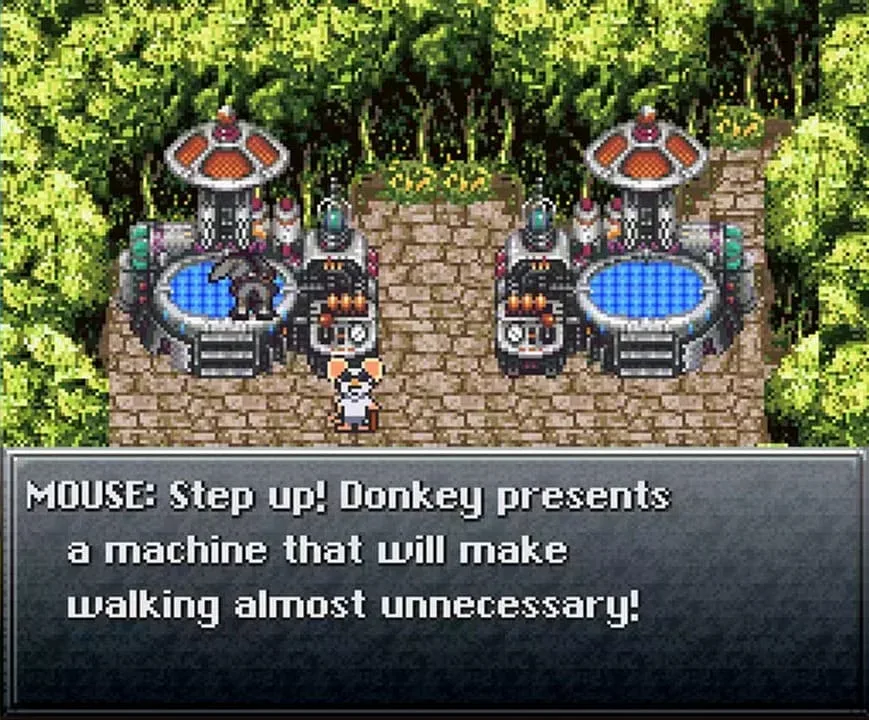
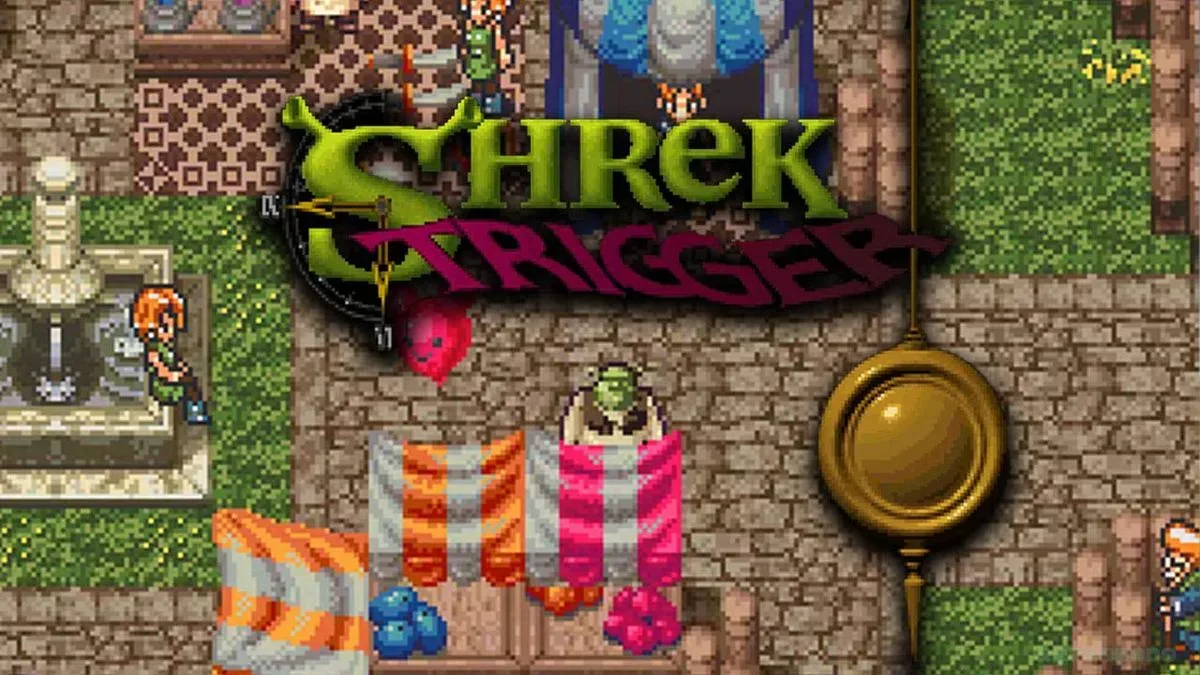
Shrek Trigger is a parody ROM hack built on Chrono Trigger, recasting the time-travel RPG as an extremely swampy adventure led by Shrek. Its premise begins with Donkey and an invention that tears through time, but the project goes far beyond a simple character-sprite swap: the campaign has been rewritten throughout, with thousands of new lines designed to move the familiar adventure into an ogre-and-fairytale world.
The hack is credited to creator mikola. It preserves the broad playable structure of the original while changing the presentation, dialogue, character identities, names of combat abilities, and several game terms. The result is not positioned as a replacement for the original RPG, but as a comic reinterpretation for players who already know the trip through time and want to see its framework deployed for a very different joke.
A familiar RPG framework, recast for the swamp
The central idea is direct: Shrek takes the role normally occupied by Crono, and the familiar party is remade around characters associated with Shrek’s fairytale setting. There are seven playable characters in total:
- Shrek
- Fiona
- Donkey
- Pinocchio
- Puss in Boots
- Mongo
- An additional concealed party member described by the creator as someone players would not want to invite along
That line-up signals the hack’s approach. Shrek Trigger is not merely interested in putting a green face over the hero’s sprite and leaving the rest untouched. It frames the full party around the parody, giving the group a different identity even as it travels through the game’s existing progression.
Importantly, the project is said to retain every possible ending from Chrono Trigger. That matters because the original game is known for multiple conclusions tied to player progress and choices. Keeping them means the parody extends through the campaign rather than stopping at its main plot path.
What a ROM hack is—and what this one changes
A ROM hack is a fan-made modification to game data. In practical terms, such a project can alter text, graphics, music, maps, rules, enemy data, or other components depending on its goals. Shrek Trigger uses that format to make extensive cosmetic and script-focused changes to an existing Super Nintendo-era RPG.
The changes described for Shrek Trigger include new character sprites and a rewritten script containing roughly 5,000 new lines. That is a substantial amount of text for a parody project: dialogue is one of the major ways an RPG establishes its tone, explains its world, and makes story scenes land. Reworking it at that scale gives the hack room to carry its gag through conversations rather than relying solely on visual recognition.
Its game terminology also gets an ogre-flavored conversion. Healing uses onions, while garlic restores magic. Player-facing attributes are renamed with deliberately absurd labels including Earwax, Beef, and Mojo. These labels do not necessarily indicate a redesigned underlying stat system; based on the available details, they are best understood as renamed terms that reshape how the original mechanics are presented.
Related coverage includes Shrek Trigger Turns Chrono Trigger Into an Ogre-Filled Time-Travel Parody.
That distinction is useful for prospective players. A renamed stat can make an established menu look completely alien at first glance, even if the role it serves remains familiar. In a parody hack, the joke works partly because serious RPG language—health, magic, power, and similar concepts—gets replaced with words that are intentionally sillier.
All 116 techniques receive new names
Shrek Trigger reportedly renames all 116 techniques. In the context of the game, techniques are the party’s special combat moves: attacks, magical actions, healing skills, and cooperative abilities involving more than one character.
Renaming the entire set is a detail that demonstrates how far the conversion reaches into the interface and battle vocabulary. It is also where the hack deliberately plays with balance for comic effect. Many techniques have been made purposefully overpowered, so players should not assume that Shrek Trigger is intended as a strict challenge run or a careful rebalance of the base game.
Instead, the emphasis appears to be on recognition and escalation. Seeing a familiar system use new names is one layer of the parody; making certain abilities comically strong is another. It lets the game’s mechanical feedback participate in the joke rather than limiting the humor to cutscenes.
Magic itself gets a similarly offbeat twist, with magical powers found through a celebrity chef. The available information does not spell out how that scene is structured, but it is another example of the hack replacing fantasy-RPG seriousness with a knowingly strange fairytale-pop-culture remix.
Boss battles remain unchanged
For all its new text and visual identity, Shrek Trigger does not overhaul everything. The boss battles are described as unchanged. That makes the project a particularly clear example of a parody conversion rather than a mechanical redesign.
Players who remember the original game’s boss encounters should therefore expect their knowledge to remain useful. The enemies and battle foundations are not presented as newly built encounters. What changes is the surrounding frame: the party members, the move names, the revised script, the items, and the exaggerated tone.
There is a practical upside to that choice. It allows the hack to preserve a recognizable play experience while substantially changing the mood. The joke is not that players have to relearn every fight from scratch; it is that the journey they remember is now being performed by an ogre-led cast with onions, garlic, and wildly renamed techniques in the menus.
It also sets expectations correctly. Anyone looking for redesigned bosses, new battle scripting, or a difficulty-focused combat overhaul should not infer those features from the rewritten campaign. Conversely, someone seeking a replay with a fresh comedic wrapper may find the unchanged boss structure reassuring.
Why extensive parody mods can work
There is a particular appeal to a parody built around a game whose structure is already familiar to its audience. Players can recognize the shape of a scene, a location in the story, or the role a party member is filling, then see how the rewrite bends it toward a completely different world. That contrast is doing much of the work.
Shrek Trigger’s reported 5,000 rewritten script lines suggest that it understands this. A character swap by itself can make for a quick visual gag. Sustained dialogue changes, renamed moves, altered stat labels, and themed recovery items give the concept more places to surface over the course of an RPG campaign.
The project also illustrates that fan modifications do not always need to pursue restoration, translation, difficulty, or technical improvement. Some exist chiefly to reinterpret tone. In this case, the original game’s time-travel premise provides the convenient setup for a fairytale cast entering a world that clearly was not designed for them.
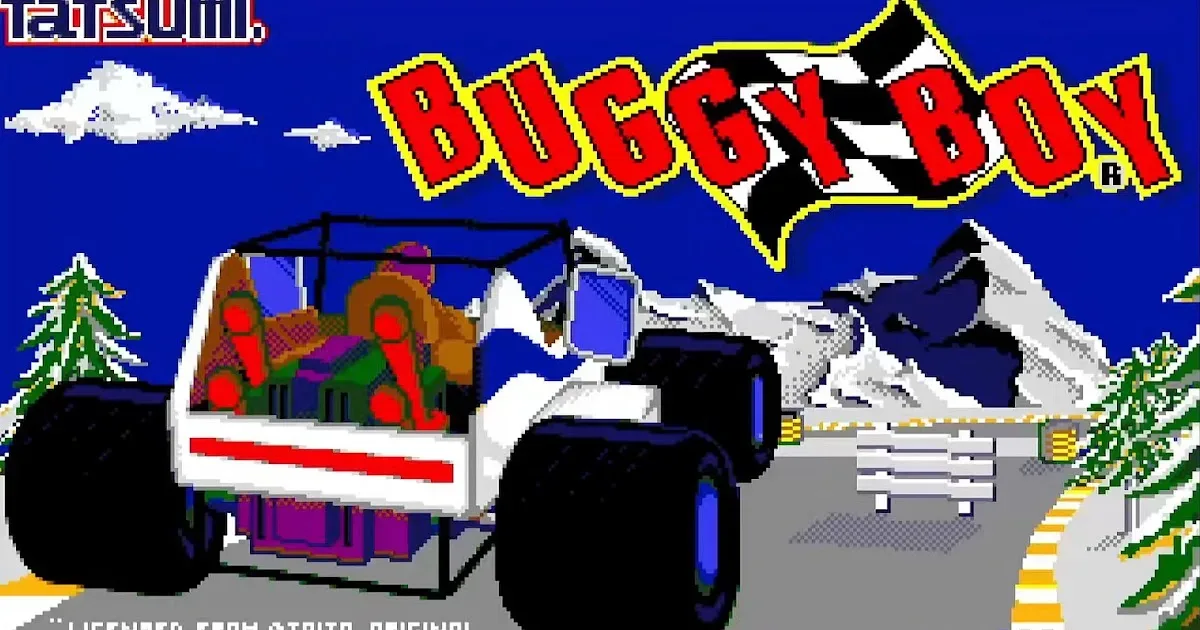
For more examples of fans taking older games in unexpected directions, see our coverage of two distinct fan revivals of Buggy Boy on Amiga. The projects are different in purpose, but both show how enduring game frameworks can become platforms for new community-made interpretations.
Patch requirements and responsible setup
Shrek Trigger requires a legally obtained copy of the Chrono Trigger (USA) ROM as its base. The required file is specified as 4,194,304 bytes with the CRC32 value 2D206BF7.
Those technical identifiers are important rather than decorative. A ROM’s region and revision can affect its file contents. A patch prepared for one exact version may fail to apply, or may produce errors, if used with a different dump. File size and CRC32—a checksum value used to identify a particular file’s data—give users a way to verify that their legally acquired base copy matches the hack’s requirements before attempting to patch it.
The project is distributed as a modification to be applied to that base ROM, not as a substitute for owning the original game. Players should follow the project’s instructions and ensure they are using the stated U.S. version and matching checksum. Since the supplied details do not name a specific patching tool or file format, it would be unwise to assume a particular application method beyond the creator’s own documentation.
What players should expect from Shrek Trigger
Shrek Trigger is best approached with the right expectations. It retains the underlying journey and unchanged boss battles of Chrono Trigger, but filters the campaign through a full-scale comedy rewrite. Shrek, Fiona, Donkey, Pinocchio, Puss in Boots, Mongo, and one undisclosed ally take the party’s place; dialogue, item concepts, statistics, and 116 techniques are reworked to match; and some abilities are intentionally too powerful because that imbalance is part of the bit.
For players protective of the original experience, the mod’s premise is plainly not an argument that the classic needs fixing. It is a separate, mischievous version built around the pleasure of seeing a respected RPG taken somewhere ridiculous. The original’s structure remains legible, while nearly every layer that communicates personality has been pulled toward the swamp.
That makes the project an unusual but coherent fan remix: a complete campaign parody that keeps its endings, retains its bosses, and commits to rewriting the language around the adventure rather than merely changing a few portraits. If nothing else, it offers the distinctive prospect of navigating a legendary time-travel RPG in a universe where onions are medicine, garlic restores magic, and “Mojo” may matter more than any sensible stat name ever should.