The retro-FPS revival has spent years revisiting a particular slice of PC history: pixel-heavy corridors, speed-first movement, oversized weapons and the general spirit of shooters from the 1990s. Sprawl Zero takes a different route through the memory lane war zone. It draws from the console-facing shooters of the early 2000s, an era defined by the original Xbox, PlayStation 2 and games that made industrial ruins, radio chatter, sternly armed soldiers and a little too much brown look extremely serious.
Sprawl Zero is available now for PS5, Xbox, Switch 2 and PC. It is set in the same universe as Sprawl, but its premise and combat systems put the focus squarely on a compact, mission-driven first-person shooter format. Rather than asking players to juggle crafting materials, compare statistical loot or navigate a long skill tree, the game centers on direct objectives, linear handmade stages, combat encounters and optional collectibles tucked away from the obvious route.
That approach is conspicuously aligned with the shooter design of the Halo, Killzone, Black, Half-Life 2 and F.E.A.R. generation. Those games were not identical, of course, but they shared an interest in pushing players through authored spaces with strongly defined weapons, memorable combat beats and a cinematic sense of place. Sprawl Zero uses that broad template while introducing a major restriction intended to make every gunfight less settled and more improvisational.
A dystopian campaign built around Five
Players control Five, a genetically modified super-soldier enforcer operating in a vast dystopian city. Five is sent on missions against a militant religious cult, and the job description is not complicated: move through hostile territory, pursue the objective and survive encounters with large numbers of armed opponents.
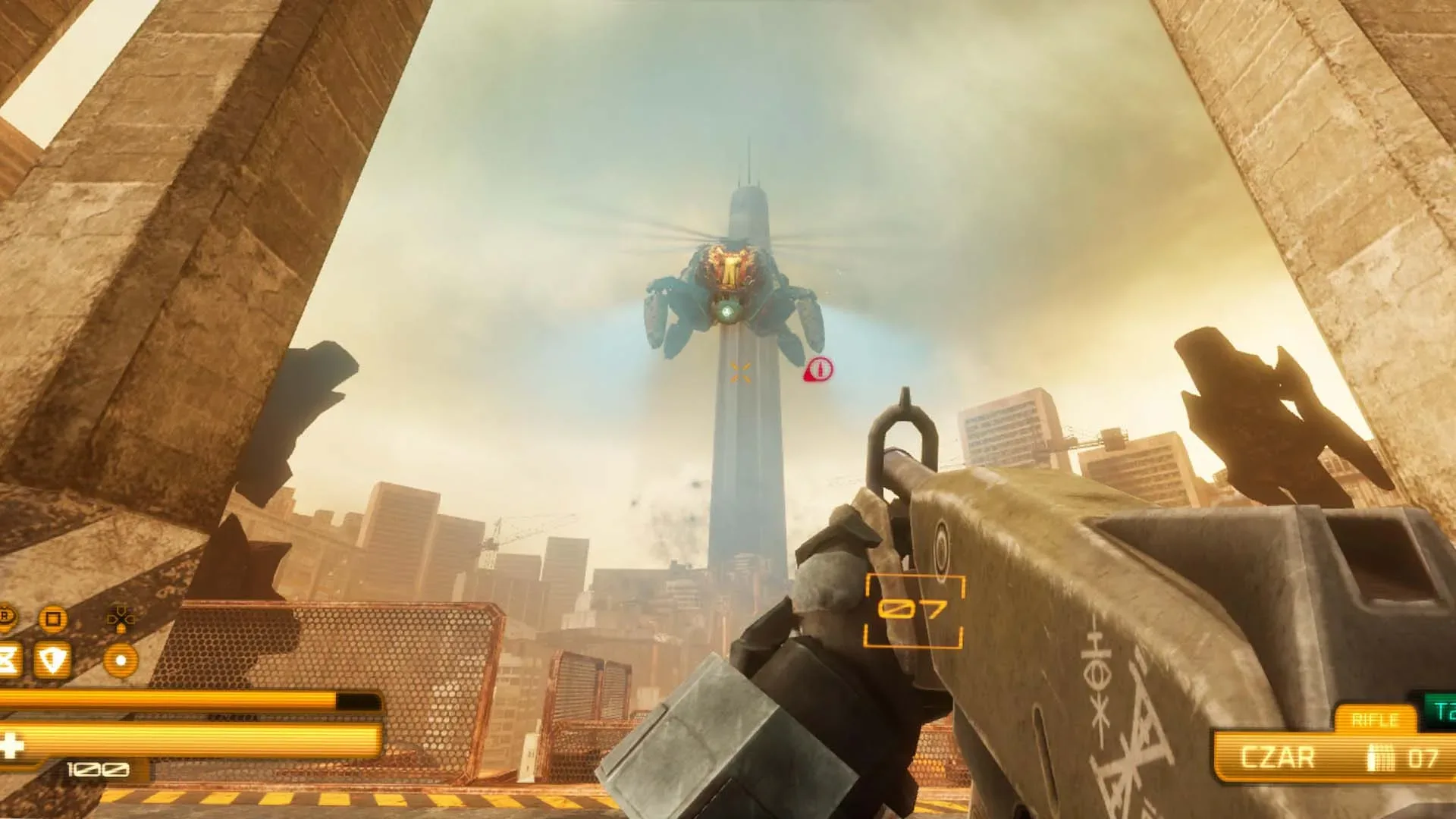
The setting embraces the hard-edged science-fiction vocabulary associated with shooters from the period that inspired it. The environments lean toward brown, beige, gray and black, while the soundtrack uses electronic music and enemies frequently speak during fights. Weapons are deliberately substantial-looking rather than sleek or delicate, and the levels mostly maintain a linear direction. These are aesthetic choices that immediately place the game in dialogue with the PS2 and original Xbox era without simply trying to reproduce a specific game.
That distinction matters. Nostalgia can make a familiar visual language appealing on its own, but a modern release needs a mechanical reason to revisit it. Sprawl Zero’s answer is a combat loop in which the player cannot comfortably settle into a favorite rifle for an entire mission.
One weapon, no reloads, constant decisions
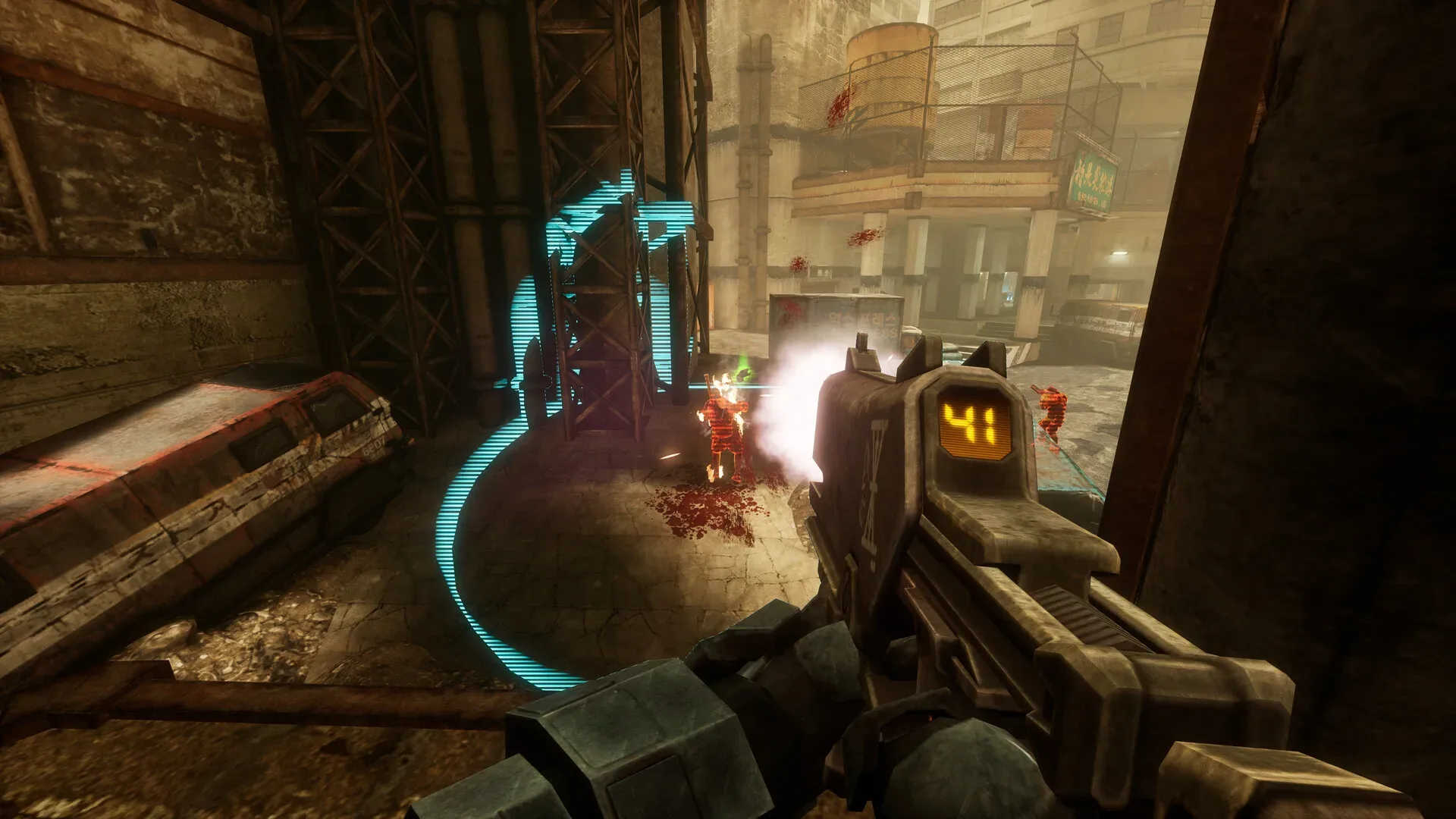
Five can carry only one gun at a time. Weapons found during a mission cannot be reloaded, which means every firearm has a finite role in the immediate fight. Once its ammunition is spent, the answer is not a quick reload animation or a trip through an inventory wheel. The player has to take another weapon from the battlefield.
It is a simple rule with significant consequences. A pistol taken from a defeated enemy may have too few rounds to clear the next room. That can force a rapid change in priorities: eliminate a nearby target to claim its weapon, find a gun among the debris of a prior encounter, or use one of Five’s special abilities to create an opening. The intended pressure is less about stockpiling and more about adapting to what is physically present.
The system also makes every newly acquired gun an event. In many shooters, dropping a weapon feels like an unwanted interruption, especially if the player has found a preferred loadout. Here, replacement is not an occasional inconvenience; it is a fundamental part of the rhythm. For the idea to work, weapons need clear identities and useful combat roles, and Sprawl Zero is built around an arsenal designed to keep that succession of pickups from feeling routine.
The result is a different kind of throwback FPS. Early-2000s shooters often delivered carefully selected weapon sets and highly choreographed firefights. Sprawl Zero retains the chunky presentation and focused level design associated with that period, then builds uncertainty into the player’s equipment from moment to moment.
Gravity Gloves turn the environment into ammunition
Five’s most distinctive tool is a pair of Gravity Gloves. They allow weapons and other objects to be pulled from a distance, making it possible to snatch a replacement gun in the middle of a fight instead of walking directly over to it. In a crowded area, that distance-grab can create a small moment of uncertainty: with multiple fallen enemies and weapons nearby, the item that flies into Five’s hands may not always be obvious until it arrives.
The gloves are not limited to firearm retrieval. Loose objects such as barrels can be lifted and hurled at enemies. This puts physical clutter to work as a combat resource and reflects the object-driven action associated with Half-Life 2’s Gravity Gun, while serving Sprawl Zero’s much faster weapon-turnover loop.
Five can also throw the weapon currently being carried. A hurled gun can stun an opponent or potentially kill one outright. That option turns an empty firearm into something more useful than discarded weight and reinforces the game’s broader philosophy: equipment is transient, and even a soon-to-be-replaced weapon can make a difference in a tight encounter.
For players who associate the early 2000s with set-piece shooter combat, the Gravity Gloves are the clearest sign that Sprawl Zero is not treating its inspirations as a museum display. They create opportunities for quick interaction with dropped equipment and level objects while keeping the action moving toward the next weapon, target or objective.
More tools arrive as fights escalate
The campaign adds further powers as players move through its handcrafted levels. Bullet time slows the action during especially chaotic combat, giving Five a way to manage dangerous situations when enemies arrive from several directions. A Gravity Shield can block incoming projectiles and then send them back when released. Five also gains a powerful punch capable of breaking shields.
Those tools become increasingly important as encounters intensify later in the game and more opponents are sent into battle at once. Each ability addresses a different problem. Bullet time creates breathing room; the Gravity Shield answers projectile pressure; and the shield-breaking punch gives the player a close-range solution to defensive enemies. Together with the gloves and disposable weapon economy, they give Five a toolkit that is broader than the relatively straightforward arsenal-focused structure might initially suggest.
It is also notable that these features do not require the game to abandon the appeal of its chosen period. Sprawl Zero still favors brisk movement through authored spaces, loud guns, hostile squads and a hard industrial science-fiction atmosphere. The special abilities build on that framework rather than replacing it with a progression-heavy action-RPG structure.
A different branch of retro shooter design
“Retro shooter” has become an expansive label, and it can obscure the important differences between eras. A game inspired by Doom or Quake tends to evoke one set of expectations: extreme speed, maze-like spaces, abstract key hunts and a large permanent arsenal. A game inspired by the PlayStation 2 and original Xbox period suggests another: mission structure, more overt fiction, reactive enemies, electronic score cues and action staged through recognizably physical environments.
Sprawl Zero belongs much more firmly to the latter branch. Its palette, audio, level flow and combat framing all evoke the years when players were charging through alleys, bases and ruined facilities on bulky consoles. Its one-gun rule and power set, however, add a modern mechanism for maintaining momentum and tension.
Its Switch 2 release also lands amid continued attention on the platform’s upcoming software calendar. Readers following the system’s seasonal slate can find more on the planned Switch 2 winter game news presentation. For shooter fans, Sprawl Zero represents a separate but welcome proposition: an immediately available FPS built around an era that is often remembered fondly but less frequently imitated with this degree of specificity.
Sprawl Zero’s concept rests on a confident combination. It uses the visual and structural language of early-2000s console shooters, places a super-soldier in a bleak future conflict, and asks players to stay mobile because their guns are never permanent. With Gravity Gloves, throwable objects, bullet time, a defensive projectile-returning shield and a shield-shattering punch, Five has more than enough ways to keep a fight from becoming a simple exchange of gunfire.
For anyone whose favorite shooter memories involve the original Xbox or PS2 rather than the earliest PC classics, that blend gives Sprawl Zero a clear identity. The game is not just revisiting the color palette and sound of that moment in FPS history. Its central combat rule makes the player constantly re-evaluate what is in hand, what is on the floor and what can be turned into the next solution.