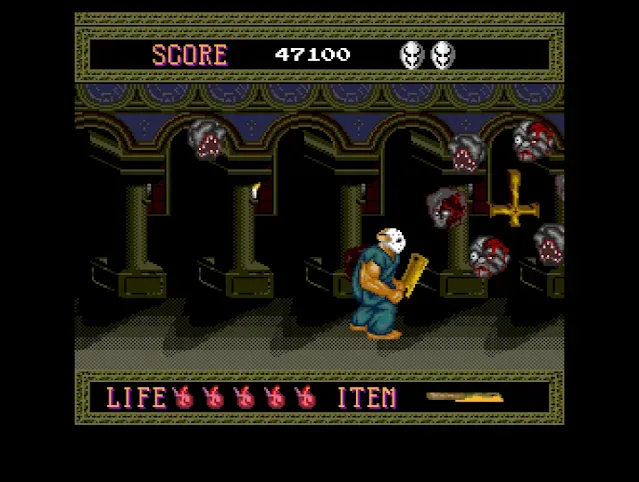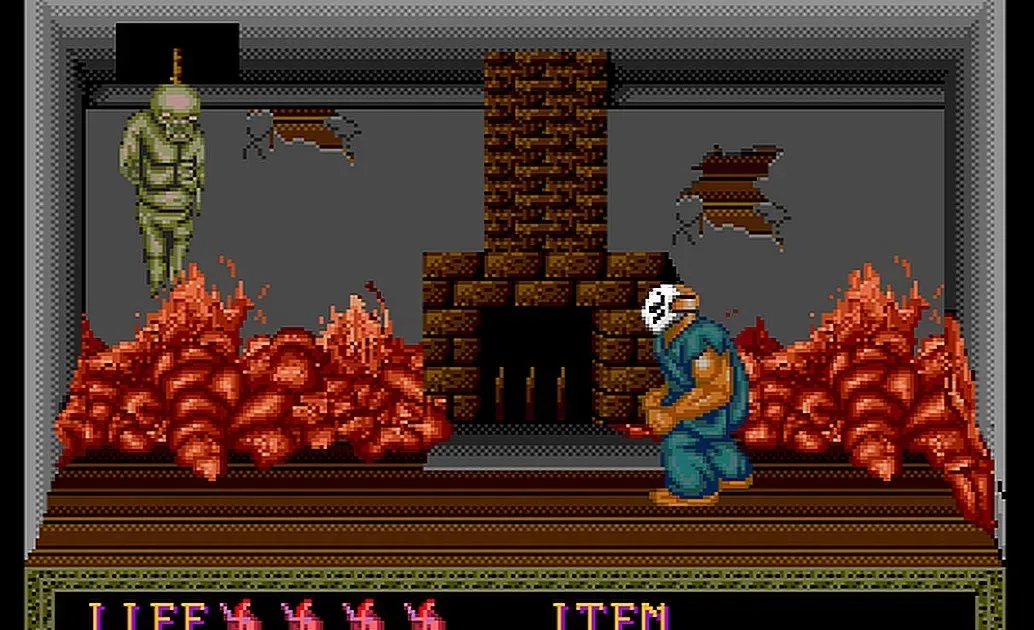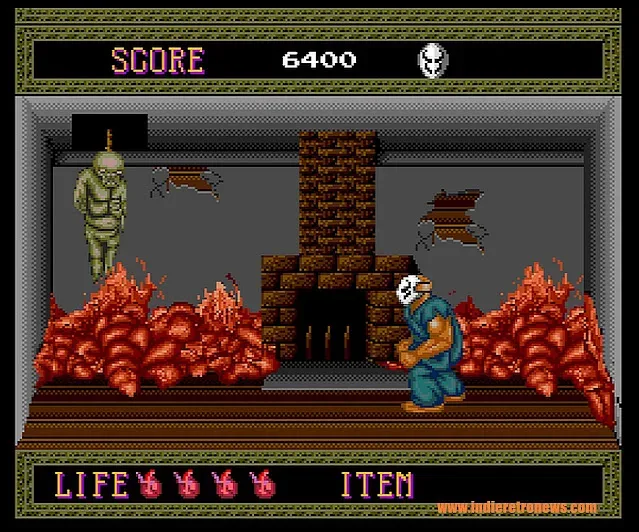
Splatterhouse, Namco’s 1988 horror action game, has been unofficially rebuilt for Amiga AGA machines. The project brings Rick’s mansion escape and rescue mission for Jennifer to the Amiga in a complete seven-stage form, targeting the enhanced-graphics A1200 family and the CD32 rather than the earlier base Amiga hardware configuration.
The conversion is credited to Modern Vintage Gamer, whose previous Amiga releases include Gunsmoke AGA and Zippy Race A500. It is a reconstruction rather than a simple repackaging of an existing release: the game has been reverse-engineered into portable C code and then adapted around the Amiga’s particular display, memory and audio capabilities.
That distinction is important. A port can mean many things in retro development, from an emulation wrapper to a direct conversion of available source code. Here, the stated work involved rebuilding the game’s logic and presentation in portable code, then creating Amiga-specific systems around it. The result aims to closely follow the PC Engine version while acknowledging that the Amiga’s planar graphics format calls for some colour approximations.
For players with the appropriate hardware, the release offers three distinct installation paths: a standard A1200 hard-drive build, a WHDLoad package and a CD32 version. Each has different memory and setup requirements, and the audio options differ depending on the version being used.
A familiar slasher nightmare on Amiga AGA
Splatterhouse puts players in control of Rick, the masked protagonist fighting through a mansion filled with creatures. The Amiga release contains the full seven-stage arcade-style adventure and supports standard joysticks as well as CD32 controllers. That controller support is particularly relevant for the CD32 edition, while conventional joystick compatibility keeps the game suited to the wider AGA Amiga audience.
The project is framed around fidelity to the PC Engine release. That does not mean every image can be reproduced with precisely identical colour handling. The Amiga uses a planar display arrangement, a technical approach in which image data is organized across bitplanes rather than in the same format used by every other platform. In practical terms, the conversion makes slight colour adjustments where necessary to fit that format.
Those compromises are presented as format-specific rather than a wholesale redesign. The central aim is to preserve the game’s structure, visual identity and fast horror-action presentation on AGA equipment. For retro players, that makes the hardware target the key point: this is not positioned as a version for every Amiga model, but as one built to make use of the AGA-era machines’ capabilities.
Why the AGA target matters
AGA refers to the enhanced graphics architecture used by later Amiga systems including the A1200, as well as the CD32 console. The release uses several Amiga-oriented techniques: Dual Playfield mode, copper lists, double buffering and hardware sprites. These are not decorative technical bullet points; together, they describe the route the port takes to balance scrolling, character and enemy imagery, and screen updates.
Related coverage includes Splatterhouse Rebuilt for Amiga AGA With CD32 and WHDLoad Versions.
Dual Playfield and copper lists
Dual Playfield is an Amiga display mode that permits two separate visual playfields to be combined. In a side-scrolling action game, a technique like this can be useful when separating layers of the image and managing how they overlap. The reconstruction uses it alongside other platform-specific work in pursuit of smooth scrolling and large on-screen sprite work.
Copper lists are display-control instructions for the Amiga’s Copper co-processor. Put simply, they allow the machine’s video hardware to be directed as the screen is being drawn. The release uses copper lists as part of its graphics approach, again with the stated goal of maintaining motion and substantial hardware sprites effectively.
Hardware sprites are images handled by dedicated display hardware rather than being drawn entirely as ordinary background graphics. The value of using them is efficiency: the system can treat those visual elements differently from the playfield. In a game built around monsters, Rick and constant side-scrolling action, that can be a meaningful part of achieving the intended look on the target machines.
Double buffering and frame-rate choices
The conversion also uses double buffering. In broad terms, double buffering prepares one frame while another is being displayed, then swaps them. It is a well-established way to reduce visible drawing artifacts and support smoother animation. In this case, it forms part of a wider effort to keep scrolling fluid while handling the game’s larger graphical elements.
Timing has received direct attention as well. The game automatically detects PAL and NTSC environments, and it includes a manual 50/60fps toggle. PAL and NTSC are television timing standards that differ in refresh rate; a game created with one timing convention in mind can feel different when run under the other. Automatic detection is intended to choose an appropriate setting for the machine, while the manual option gives the player a way to select between 50fps and 60fps playback.
That is a practical consideration rather than merely a settings-menu extra. A fast action game’s movement and pacing can be closely linked to how frequently frames update. The stated goal here is correct-speed play across differing setups, not simply displaying an image on whichever standard happens to be present.
Three audio routes, depending on the build
The audio configuration is one of the most flexible parts of the release. Its base music solution is a newly rearranged four-channel ProTracker soundtrack. ProTracker is associated with the Amiga’s tracker music tradition, where music is assembled from samples and patterns. A four-channel arrangement is especially suited to the platform’s audio identity, but it also requires careful decisions when sound effects occur during play.
The port addresses that by giving game sound effects priority over audio channels when needed. The intent is that effects can take precedence without the underlying musical atmosphere being needlessly disrupted. This is an implementation detail that matters in a game where attacks, impacts and horror cues are central to the moment-to-moment presentation.
WHDLoad users and CD32 players also receive CDDA options. CDDA, or CD Digital Audio, refers to standard audio played from a CD rather than tracker music generated through the Amiga audio channels. Those editions allow players to switch freely among three musical presentations:
- the original arcade CD soundtrack;
- PC Engine music; and
- the new ProTracker arrangements.
On the CD32 release, PC Engine CD audio is selected by default. The CD32 package includes both CD audio soundtracks as well as the ProTracker music, which makes it the most immediately self-contained option for someone running a stock console. The selectable music also recognizes that different versions of Splatterhouse have distinct audio identities. Rather than declaring one definitive choice for every player, the conversion makes those alternatives available where the build supports them.
Which version fits your Amiga setup?
The required hardware is clearly divided between the three packages. Prospective users should match the release to the machine and memory they actually have instead of assuming the files are interchangeable.
Standard A1200 hard-drive version
The standard hard-drive release works on any AGA Amiga with a 68020 processor or better and 2 MB of Chip RAM. Fast RAM is optional for this version. Installation consists of extracting the LHA archive and starting SplatterHouse either from its Workbench icon or through the Shell.
Chip RAM is memory shared with the Amiga’s custom hardware, making its stated amount especially relevant to a graphics- and audio-intensive production. Fast RAM is additional memory that is not shared in the same way. The distinction explains why the standard package can list Fast RAM as optional while another installation route requires it.
WHDLoad package
The separate WHDLoad build is also for AGA Amigas, but its requirements are higher: 2 MB of Chip RAM, 4 MB of Fast RAM, WHDLoad 17 or later, an A1200 Kickstart image and a matching RTB file. The game can be exited with F10.
WHDLoad is a system commonly used on Amiga hardware to install and launch software from hard-drive storage. In this instance, it is not simply another filename for the standard version. It is a package with its own memory requirements and with access to the additional CDDA music choices described above. Anyone choosing this route will need to ensure the required Kickstart image and corresponding RTB file are already in place.
CD32 version
The CD32 build is designed for a stock CD32 with 2 MB of Chip RAM. It contains the two CD audio soundtrack choices and the ProTracker score. As noted, it starts with PC Engine CD audio selected by default, though the included music choices can be toggled.
For CD32 owners, the stock-hardware requirement is the straightforward headline. The console version does not demand the Fast RAM specified for the WHDLoad package, while still supplying the expanded audio selection. It also supports the CD32 controller alongside standard joysticks.
Tools and credits behind the reconstruction
The release credits Modern Vintage Gamer for the port, reconstruction and Amiga code, noting that some AI-assisted development was used. The credit is specific but does not define the extent of that assistance; the confirmed point is that AI assistance formed part of the development process.
Other named components include PTPlayer 6.4 by Frank Wille, which is public domain, and the Shrinkler executable cruncher by Blueberry. The build used Bartman/Abyss’s amiga-debug toolchain. Together, those acknowledgements outline a project assembled with established Amiga tools and components while maintaining a clear credit trail for the software involved.
The original game remains credited to Namco, with a 1988 copyright. This reconstruction arrives as another example of ongoing work around older platforms: hardware-specific projects can give an established game a new home while requiring careful treatment of memory, video timing, controller support and music playback. For a broader look at current retro-focused hardware activity, see our coverage of the AYN Odin 3 Portal.
Most importantly for prospective players, this is an AGA-focused release with concrete paths for A1200-style hard-drive setups, WHDLoad configurations and an unexpanded CD32. Its technical ambition is not based on a claim that the systems are identical: the port openly accommodates the Amiga’s colour format while using display hardware, buffering and timing options to pursue a faithful rendition of the PC Engine-era experience.