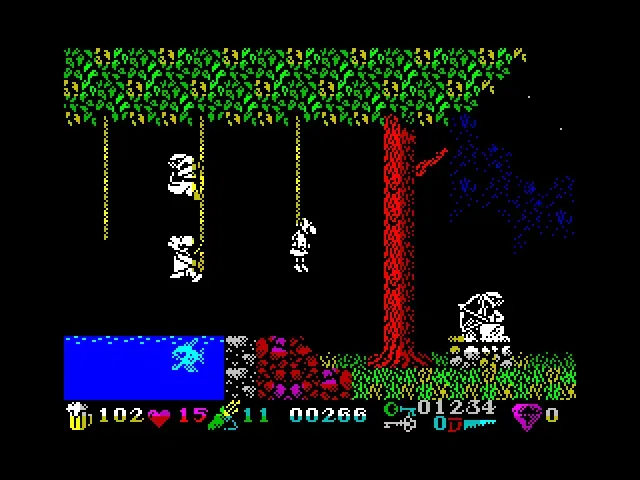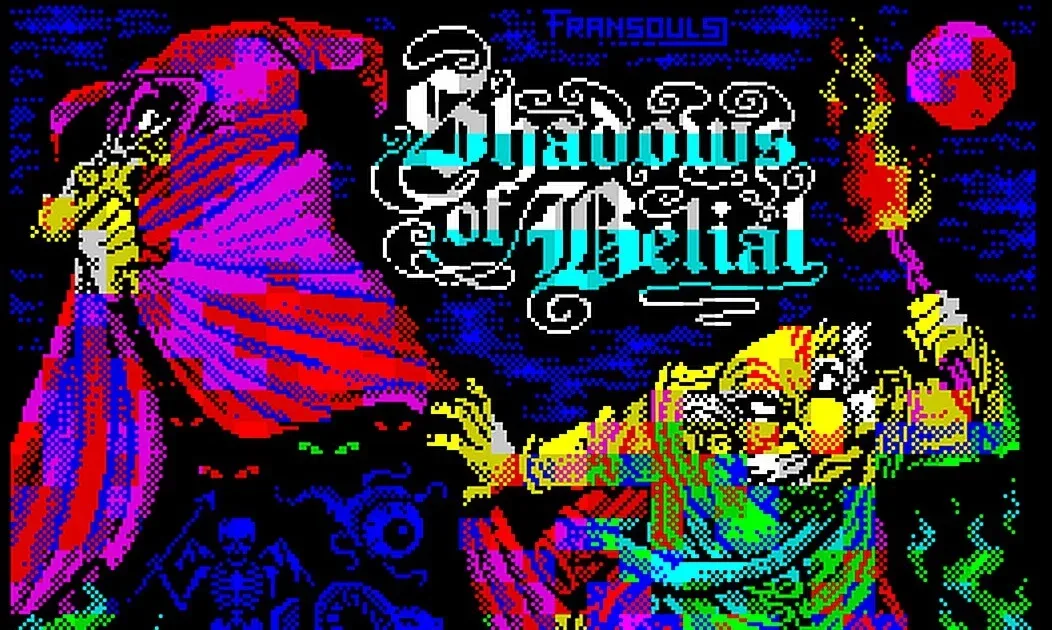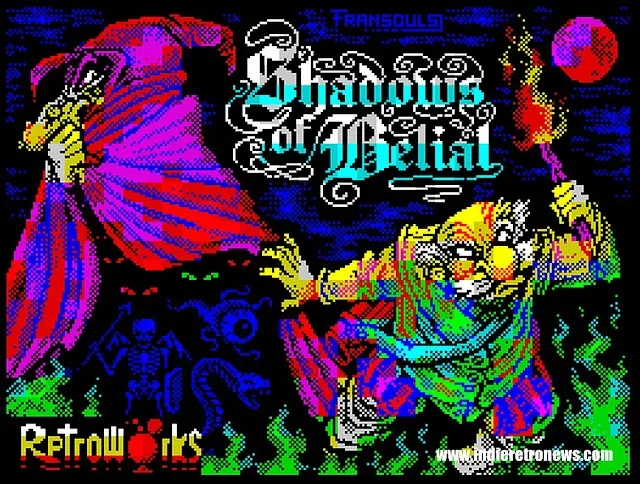
RetroWorks has released Shadows of Belial, a new action-adventure made for the ZX Spectrum 128K. Its premise is unapologetically grim: Sir Fred is pursuing justice and redemption while confronting the consequences of his own past. The journey is divided into five stages, each escalating the pressure from a pirate-infested mining settlement to an underworld threshold and a final reckoning.
That structure gives the game a clear dramatic route rather than presenting its dark fantasy setting as mere decoration. The stated objective is not simply to reach the next area. Sir Fred’s pursuit is tied to a family grievance, stolen honour and an infernal pact, with the later stages framing survival as the condition for setting those wrongs right.
A journey that starts with gems and pirates
The opening stage takes place in a ruined mining village occupied by Barbary pirates. Players must recover five enchanted gems, which are needed to unseal an entrance blocking the way forward. This makes the first area more than an introductory backdrop: progress is explicitly linked to finding a defined set of items.
In adventure-game terms, an enchanted gem is a key item: an object whose primary purpose is to enable access elsewhere rather than simply add to a score. The five-gem requirement suggests a tangible early-game objective, while the sealed entrance establishes a direct connection between exploration and advancement. The supplied details do not specify where the gems are placed, what dangers guard them, or whether they can be collected in any order, so those particulars remain unknown.
For more context, explore Samsung Galaxy Tab S12 Ultra vs. S11 Ultra: Same Giant Screen, Faster Chip, $200 Higher Starting Price.
The mine reveals the story’s darker centre
After the village, the route heads into the lifts of a cursed mine. There, Sir Fred uncovers the dark pact at the centre of the conflict. A mine lift is naturally a vertical connection between spaces, and its use here fits the story’s increasing descent from a damaged settlement into something supernatural and morally corrupted.
The next destination is a forbidden palace created through Belial’s magic. That detail is important because it identifies the palace as more than a conventional royal setting: it is a place sustained or formed by hostile supernatural power. The game’s title therefore points not just to an antagonist’s name but to a force shaping the spaces through which Sir Fred travels.
Belial’s role is described through the magical palace and the infernal pact, while the game keeps Sir Fred’s personal history at the heart of the conflict. The result is a fantasy quest with two linked stakes: stop the threat ahead and deal with the legacy behind the hero.
Porta ad Infernum raises the stakes
The final stretch includes “Porta ad Infernum”, a lava-filled abyss described as a descent into the underworld. Its Latin-styled name can be read as “gate to hell,” matching both the environment and the warning attached to the stage. One mistake there is said to bring eternal damnation.
That is evocative language, but it is worth separating atmosphere from confirmed mechanics. It clearly establishes that the area is meant to be dangerous and punitive. It does not establish exactly how mistakes are handled in play—whether through instant defeat, a restart, lost progress, limited lives, or another system. Players looking for that level of detail will need to consult the game’s own materials.
Still, the lava abyss supplies a strong final-act image: the quest moves from recovering magical objects in a village to surviving an infernal environment where the margin for error is presented as exceptionally small. It is a useful escalation for a five-stage adventure, because it makes the final approach feel like a destination with consequences rather than a routine last level.
The final trial: The Wrath of the Righteous
Surviving the underworld leads into the climax, “The Wrath of the Righteous.” This final trial is where Sir Fred attempts to avenge his family’s blood and restore the honour that was taken from them. The title signals a shift from escape and survival toward judgement and retribution.
RetroWorks’ outline does not spell out whether this finale is a boss encounter, a gauntlet, a story sequence, or a combination of several challenges. What is confirmed is its narrative function: it is the point at which the personal stakes introduced at the beginning are resolved. The quest for justice is therefore built into the game’s route, not left as background lore detached from its stages.
What is confirmed—and what remains to be learned
Shadows of Belial is confirmed as a ZX Spectrum 128K action-adventure with five stages, starring Sir Fred and centred on a conflict involving Belial. Its journey includes the following major locations and goals:
- A ruined mining village overrun by Barbary pirates, where five enchanted gems must be recovered.
- A cursed mine and its lifts, where an infernal pact is uncovered.
- A forbidden palace brought into being by Belial’s magic.
- The lava-drenched underworld abyss of “Porta ad Infernum.”
- “The Wrath of the Righteous,” the concluding trial concerning Sir Fred’s family and honour.
The available release information does not detail controls, enemy types, combat systems, puzzle design, difficulty settings, distribution formats, price, or broader platform support. It also does not identify how the five stages map precisely onto every named location. Those omissions matter, especially for a game whose pitch foregrounds atmosphere and a severe late-game challenge; they are simply not details that can be safely inferred from the present description.
A focused retro release with an infernal arc
For ZX Spectrum 128K players, the appeal is in a purpose-built action-adventure that commits to a dark, progressively more supernatural quest. The sequence is easy to grasp: recover the gems, pass the sealed route, uncover the pact, enter the palace, descend through the inferno and face the final judgement. That clarity is paired with a story about inherited loss, past sins and the attempt to win back honour.
Shadows of Belial’s five-stage outline leaves many mechanical questions open, but it provides a distinct identity for each stretch of the campaign. Pirates occupy the opening ruins, cursed machinery carries the hero downward, magic reshapes the palace, lava defines the abyss, and the last trial puts the personal motive front and centre. For a new ZX Spectrum 128K release, it is a suitably old-school proposition: a doomed knight, a sealed path, a handful of enchanted gems and, naturally, a trip through hell before the credits can plausibly roll.