Halo: Combat Evolved is reportedly being pushed toward two places that sound like they were selected by a mischievous AI with access to a hardware museum: the New Nintendo 3DS and a web browser. One project is said to target Nintendo’s handheld directly, while another makes the game playable through a browser with a much broader multiplayer ambition. Neither should be mistaken for a polished, official re-release, but each illustrates why the old game remains an irresistible target for technical preservation and porting experiments.
The important word in both cases is work in progress. The New Nintendo 3DS version has not been released publicly, and its developer has indicated that substantial work remains. The browser version is playable through a publicly shared address and is described as offering campaign play, split-screen co-op, controller support and online matches of up to 128 players. Reports surrounding that build also point to plenty of bugs. That makes this less a story about a definitive new way to play Halo and more a snapshot of ambitious projects still climbing the mountain, energy sword in hand.
A Halo project for the New Nintendo 3DS
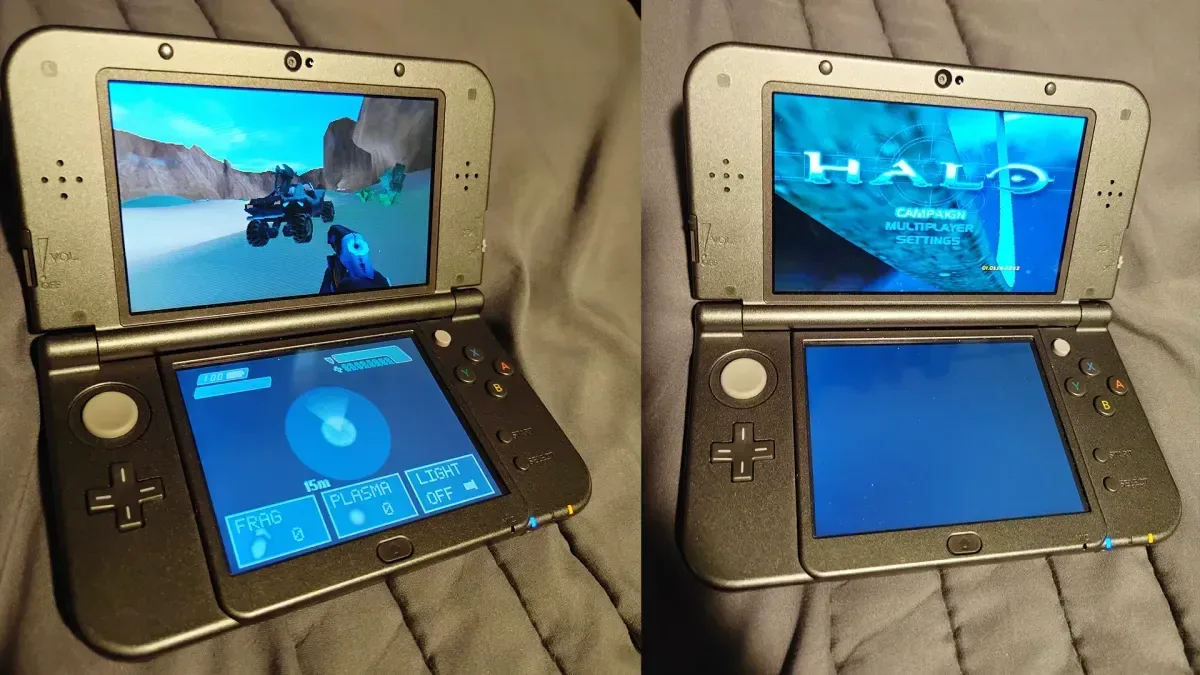
The handheld effort has been shown running on original Nintendo hardware and is associated with Generalkidd on X. The target is specifically the New Nintendo 3DS, not simply any member of the 3DS family. That distinction matters. The newer revision brought extra processing headroom, and the port’s reported performance and visual compromises underline how little room there is for wishful thinking when adapting a console shooter to a small portable system.
Footage and images shared of the project show a recognisable but heavily reduced version of Halo: Combat Evolved. The developer has said the original models are being used at significantly lower quality so that the New 3DS can handle them. In other words, this is not an attempt to make the game look like a lost retail 3DS release from an alternate universe where every cartridge came with a tiny cooling fan. It is a technical adaptation designed around strict limits.
Reported frame rates are around 20 to 30 frames per second on average. That range should be read as a progress indicator rather than a promise of a final performance target. Frame rate measures how many completed images a game presents each second. A stable 30 frames per second generally produces more consistent motion and input response than a game that swings around within a 20-to-30 range, especially in a first-person shooter. The practical takeaway is simple: footage can demonstrate that a port exists and functions, but it cannot establish that the final build will be smooth, stable or ready for long play sessions.
Features shown so far
The handheld project is reported to include the following elements at its current stage:
- Campaign mode
- Local multiplayer
- Stereoscopic 3D support
- Sound
- Use of the lower screen for the map
Those details are meaningful because they suggest the work is considering the 3DS as a platform rather than treating it as a screen with buttons attached. A map on the second display is a particularly natural fit for the hardware: it can keep navigation information available without covering the main action. Likewise, the system’s glasses-free stereoscopic display is a native capability that is easy to leave on the cutting-room floor when a project is already busy convincing an older shooter to run on a handheld.
Online multiplayer is reportedly planned but not yet ready. That is a major dividing line. Local multiplayer describes people using the same nearby setup or local connection, whereas online multiplayer requires the additional work of connecting players across the internet, handling synchronization, dealing with disconnections and making the whole arrangement behave when someone’s Wi-Fi decides the battle needs more suspense. Until that work is finished and released, the port’s online prospects remain just that: prospects.
Related coverage includes Halo: Combat Evolved Is Being Adapted for Nintendo 3DS and Web Browsers.
The project has also been described as buggy at present, with developer mitchellhynes reportedly acknowledging that issue. Bugs are not surprising in an unreleased port, particularly one compressing a game into a device with different controls, displays and performance constraints. They are still important to state plainly. A feature list tells readers what the project aims to support; it does not confirm that every feature currently works reliably from start to finish.
What “decompiled” means here
Discussion around these projects says Halo: Combat Evolved has been decompiled. In practical terms, decompilation is the process of examining compiled software and reconstructing it into a form that developers can study and potentially adapt. Compiled code is the machine-oriented version a system runs; decompilation seeks to make its logic understandable and usable again for development work.
That is technically different from casually copying a game to another device. A port normally requires extensive platform-specific work: rendering has to suit the destination hardware, controls have to be mapped sensibly, memory use must be kept in check, audio needs to function and platform features must be integrated. On New Nintendo 3DS, reducing model quality is one reported example of those compromises. The basic point is that a port can retain a game’s identity while looking markedly different from its original presentation.
For fans of older systems, this is the same broad spirit behind many projects that keep software active beyond its original commercial moment: not every effort is a remake, and not every enhancement is a rebuild. That distinction is central to a separate retro project focused on modernising controls without rebuilding the game. In Halo’s case, the reported work is far more drastic at the platform level, but the value of clearly describing what has and has not changed is the same.
A browser version with very big multiplayer claims
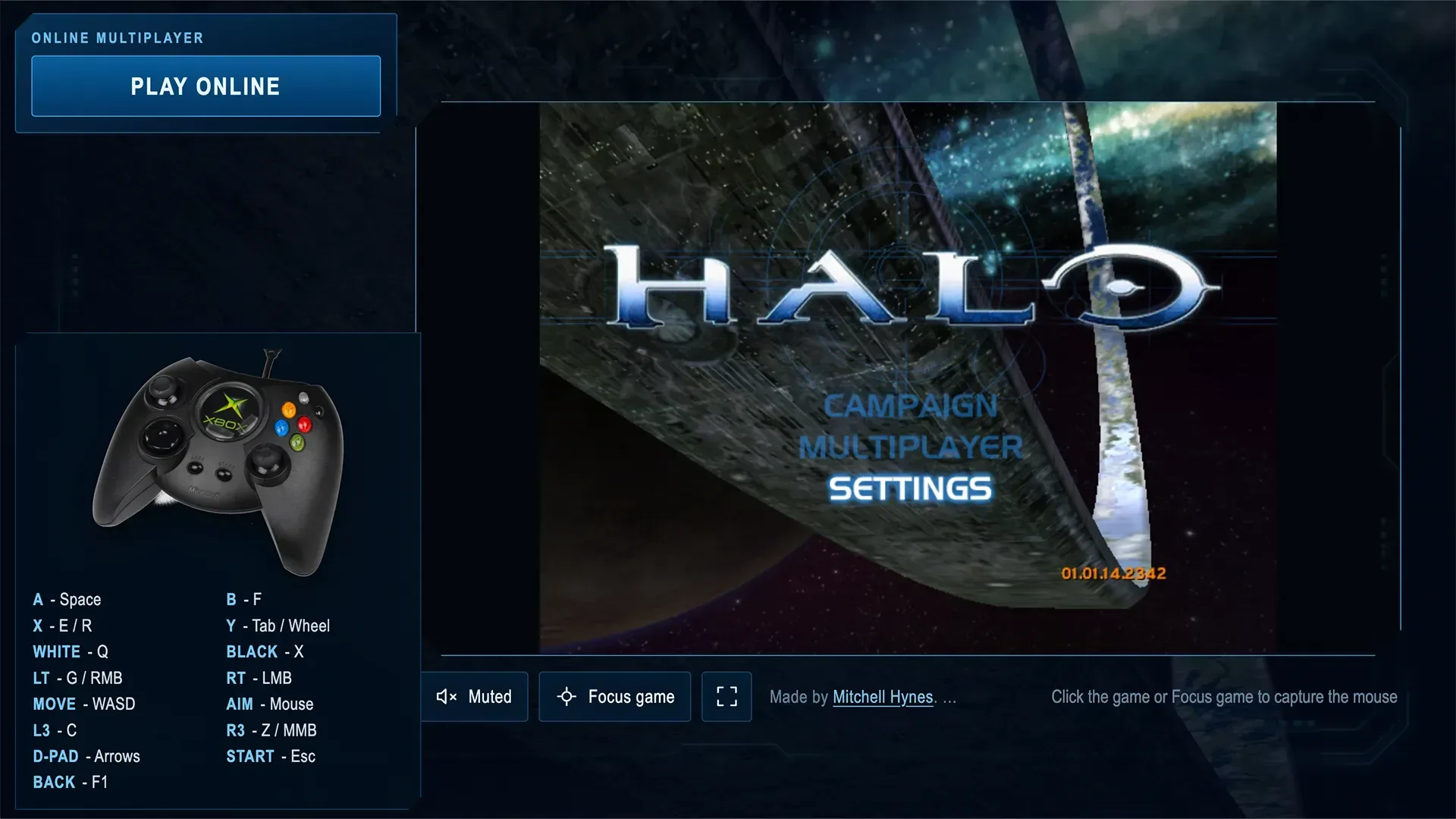
The second project takes the opposite route: instead of squeezing Halo onto a handheld, it aims to make the game run in a browser. The shared build is described as a full port with campaign mode, split-screen co-op, controller support and online play for as many as 128 people in one match.
That player count is the most eye-catching claim, and it deserves the strongest caution. A maximum supported player number is not the same as proof of consistently stable 128-player games across different connections, browsers and devices. Networked shooters depend on much more than getting a map to appear on-screen. They need to keep player movement, shots, damage and match state in sync closely enough that participants are seeing a coherent fight rather than 128 people independently negotiating with reality.
Browser play also creates a different kind of accessibility. In the best-case scenario, a game that runs through a browser can lower the barrier to trying it because there is no conventional platform-specific installation path. But it also means the experience may vary with browser support, controller setup, hardware, connection quality and the state of the project itself. Reports have even suggested it can run in Teslas and other electric vehicles, an amusing indication of how widely browsers appear, not a substitute for verified compatibility guidance.
The browser build is said to have numerous bugs. Claims circulating around it have also suggested AI-assisted development, but that attribution and its connection to specific issues should be treated cautiously. Bug reports alone do not identify a cause. What can be said is that the project is reportedly being updated and that it should be approached as an actively changing experimental build, not as a frictionless official service.
What players should take from these experiments
The headline temptation is to declare that Halo now runs “anywhere.” The more useful interpretation is narrower and more interesting: enthusiasts are testing how far a familiar game can travel when its original assumptions are removed. The New Nintendo 3DS effort is about making deep technical compromises while retaining the feel of a major console shooter. The browser effort is about reach and unusual multiplayer scale, with the instability that can accompany a rapidly evolving project.
For anyone watching rather than immediately hunting for a download, there are a few sensible markers to follow:
- Release status: the New Nintendo 3DS port is not ready for public release.
- Hardware scope: the reported handheld work is for New Nintendo 3DS hardware, where its additional power is relevant.
- Feature status: campaign, local multiplayer, 3D, sound and second-screen mapping have been listed for the handheld project, while online multiplayer remains in development.
- Stability: both projects have been associated with bugs, so footage and feature claims should not be treated as a quality guarantee.
- Big multiplayer numbers: the browser project’s 128-player claim is ambitious, but real-world consistency is a separate question.
There is also a preservation angle worth separating from nostalgia. Porting work can demonstrate knowledge, keep interest in old software alive and reveal just how adaptable a game’s design can be. It does not automatically settle questions around distribution, rights or long-term availability. A public project can change quickly, disappear, receive updates or remain unfinished. Fans should therefore avoid assuming that a demonstration necessarily leads to a permanent, official or fully supported way to play.
Still, the contrast is hard not to enjoy. On one side is a New Nintendo 3DS struggling heroically through downgraded models, 3D output and second-screen map duties. On the other is a browser build attempting campaign, couch co-op and huge online matches. Halo: Combat Evolved may have originated at the sharp end of console gaming, but these projects show that its technical afterlife is still willing to take a detour through stranger territory.