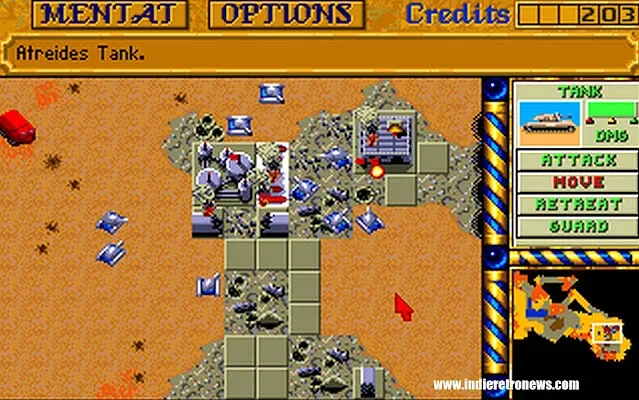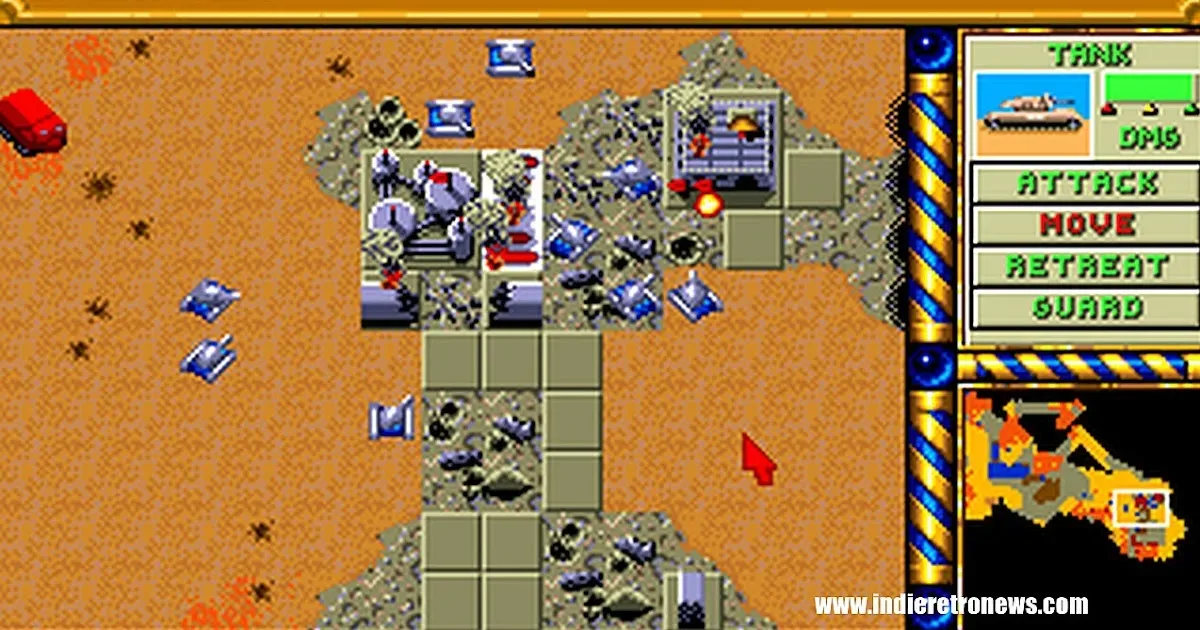
Dune II, Westwood Studios’ 1992 strategy landmark, is the focus of an early enhancement project for its Amiga version. The stated aim is unusually specific: improve the original executable itself rather than remake the game in a new engine or create a wholesale replacement.
That distinction matters. The project is intended to retain Dune II’s native visual character and underlying gameplay while reducing some of the interface friction that came with early real-time strategy design. Its central breakthrough so far is multi-unit selection: players can select troops as a group and issue shared movement or attack orders instead of repeatedly directing units one at a time.
It is still a work in progress, and there is no download available yet. But the proposed feature set reaches well beyond a simple selection-box patch. It includes control groups, attack-move, production queues, factory rally points, improved unit information and AI behavior, optional higher unit limits, plus other quality-of-life changes designed not to radically alter the original game.
Why multi-selection is such a big deal
For players used to later RTS games, drag-selecting a group of units is almost invisible muscle memory. Click, pull a rectangle around a squad, then send it somewhere. Dune II predates the widespread normalization of that interaction. Its original control approach can therefore make even basic battlefield maneuvers feel laborious by modern standards.
The enhancement adds several complementary selection tools:
- Shift-clicking to add units to an existing selection.
- Dragging a selection rectangle around units.
- Selecting more than one unit at once.
- Multiple selection frames.
- Clearing the selection by clicking empty terrain.
- Double-clicking to select similar units.
Those functions change the input layer—the practical means through which the player gives commands—rather than necessarily changing the rules of combat, resource gathering or faction balance. A group command can make a familiar army easier to manage, but it does not automatically mean the units become stronger or the original mission structure disappears.
Group MOVE and ATTACK orders are already part of the listed build, as are better group movement and simple formations. Together, those additions could make a force feel more like a force and less like a long appointment calendar for individual tanks. That is an important quality-of-life improvement in a genre built around making quick decisions while managing a growing base.
The roadmap reads like RTS history catching up
Several features identified for the project became conventional RTS tools after Dune II’s 1992 release. The enhancement’s appeal is not that it claims to reinvent the format; it is that it wants to fold those familiar conventions back into an influential older game while preserving its recognizable form.
Related coverage includes Dune II Amiga Enhancement Project Targets Modern RTS Controls Without Rebuilding the Classic.
Control groups
Ctrl+1 through Ctrl+9 control groups are included in the feature list. A control group lets the player save a chosen collection of units to a number key, then recall that group quickly later. In practical terms, it means a player can designate a combat force, move attention back to base construction, and return to that force without individually reselecting every member.
That convenience matters most when a battle occurs away from the base. It reduces the time between deciding that a group needs orders and actually issuing them. It also makes composition easier to preserve: a player can keep a particular group together rather than hunting across the map for units that were already working as a team.
Attack-move and formation support
The listed attack-move command is another familiar RTS shorthand. In general terms, it combines moving toward a destination with engaging enemies encountered along the way, rather than requiring a player to issue separate movement and attack actions continually. Its exact behavior in this project remains to be seen, but the intended role is clear: reduce repetitive clicking during an advance.
Better group movement and simple formations point in a similar direction. When many units receive the same destination, their pathing and relative positions can determine whether an army arrives coherently or becomes an accidental parade of traffic problems. The project’s language is appropriately modest here—simple formations, not a claim of an entirely redesigned combat system—but even modest coordination can improve readability and command responsiveness.
Production queues and rally points
The roadmap also names production queues and factory rally points. A production queue lets a player line up multiple units for construction at a factory. A rally point tells newly created units where to go after they emerge. Both functions reduce routine base-management chores.
That has a tactical payoff. Instead of repeatedly returning to a factory to order the next unit and then manually dispatching every fresh vehicle, the player can establish a plan and spend more attention on scouting, defense and attacks. The point is not to erase base management; it is to make repetitive actions less dominant than strategic choices.
Preservation, not a new-engine remake
The project’s defining technical and design choice is its plan to work directly with the original Amiga executable. An executable is the program file that runs the game. Enhancing it suggests an effort to insert or alter behavior within the existing software rather than rebuilding Dune II from the ground up in a contemporary framework.
That approach carries an obvious preservation-minded appeal. The stated intention is to leave the original visuals and core play intact, with modernized controls layered into the experience. It also establishes a useful boundary for expectations: this is not being positioned as a new Dune II with rewritten art, a replacement engine or a broad reinterpretation of what made the 1992 game what it was.
There is a wider retro-gaming value in that philosophy. Original-hardware-focused projects can make older software more approachable without asking players to trade away every quirk that gives it historical identity. The balance is delicate, though. Once upgrades such as AI improvements and higher unit limits enter the conversation, their implementation will matter. Convenience can preserve an old game’s character; sweeping behavioral changes can also alter its challenge and rhythm.
For now, the project explicitly frames its changes as quality-of-life work that should not change the original too much. That is a goal rather than a finished promise, and the early status means the final balance of preservation and enhancement cannot yet be judged.
Potential playable Fremen and Sardaukar
One of the more intriguing possibilities is the exploration of Fremen and Sardaukar as fully playable factions. The project is examining code structures said to have been left inside the original game for those groups.
This is notably more consequential than selection tools or factory orders. A playable faction affects the game’s strategic vocabulary: what a player can build, how a match develops and which tactical options are available. At this stage, however, it remains exploratory rather than a confirmed finished feature. Players should treat the concept as an avenue under investigation, not as an announced mode ready to use.
The same caution applies to the broader list of proposed upgrades. The material describes an early project with a substantial ambition, and feature lists in works-in-progress can evolve as technical constraints become clearer. The confirmed milestone is the implementation of multi-selection functionality; the rest should be read in the context of active development rather than a release checklist.
What the feature list currently covers
Alongside multi-unit selection, the current development feature list identifies the following areas:
- Group MOVE and group ATTACK commands.
- Ctrl+1–9 control groups.
- Double-click selection of similar units.
- Attack-move orders.
- Improved group movement and basic formations.
- Factory rally points and production queues.
- Improved unit information.
- Improved AI behavior.
- Optional higher unit limits.
- Additional quality-of-life improvements intended to avoid substantially changing the original game.
The combination makes sense as a coherent interface pass. Selection, groups and attack-move address battlefield command; queues and rally points address production flow; unit information and AI concern clarity and opposition behavior. Optional unit limits are a separate, potentially more transformative lever, which is likely why their optional status is important.
For a useful comparison of another project designed around extending the life of original hardware rather than simply leaving it behind, see xeRAbora’s RetroAchievements work on original PS2 hardware. The platforms and goals differ, but both reflect continued interest in making old systems do something newly useful without abandoning the machine at the center of the project.
What players should expect for now
The sensible headline is promising, not imminent. Dune II’s Amiga version could gain the sort of tools that later became foundational to RTS play, while maintaining the original game’s appearance and principal structure. Multi-selection alone addresses one of the clearest barriers for players coming to the game after decades of genre evolution.
But there is no public download at present, no stated release timing, and no basis to assume every discussed addition will arrive in exactly the form outlined. The Fremen and Sardaukar concept, in particular, remains a possibility being explored. For now, the strongest evidence is an enhancement effort whose implemented selection work makes its larger preservation-with-convenience goal feel technically credible.
That is a compelling lane for Dune II: not pretending 1992 never happened, just giving 1992 a few buttons it very much deserved.