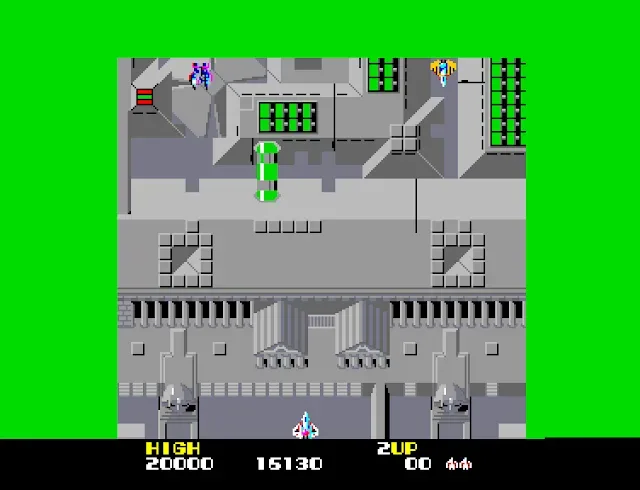
Scion Ex, an unofficial Commodore Amiga port of Seibu Denshi’s 1984 arcade shoot ’em up, is now available from developer Peppe74. The project was created with help from AI tools and targets a notably modest slice of Amiga hardware: a stock Amiga 500 with 512K of RAM, or an Amiga 1000 using the A1050 front-panel expansion.
That specification is a central part of the release’s appeal. Rather than positioning the game as something that demands a heavily expanded system, Scion Ex is built around the limits of base OCS-era machines. Its display design also shows the practical compromises involved in bringing an arcade shooter to that hardware without sacrificing the smooth movement that the game depends on.
A rare shooter gets another home conversion
Seibu Denshi’s Scion began as a 1984 coin-op shooter. Before this Amiga version, its home release history was extremely narrow: it received a Japanese MSX release in 1985. The Amiga port therefore opens the game to a platform that did not receive an official version at the time.
The premise is rooted in the direct, score-driven language of early arcade action. Players fly a fighter craft through a vertically scrolling battlefield, shooting waves of alien vessels while navigating the action in the air. But simply surviving the enemy formations is not enough to complete a stage.
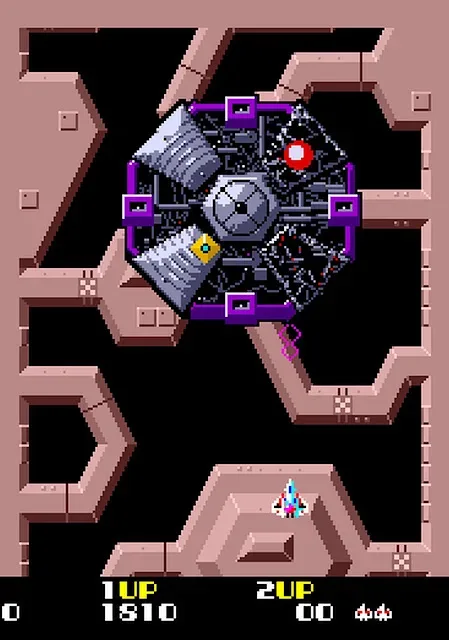
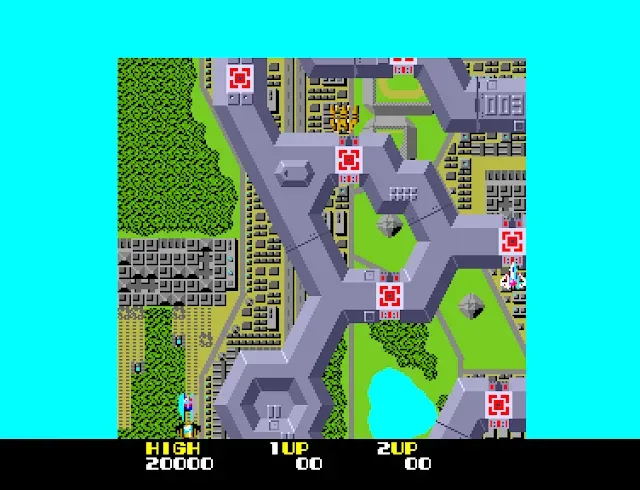
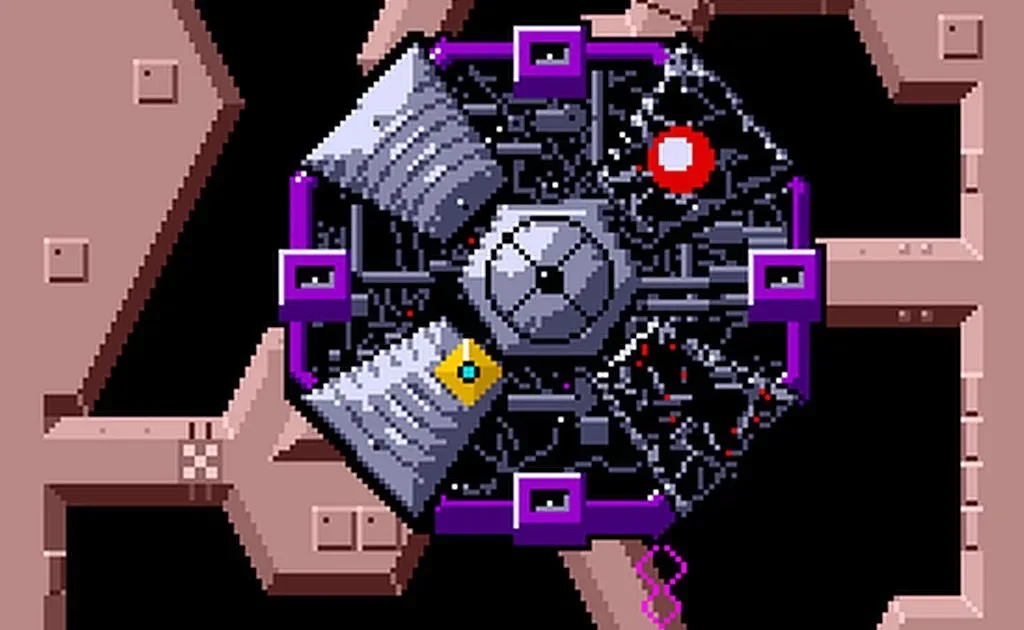
Each area also presents a large latticed structure on the ground. The objective is to destroy it by hitting its square targets with bombs. The necessary bombing weapon is not available by default: players need to shoot down a particular airborne craft to unlock the extra armament. Once the weapon is obtained, the task shifts from conventional dogfighting to precise destruction of the structure below. Collapsing the entire complex clears the route to the following stage and its end-boss base.
That two-part loop gives Scion Ex a more specific objective than a shooter focused solely on clearing enemies. Airborne opponents remain an immediate threat, while the ground target establishes a longer-term priority. Missing the special vessel means missing access to the weapon required to finish the structure, making target recognition and timing part of the stage strategy.
The HUD trade-off is a performance decision
Peppe74 initially considered a traditional side panel for score and life information. A sidebar can make a screen feel more arcade-like and complete, but it created a costly technical problem here. Redrawing the panel every frame alongside smooth dual-playfield scrolling caused too large a performance drop.
The final version instead places the heads-up display at the bottom of the screen. As a result, the playfield does not use the full display area, but the change is intended to preserve smoother scrolling on the target hardware.
Related coverage includes Scion Ex Brings Seibu Denshi’s 1984 Shooter to Stock Amiga Hardware.
Dual playfield is an Amiga display approach that allows two independently managed graphical layers to be presented together. In a scrolling shooter, that can be valuable for separating elements of the scene or creating richer movement across the screen. It also increases the work involved in keeping the picture updated. The challenge is not merely placing score and life counters on screen; it is updating those counters continuously without interfering with the game’s animation and scrolling budget.
In this context, the bottom status bar is more than a cosmetic revision. It is an engineering compromise: less visible play area in exchange for a more consistent sense of motion. For a vertically scrolling shooter, where players must read approaching enemies and steer through a fast-moving field, stable movement is likely to matter more than reproducing a preferred scoreboard layout.
Why the target machines matter
The Amiga 500 and Amiga 1000 are closely associated with the platform’s original generation, and Scion Ex is designed to run without asking owners to move into a substantially upgraded configuration. The stated 512K requirement is especially important because it keeps the release focused on a baseline setup rather than a machine expanded with significantly more memory.
For Amiga players, hardware requirements can determine whether a new homebrew or unofficial conversion is an easy game to try or a project that requires additional components. Scion Ex’s target makes it relevant to people maintaining older systems in a comparatively original form, including Amiga 1000 users with the A1050 front-panel expansion.
The game’s presentation decision should be read through that lens. A full-height playfield and a side HUD may sound ideal in isolation, but the port prioritizes a result that can maintain its scrolling on the hardware it promises to support. The reduced gameplay window is thus an explicit consequence of compatibility and performance goals, not an unexplained limitation.
How Scion Ex’s stage objective changes the shooting
Scion Ex asks players to manage three related pressures: hostile spacecraft, the special carrier that unlocks bombing capability, and the ground structure that must be erased to proceed. The order matters. Standard fire is used to contend with the aerial assault, but bombs are needed for the square targets embedded in the structure.
That means the special mid-air vessel represents a key opportunity rather than just another enemy. Shooting it down activates the additional weapon, enabling the stage-clear condition. From there, the player must direct bombs effectively while continuing to survive the surrounding attack.
The approach makes the game’s vertical scrolling serve two purposes. It supplies the momentum expected of an arcade shooter, and it frames the ground installation as an active objective moving through the player’s attention. The boss base at the end of the stage then provides a final encounter after the larger complex has been destroyed.
It is a structure that distinguishes the game from a shooter where progress is based only on distance traveled or enemies defeated. The player is encouraged to identify a required target, secure the correct tool, and then use it against a specific set of environmental weak points.
An Amiga release shaped by its limits
Scion Ex is not presented as an attempt to erase the realities of running an arcade-style shooter on an entry-level Amiga. Instead, the release makes those realities visible in one clear place: the relocation of its status information. The bottom HUD is the practical answer to an attempt that proved too expensive in frame time, while dual-playfield scrolling remains the feature worth protecting.
That straightforward prioritization is useful for anyone interested in new software for original hardware. It explains why the play area is framed as it is, identifies the machines the game is intended to run on, and makes clear that the port’s visual layout follows from a technical decision rather than a missing design element.
Scion Ex also joins the continuing stream of projects giving classic computer platforms software that was unavailable to them in their original commercial lifetimes. For another example of contemporary Amiga-focused development, see Woody’s World and its ambitious Amiga platforming design.
For this release, the draw is specific: an unofficial version of a 1984 Seibu Denshi shooter, previously known on home systems through its Japanese MSX release, now tailored for stock-oriented Amiga configurations. Its airborne battles, bomb-dependent ground objective, and deliberately economical HUD all point to a port designed around keeping the action moving on the machines named in its requirements.