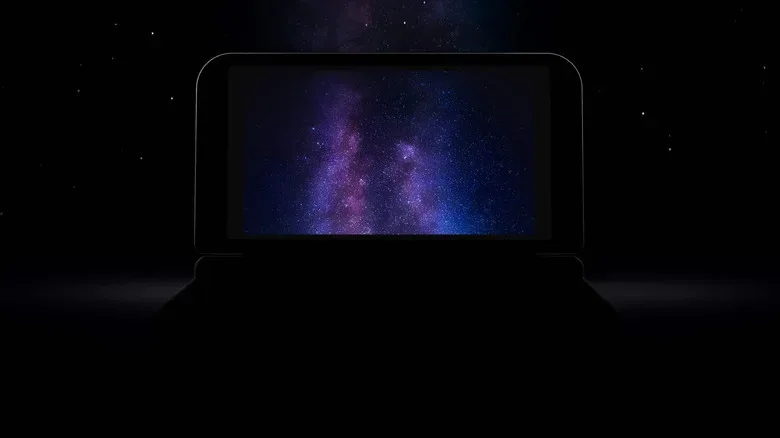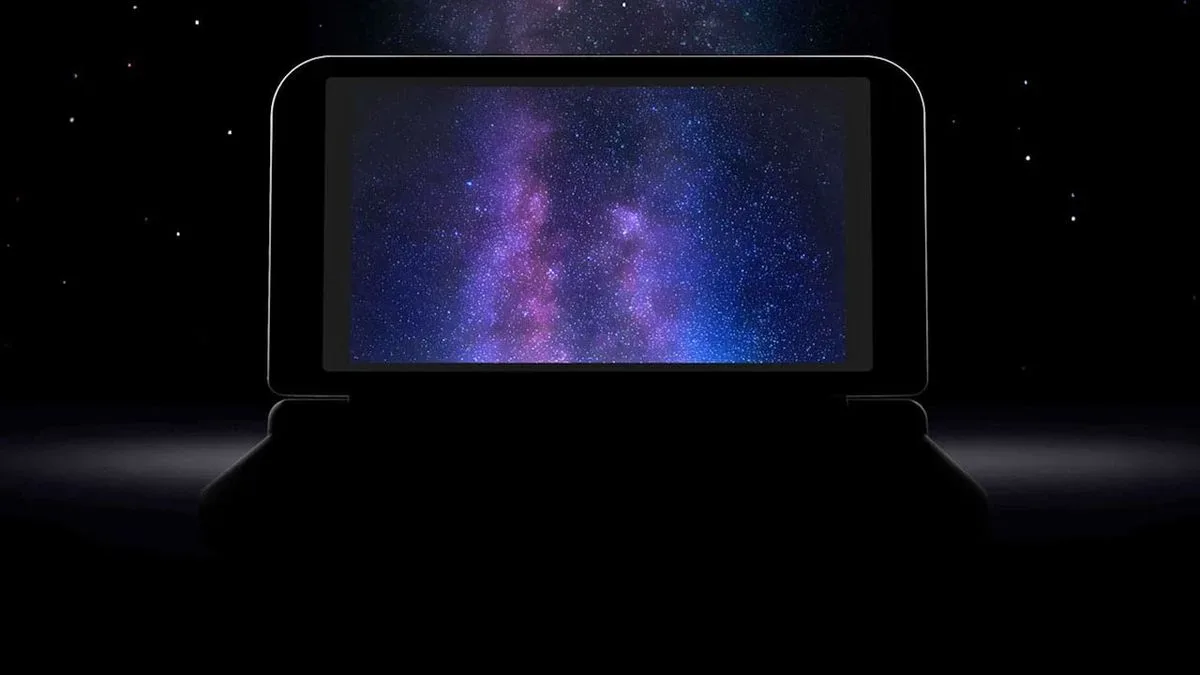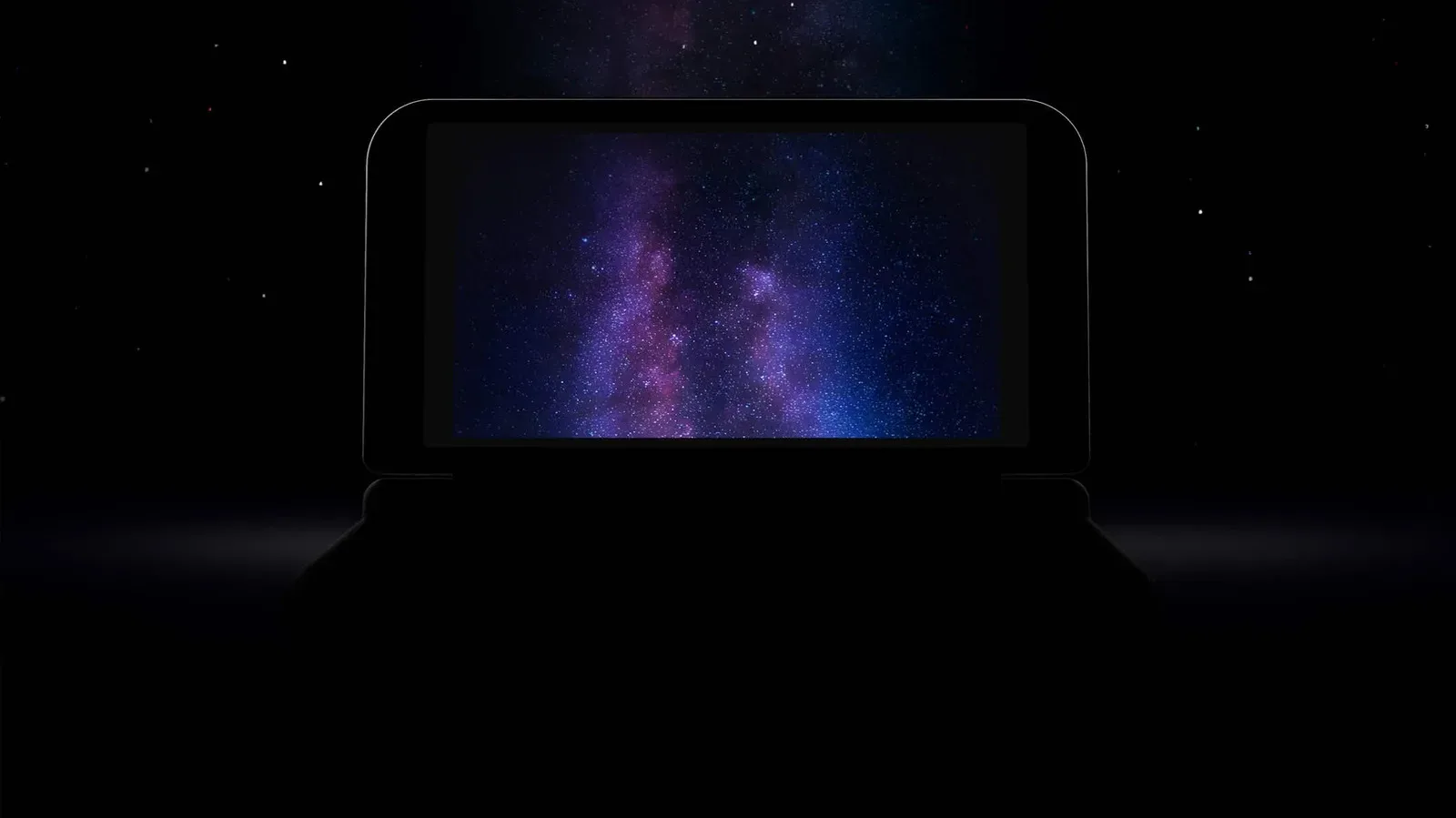
Retroid is preparing to enter the dual-screen handheld race with a device called the Pocket Duo. The company has offered only a brief, very dark teaser of the machine so far, which means the important particulars remain concealed: no confirmed processor, display resolution, battery capacity, controls layout, price, or release date has been shared.
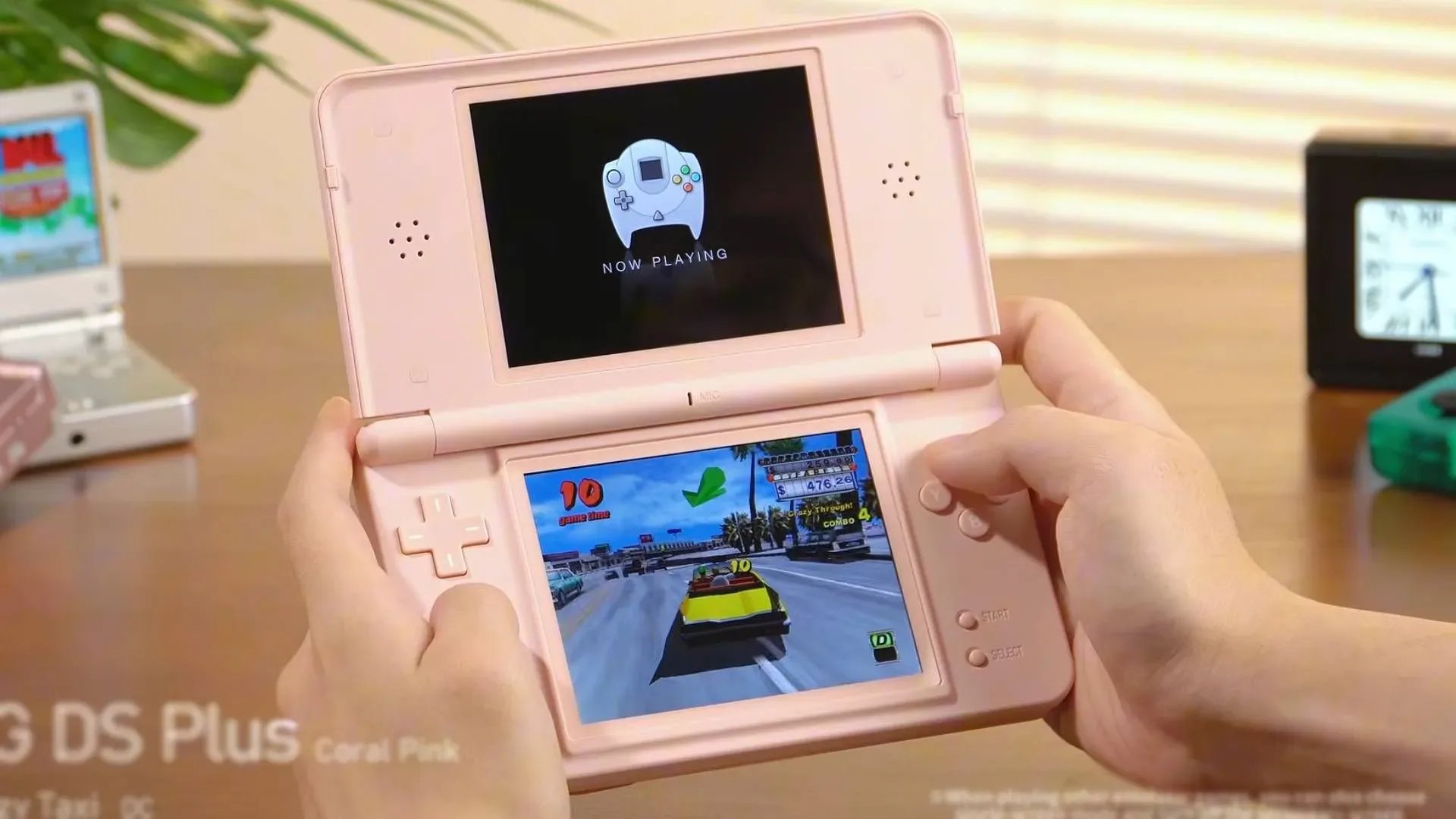
Even with that long list of unknowns, the name and the teaser’s silhouette make the intended direction clear. Pocket Duo is a purpose-built, two-screen portable aimed at the kind of gaming experience people associate most immediately with Nintendo DS software. That is increasingly its own distinct corner of retro handheld hardware—not merely another rectangular device with enough power to emulate old systems, but a product trying to make games designed around two displays feel natural again.
The Pocket Duo arrives as interest in this form factor is becoming harder to dismiss as a novelty. A dual display changes how a portable handles maps, inventories, touch-driven menus, stylus-oriented puzzles, status screens, and the simultaneous action that defined much of the DS library. One screen can display the main action while another handles information or interaction, instead of asking players to swap views, rely on an awkward screen layout, or stretch a single image across a conventional handheld display.
A teaser, not a spec sheet
The current Pocket Duo footage is better treated as confirmation that the product exists than as a full reveal. Its low-lit glimpse shows a finished-looking device, but does not settle major questions about its construction or capability. It is not yet possible to say exactly how Retroid’s new multi-display handheld will be arranged, how large either screen will be, what panel technology it will use, whether touch input is present, or how the hinge and controls will feel.
That restraint matters because the dual-screen category has several competing design priorities. A compact clamshell can be more pocketable and closer to the physical idea behind the Nintendo DS, but a device also needs a sturdy hinge, sensible screen proportions, accessible controls, good ergonomics, and enough thermal and battery headroom. Two displays invite more possibilities, yet they also impose more design decisions than a one-screen handheld.
For now, the safest description is also the simplest: Retroid is working on a self-contained dual-screen portable. The teaser suggests a cable-free, clip-free design rather than a handheld paired with a separate display accessory. That distinction could be important for players who want a device that can open, play, close, and travel as one piece of hardware.
Retroid already has relevant hardware experience
The Pocket Duo is not coming from a company unfamiliar with portable gaming devices or clamshell-shaped hardware. Retroid’s recent lineup includes the Retroid Pocket 6 and the Pocket Flip 2. The latter uses a 5.5-inch OLED display, illustrating that Retroid has experience with a folding-style product as well as OLED-equipped handhelds.
It has also approached a second-screen setup from another angle. Retroid sells a Dual Screen Add-on, which attaches a 5.5-inch AMOLED display to other compatible handhelds. An add-on can broaden the role of an existing device, but it necessarily introduces attachments, positioning considerations, and a less unified setup. Pocket Duo appears to be Retroid’s move toward making the multi-screen idea integral to the handheld instead.
That approach has an obvious appeal for DS-focused play. A dedicated design could avoid the visual and practical compromises that often follow when a second display is bolted onto hardware designed around one. It also gives Retroid an opportunity to tune the relationship between its screens, controls, chassis, and software around a single use case—although none of those implementation details have been confirmed.
Performance remains the biggest open question
No chip has been announced for Pocket Duo. Retroid could select hardware at a variety of performance levels, and the final choice will shape what audiences expect from the system. The company’s recently released Pocket Nova uses Qualcomm’s QCS8550 chip, which is capable of handling simulation of Nintendo DS, Nintendo 3DS, and even Nintendo Switch titles. Pocket Duo has not been confirmed to use that processor, however, and there is no basis yet to treat Pocket Nova-level power as a promise.
The distinction is crucial. Nintendo DS emulation and a well-presented two-screen interface are likely central to the appeal of a product with this name and format. But 3DS and Switch ambitions would introduce a considerably different performance conversation, as would the display demands of presenting higher-resolution content across two panels. Until Retroid identifies the silicon and software approach, Pocket Duo’s ceiling should remain an open question rather than a specification filled in by assumption.
Still, Retroid has a useful foundation. Its work on handhelds, a clamshell model, an AMOLED add-on display, and a more powerful Pocket Nova gives the company several relevant reference points. The challenge will be combining those strands into a coherent dedicated device rather than treating a second screen as an afterthought.
Where Pocket Duo may fit on price
Price is also unannounced, but the present dual-screen market provides some broad boundaries. The Anbernic RG DS starts at $100, while the Ayaneo Pocket DS starts at $579. Retroid’s Pocket Nova starts at $239. With two displays and a more specialized physical design, Pocket Duo is expected to cost more than the Pocket Nova, though that is an expectation rather than a confirmed price strategy.
A place between the entry-level RG DS and the premium Ayaneo Pocket DS would make sense as a general competitive range, but the eventual number will depend heavily on choices that have not been revealed. Panel type, screen size, chipset, memory configuration, hinge quality, storage, battery, cooling, and bundled accessories can all alter the equation. Retroid may be targeting a value-minded middle ground, or it may choose components that push Pocket Duo upward. The teaser does not yet answer that.
What can be said is that Pocket Duo looks positioned to compete most directly with the Ayn Thor, another device associated with this developing two-screen segment. That competition gives Retroid a clear reason to show that its hardware can deliver convenience as well as raw capability. A dual-screen handheld has to earn its extra bulk and cost by making the format feel useful from the moment it is opened.
Why a dedicated DS-style format still matters
There is a practical reason this niche is gaining attention. Emulating many older consoles on a single-screen handheld can be fairly straightforward because the original games were built for one display. DS games are different: their design frequently assumes that players can see two spaces at once. Some titles place core play on the upper screen and inputs or supporting information on the lower one; others use the split to make their worlds feel bigger or to shift players between complementary tasks.
A standard handheld can run into presentation compromises here, such as tiny side-by-side screens, stacked views that waste display space, or rapid toggling between screens. A genuine dual-screen portable may not erase every challenge—especially where touch controls are concerned—but it can restore the basic visual logic that the software expected.
That is why Pocket Duo is more than another retro device with a new silhouette. It is part of an effort to accommodate games on their own terms. For players revisiting Nintendo’s portable catalog, that could be as meaningful as extra processing power. The same interest in preserving how games are experienced helps explain the enduring appeal of older Nintendo hardware and software, including discussions around how a new player’s perspective can reshape the feel of The Wind Waker HD.
What to watch for next
Retroid’s next Pocket Duo update will need to answer a few basic questions before buyers can judge it against the expanding field. Screen sizes and panel types are near the top of the list, followed by processor, touchscreen support, battery capacity, physical controls, operating system details, dimensions, and price. A clear view of the hinge and the handheld in use would also say far more than the shadowy first teaser.
Until then, Pocket Duo is an intriguing name attached to an intentionally limited preview. Retroid has signaled that it wants a place in the dedicated dual-screen handheld conversation. Whether it becomes a compelling alternative to Ayn Thor and other options will come down to the details it has not shown yet.