Some game rediscoveries arrive with a glossy remaster, a crowdfunding campaign, and a trailer full of dramatic bass drops. Oracle (La Légende de / The Legend of) is taking the far more delightfully archaeological route: an unfinished Commodore Amiga role-playing game from 1996 has surfaced as a preserved, ready-to-run ADF disk image.
This is not a newly completed edition, nor should players approach it expecting a lost masterpiece that somehow spent three decades polishing its inventory screens in a secret vault. It is a preserved snapshot of a project that stopped during development. Specifically, the build is version 0.3d, dated December 13, 1996. That status is exactly what makes it compelling. Oracle offers a direct look at an ambitious work-in-progress from the mid-1990s Amiga scene, including systems that were already functioning and the technical choices behind them.
Originally planned as a shareware release, Oracle was being made with AMOS Professional, a development environment closely associated with Amiga hobbyist programming. Development began in 1996 but did not reach a commercial finish. With this newly preserved disk image, fans can now load the game on compatible Amiga hardware or through emulation without first having to untangle the original programming setup. In retro-computing terms, that is a meaningful difference between a historical footnote and something people can actually explore.
A Dungeon Crawler Built in the Shadow of Dungeon Master
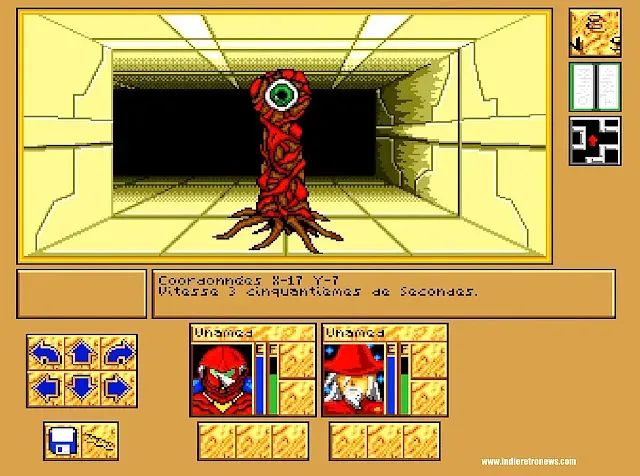
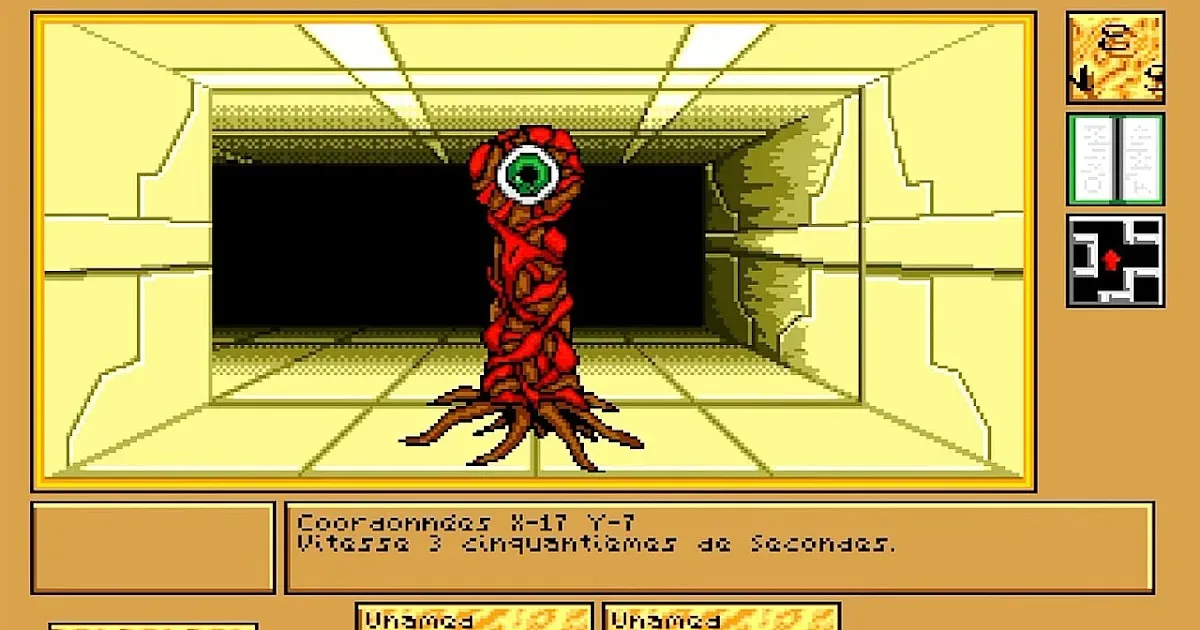
Oracle belongs to the first-person, grid-based dungeon-crawler tradition strongly associated with Dungeon Master. That means claustrophobic corridors, a viewpoint that puts the player directly into the maze, and the gradual process of building an understanding of a dangerous space one section at a time. It is a genre designed to make every door feel vaguely suspicious, which remains one of gaming’s most efficient ways to turn a rectangle made of pixels into a personal enemy.
The available build contains several working features that show the intended direction of the project:
- A mouse-driven interface.
- An automap that updates as the player explores.
- Early non-player-character movement and combat behavior.
- Rendered walls, floors, and ceilings for the dungeon corridors.
- Animated doors driven through AMAL scripting.
- Sound and music supported by AMCAF.
Individually, these elements may sound expected for a game pursuing the Dungeon Master formula. Taken together in an unfinished AMOS Professional project, however, they make Oracle valuable as a period artifact. The game is more than a static collection of screens or an isolated prototype level. It has an active interface, navigable spaces, mapping, enemy-related mechanics, visual effects, and audio infrastructure. Players are able to see an RPG framework in motion, even if it never reached the level of content, balance, and polish required for a full shareware launch.
Why an Unfinished Build Is Worth Preserving
Games that did not make it to store shelves, mail-order catalogs, or the shareware racks of the era are often reduced to rumors, old screenshots, or a developer’s memory. Preserving Oracle in runnable form makes the game more useful than a description ever could be. It lets enthusiasts examine how it controls, how the map behaves, how its dungeon presentation is assembled, and where the work appears to have been heading at the moment development stopped.
That does not transform the version 0.3d build into a finished release. Its unfinished nature should be treated as part of the package, rather than a defect newly discovered by someone who expected 1996 to deliver a surprise patch note. Missing content, incomplete systems, rough edges, or compatibility limitations are all plausible parts of an abandoned project at this stage. The appeal lies in encountering the work honestly: not as a revision that quietly smooths over history, but as the surviving version that exists.
For retro-game preservation, this sort of recovery also broadens the understanding of what the Amiga was still hosting in the mid-1990s. The platform was home to commercial software, demos, shareware, bedroom coding experiments, and projects that landed somewhere between all of those categories. Oracle was intended for shareware distribution, and its survival helps document that less formal development pipeline. There were plenty of ideas that could become functional games without necessarily crossing the finish line or gaining broad distribution.
The Technical Pieces: AMOS, AMAL, AMCAF, and AGA
Oracle’s construction is as interesting as its fantasy premise. AMOS Professional was used for development, while AMAL scripting handles animated doors. AMAL was designed to support animation and movement routines, making it a natural fit for an effect such as a dungeon door opening in front of the player rather than simply swapping between two entirely still states.
The game also uses AMCAF for sound and music, while its corridor visuals render the walls, floors, and ceilings that define its first-person dungeon spaces. These details matter because dungeon crawlers depend heavily on presentation to establish place. A player needs to read the corridor layout, recognize doors and passages, and retain enough visual orientation to make the automap useful rather than merely a tiny monument to previous bad decisions.
Oracle also makes use of the Amiga’s AGA chipset. That places it firmly on the more capable end of the Amiga ecosystem for the period. It is not positioned as a casual “drop this into any machine and watch the wizardry happen” experience. The preserved build is a specialized release for users with appropriate configurations, whether that means real expanded hardware or a carefully configured emulator.
What Hardware and Emulator Users Need
The reported smooth-running setup uses either Workbench 3.0 or Workbench 1.3 with an Amiga 1200 profile, a Motorola 68020 processor, 2 MB of Chip RAM, and 8 MB of Fast RAM. WinUAE is one emulator option for running the ADF image, and the availability of a ready-to-run disk image removes the need to launch the project through its original development environment.
Those requirements are not just trivia for a setup screen. They are central to setting expectations. A stock Amiga 500 with 1 MB of memory may encounter compatibility problems, and fans should not assume that any base-model Amiga configuration will load Oracle cleanly. The game pushes the AGA chipset, so an expanded, later-generation configuration is the safer target.
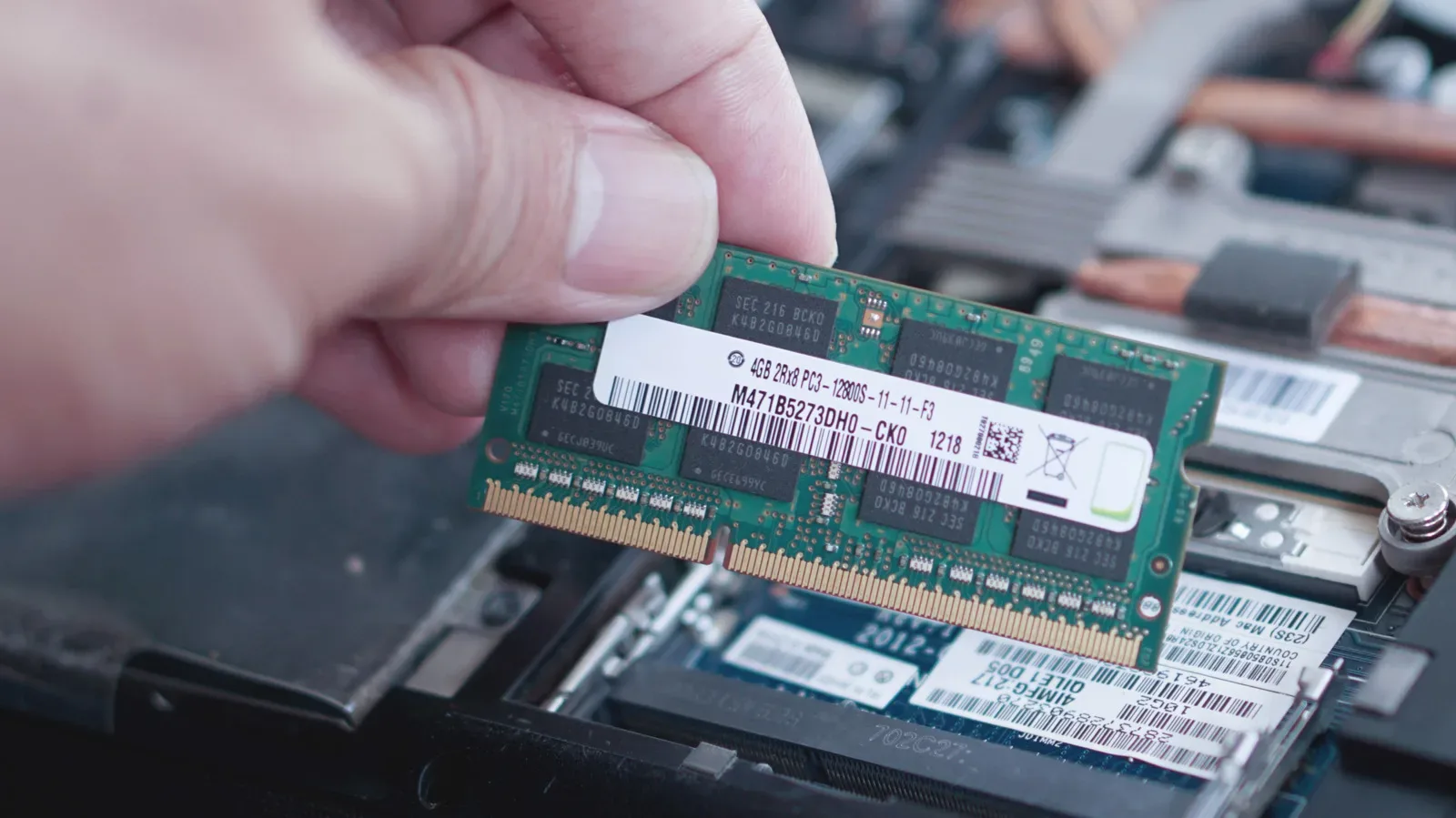
For people coming from modern PC emulation, it is worth remembering that allocating virtual resources is not a magic “more numbers equals better” button. The correct profile, chipset, processor, RAM configuration, and operating environment can all matter. Anyone accustomed to tracking down memory oddities in newer machines may recognize the general troubleshooting mindset from guides such as this look at diagnosing RAM problems when a PC gets unstable, even though Amiga emulation requires its own platform-specific settings and software knowledge.
A sensible approach is to start from the known configuration: Workbench 3.0 or 1.3, an Amiga 1200-style setup, a 68020 CPU, 2 MB Chip RAM, and 8 MB Fast RAM. Once Oracle is running as intended, experimenters can decide whether they want to explore other profiles. Starting with a stock 1 MB Amiga 500 and hoping the dungeon will politely lower its technical ambitions is less likely to be productive.
A Time Capsule, Not a Replacement for the Classics
Oracle should be viewed as an unfinished historical game, not as a newly unearthed rival to the genre’s best-known finished releases. Its significance comes from the chance to inspect an abandoned Amiga RPG with real operating systems under the hood. The mouse control, evolving automap, NPC behavior, animated-door scripting, environmental rendering, and audio support together demonstrate that the project had moved well beyond an idea on paper.
It also carries the particular charm of 1990s computer development: ambitious design goals, tightly constrained hardware, specialized tools, and a project that might have reached a shareware audience if circumstances had broken differently. Instead, version 0.3d dated December 13, 1996 became its final historical state. Now that state can be loaded, studied, and played by people interested in the Amiga’s long tail of unrealized games.
For dungeon-crawler fans, Amiga historians, and preservation-minded tinkerers, Oracle is a small but welcome discovery. It is proof that even when a project never gets its official ending, the surviving build can still tell a story—one corridor, one animated door, and one steadily filling automap square at a time.