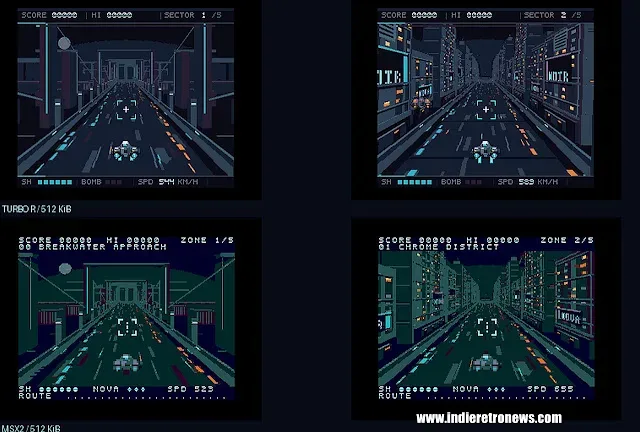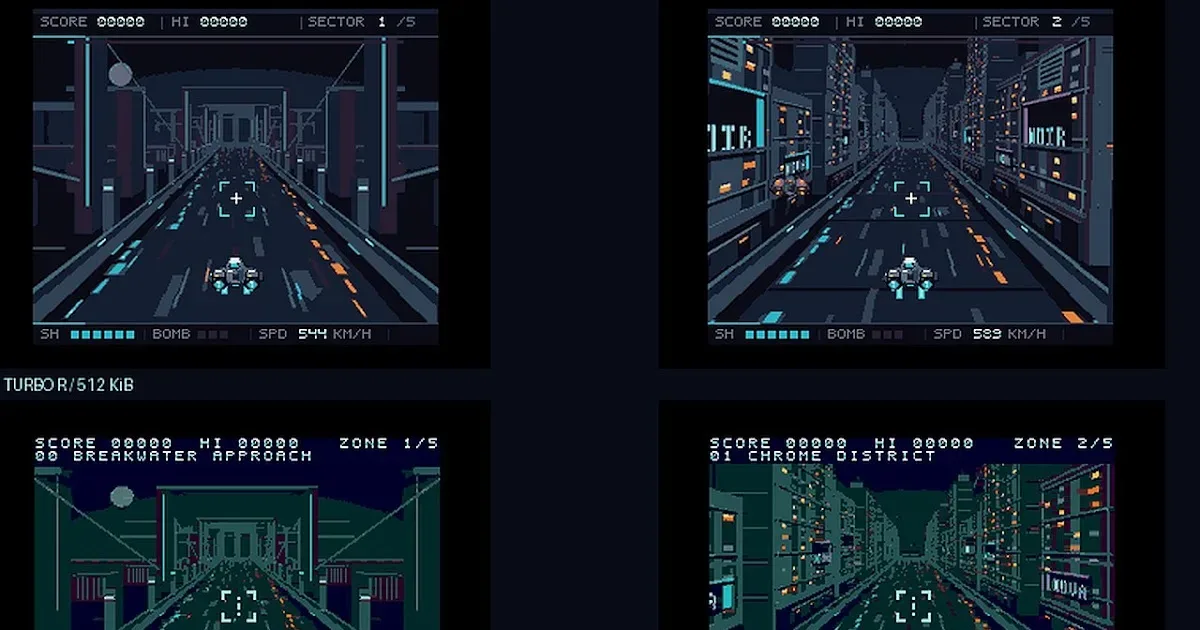
NEON REVENANT is an in-development, native pseudo-3D rail shooter for the MSX family, and its most notable feature is not simply that it is aimed at old hardware. Kanon-AI is preparing distinct versions intended for dramatically different points in the MSX range, from V9990-equipped and Turbo R systems through MSX2 machines and all the way down to MSX1.
The project is currently an “AS IS” prototype, rather than a finished commercial release. That distinction matters: the present build is presented as a proof of concept, and while earlier iterations received testing on real hardware, this latest version has primarily been verified through emulation. Still, the technical scope described for the prototype is unusually ambitious. It is built around four separate 512 KiB ROM editions, each tailored to a particular hardware profile instead of treating MSX as one uniform target.
For fans following contemporary software on legacy systems, NEON REVENANT is a useful reminder that a platform name can conceal meaningful differences in capability. Its design is not built on the assumption that every player has the same graphics hardware, memory headroom, or audio expansion. The game instead changes its campaign structure and technical approach to fit the machine it is running on.
Four ROM editions, not one blanket MSX version
Kanon-AI’s previous four MSX projects made with ASTRA informed NEON REVENANT’s development. Here, that experience is being applied to a pseudo-3D rail-shooter framework designed around strict platform constraints.
A rail shooter is a game where the player’s movement follows a predetermined path, leaving the player to focus principally on aiming, firing, survival, and responding to incoming hazards. In a pseudo-3D game, the impression of depth is created through visual techniques rather than a fully 3D-rendered world. The supplied information does not detail the exact rendering method used by NEON REVENANT, so it would be premature to assign it a particular graphical technique. What is clear is that the project is trying to deliver a sense of forward-moving shooting action within the limits of several generations of MSX hardware.
The four ROM builds each occupy 512 KiB, but the shared ROM size should not be mistaken for shared system requirements or identical content. The editions are aimed at:
- advanced V9990-equipped systems;
- MSX Turbo R hardware;
- standard MSX2 systems; and
- MSX1 systems.
This is a practical approach to a fragmented retro ecosystem. Rather than demand the most capable setup from everyone, the developer is working across the range. It also means the lower-end edition is not merely an afterthought. The MSX1 version has a five-zone campaign, while the more advanced versions are described as having a three-zone campaign.
The MSX1 build has its own headline encounter
The MSX1 edition is especially striking because it culminates in a large, multi-stage PCG battleship boss. PCG, or programmable character graphics, refers to a technique that uses redefinable character patterns as visual building blocks. In a hardware-constrained game, that can be an important route to creating more elaborate-looking animated objects while working within the system’s display model.
Related coverage includes Neon Revenant Brings Pseudo-3D Rail Shooting to MSX Hardware.
The prototype’s battleship is said to include articulating hull sections, cannon barrels that recoil when firing, and a pulsing core that can be damaged only after its destructible armour has been dealt with. Those details describe a boss built around phases and target priority rather than a single static sprite or one-hit objective. The player’s likely task, based on the described structure, is to break through protective sections before attacking the exposed weak point.
That is meaningful for more than spectacle. A multi-stage enemy can provide a changing objective within the fixed forward path of a rail shooter. The armour establishes an initial barrier, the guns create immediate pressure, and the core supplies the decisive target. The effect depends on implementation, of course, and this is still a prototype, but the concept shows that the MSX1 build is being given a bespoke climax rather than simply receiving a reduced copy of the other editions.
Performance targets are tied to the hardware
NEON REVENANT is being shaped by what its creator describes as careful optimization and framework constraints. Those terms can sound abstract, but they are central to software intended for several old hardware tiers. Optimization means arranging code, graphics, audio, and memory use so the game can maintain responsive action. Framework constraints are the fixed rules imposed by the hardware and development approach: available memory, graphics capabilities, sound facilities, and the amount of work the game can complete during each screen refresh.
The MSX2 and MSX1 editions use standard PSG audio and do not require FM expansions. PSG stands for programmable sound generator, a category of sound hardware used for basic synthesized audio. The important practical point is simple: these versions do not ask players to add an FM sound expansion to hear the game’s audio.
The MSX1 version is also designed around RAM allocations as low as 32 KiB. RAM is the working memory a game uses while it runs; it is separate from the ROM that stores the program itself. Fitting a moving shooter into such a limited working-memory budget requires developers to be selective about what is held in memory at any moment and how resources are reused. The provided material does not specify the project’s individual memory-management techniques, but the 32 KiB target illustrates why platform-specific versions are central to the game rather than a marketing footnote.
Emulation checks in openMSX put the V9990 version at around 30 updates per second. An update is a cycle in which the game advances its internal state: player input is processed, enemies or projectiles change position, and the display is prepared for the next refresh. A rate around 30 updates per second is therefore a useful technical indicator, though it should not be treated as a full substitute for testing the current prototype on every real configuration.
For the MSX1 build, all 400 validation checks have passed under both NTSC and PAL regional configurations. NTSC and PAL refer to video standards associated with differing refresh rates. That testing result is encouraging for the prototype’s compatibility work, but it sits alongside the developer’s clear warning that the current release remains principally emulation-verified.
PAL players should expect a slower pace
One practical compatibility note applies specifically to players using PAL configurations. NEON REVENANT operates in a frame-bound manner, meaning its game speed is linked to the rate at which frames are processed rather than being independently timed to real-world seconds. As a result, PAL gameplay and music will run slightly slower than on NTSC.
This is not necessarily an error in the prototype; it is a consequence of the timing model described for the game. For players, it means that regional setup affects feel. Enemy motion, the cadence of action, and music tempo can all be perceived differently when the game is tied to frame rate. Anyone comparing footage or emulation settings should keep that in mind before assuming two versions behave identically.
That level of regional consideration is part of what makes a multi-target MSX project more involved than simply getting a program to boot. NEON REVENANT is accounting for chipset differences, memory limits, audio requirements, and television-standard timing. It is not a finished result yet, but it is a substantive technical exercise with a game attached to it—not just a static technology demonstration.
What the prototype status means for players
The safest way to approach NEON REVENANT right now is as an evolving proof of concept. The latest build is available in prototype form, but “AS IS” signals that players should not read its current state as a promise of final behavior, final balance, or final compatibility on physical MSX systems. Earlier versions having been tested on real hardware is valuable context, yet it does not turn the present build’s emulation-focused verification into universal hardware confirmation.
For MSX enthusiasts, the project is nevertheless worth watching for its explicit cross-tier goals. It attempts pseudo-3D rail shooting on hardware ranging from advanced setups to an MSX1 configuration with as little as 32 KiB of RAM, uses no mandatory FM expansion on MSX2 and MSX1, and gives the entry-level version a five-zone structure capped by an elaborate battleship encounter.
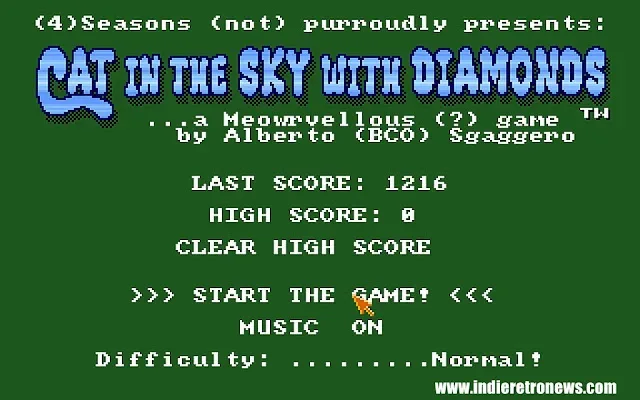
It also fits into a wider current of developers making new games for machines with sharply defined technical ceilings. For another recent example of a newly made retro-system arcade project, see Cat in the Sky with Diamonds on Amiga 500. NEON REVENANT’s particular interest lies in how openly it treats compromise and variation as part of the design: different MSX hardware is not being flattened into one target, and the MSX1 edition is being positioned as its own meaningful version.