Krakout Amiga AGA Enhanced Edition is now available as a native Amiga release from developer thall72, giving the long-running brick-breaker a purpose-built version for the Amiga 1200 and other AGA-equipped Amiga systems. The project aims for a careful split between preservation and presentation: its gameplay logic remains faithful to the Commodore 64 original, while its graphics, music, sound effects and interface have been rebuilt around the A1200’s AGA hardware.
That distinction matters for a game whose identity rests on speed, angles and pressure. Krakout is not simply a game about clearing bricks. Its notable twist is that the player’s bat can be positioned on the left or right side of the playfield rather than only along the bottom. That changes the geometry of every return and gives the game a less familiar rhythm than a conventional horizontal brick-breaker. The Enhanced Edition retains that side-mounted bat system, along with all 100 screens, bonus bricks and floating enemies that interfere with the ball’s path.
The result is a new Amiga version that is not presented as a replacement with redesigned rules, but as an AGA-focused rendering of the original game structure. For retro players, that makes the release interesting on two levels: it is a way to play Krakout on original AGA hardware, and an example of how a classic design can receive technical and audiovisual attention without changing the fundamentals that made it recognisable.
A faithful game underneath the AGA finish
Krakout originated on the Commodore 64 under Gremlin Graphics, with music by Ben Daglish. Its combination of a fast arcade pace, a side-oriented bat and a large set of brick-filled screens helped distinguish it from the many games built around the broader brick-breaking template.
thall72’s edition preserves the complete 100-screen progression. That is an important commitment, because a screen-by-screen arcade game is defined not merely by the number of stages but by the layouts and the hazards that create its difficulty curve. The bonus bricks and hostile floating enemies are still part of the equation, so success is still about reacting to the ball’s movement and controlling its returns under pressure rather than simply treating every level as static target practice.
What does “gameplay logic” mean here? In this context, it refers to the rules and behaviour beneath the artwork: how the ball moves, how brick interactions work, where the bat can be used, and the role of bonuses and enemies. Retaining that logic means the release is intended to preserve the original play structure even though what players see and hear has changed substantially.
That approach has practical value. Visual upgrades can make a retro conversion feel more contemporary on its target machine, but changes to collision behaviour, pacing or level rules can alter the original game’s feel. Keeping those underlying systems intact places the emphasis on adapting Krakout to the Amiga 1200 rather than reinventing it.
Built for the Amiga rather than running through emulation
The Enhanced Edition was written from scratch in native Amiga machine code and is intended to run at full speed on a stock 68020 processor, without emulation. The development process also used AI assistance. The release therefore is not described as an emulated Commodore 64 version packaged for Amiga owners; it is a dedicated program designed to execute directly on the target computer.
Native machine code is code written for the processor architecture of the host system. In this case, the relevant baseline is the Motorola 68020 used by the Amiga 1200. An emulator, by comparison, reproduces one machine’s behaviour on another system. Both routes can be useful, but a native build lets a project target the Amiga’s hardware directly and is central to the stated goal of maintaining full speed on an unexpanded A1200.
The stated hardware target is particularly welcoming for owners of original systems. No accelerator or other expansion is listed as necessary, and the game requires only the 2 MB of chip RAM available on the standard A1200. Fast RAM is not required. That keeps the barrier to entry close to the machine’s original baseline rather than turning the game into a showcase dependent on later upgrades.
There is also a broader preservation angle. Homebrew and enhancement projects often serve audiences with very different setups: original machines, modern displays and emulators. A version built to run on stock AGA hardware offers a clear reference point for those using period-appropriate equipment, while testing on both a real NTSC Amiga 1200 and in emulation suggests attention to more than one way people use Amiga software today.
AGA visuals rebuild the presentation
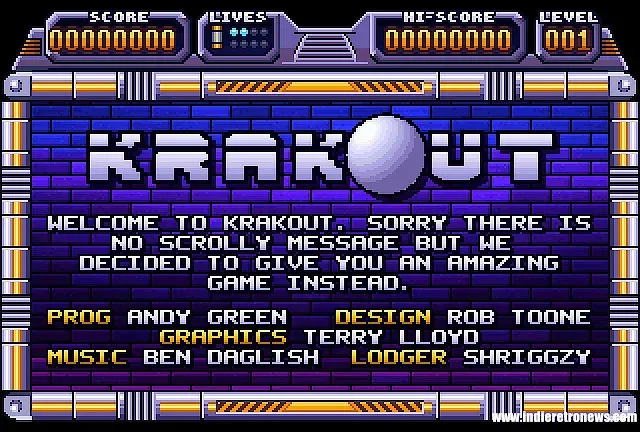
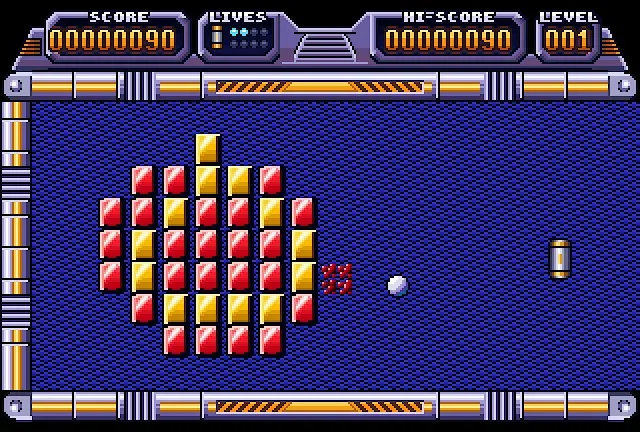
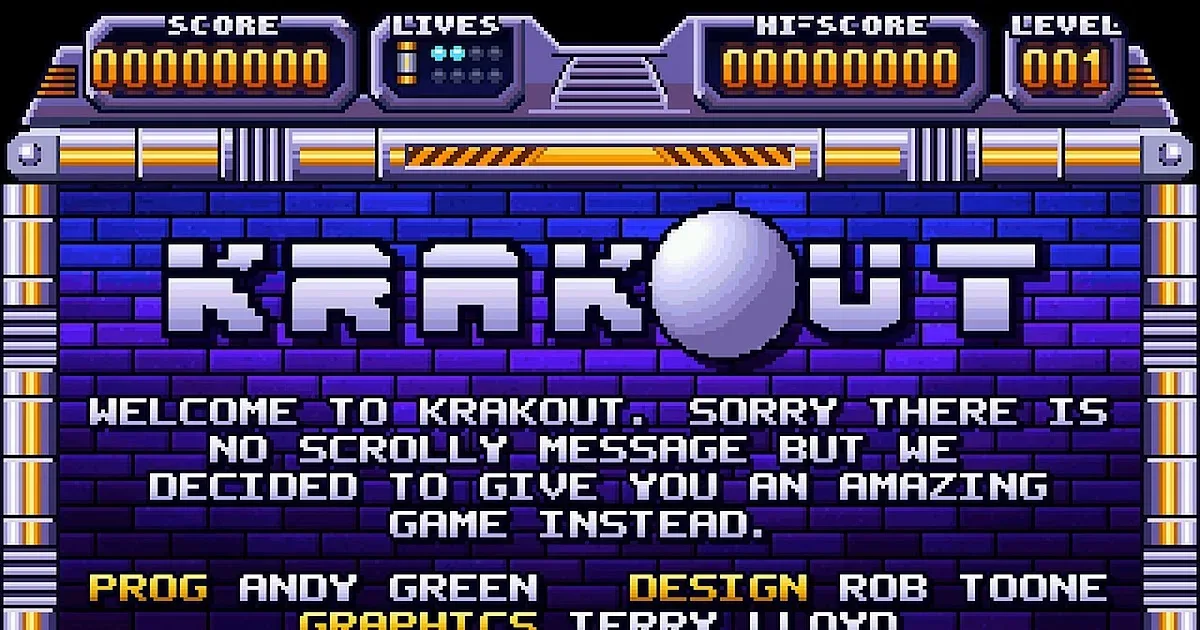
The gameplay remains intentionally conservative, but the presentation does not. The game opens with a 256-colour, high-resolution introduction featuring the original cover artwork. During play, the package adds chrome-and-gold brick designs, scrolling backgrounds, redrawn sprites and a redesigned heads-up display.
AGA, short for Advanced Graphics Architecture, is the Amiga chipset associated with the Amiga 1200 and other AGA models. Here, it is the basis for the overhaul rather than a reason to alter the game’s mechanics. The release uses the platform’s capabilities to give Krakout a more elaborate visual identity while retaining the arcade layout and screen progression that define the original.
The new HUD is an especially functional part of that change. A heads-up display is the on-screen information layer used to communicate game-state information while play continues. A sleeker HUD may be cosmetic, but it is also one of the areas where a remake or enhancement can improve readability without touching the challenge itself. The supplied details do not specify its individual indicators, so players should not assume additional mechanics or altered scoring rules from the interface refresh alone.
The chrome-and-gold bricks and richer backgrounds also point to an adaptation designed for visual contrast. In a rapid ball game, brick visibility and the clarity of sprites can directly affect how easily a player reads a busy screen. That does not make this a different Krakout, but it explains why an enhanced visual pass can be more than a decorative extra.
Ben Daglish’s score returns with sampled instrumentation
Music is another major part of the update. Ben Daglish’s original composition has been rearranged with sampled instruments and an added drum kit. Crucially, every original note and timing is retained. New sound effects accompany the brick-smashing and explosion actions.
This is a useful example of the project’s overall philosophy. A rearrangement can change the texture and apparent scale of a piece of music, while preserving notes and timing keeps its musical structure intact. The added percussion and sampled sound are therefore not described as a newly composed soundtrack; they are a different presentation of the existing composition.
For a game built around constant impacts and quick movement, sound effects are part of the feedback loop. The distinction between an impact, a bonus-related event or an explosion can support the action even when a player is watching the ball closely. Still, the central promise is fidelity: the whimsical character and timing of the original Daglish music remain the foundation.
For more current gaming coverage beyond the retro scene, see this look at Ugly Within’s announced console and PC plans.
Disk-saving scores and a streamlined options menu
The AGA edition includes persistent high scores saved to disk, plus an options menu in which settings can be toggled with a quick press of the fire button. Those additions are modest, but they fit an arcade game especially well. A high-score table gives repeated runs a lasting record, which is important for a title structured around mastering screens and extracting better performance from the same ruleset.
There is one practical step for anyone using the ADF disk image: the disk must be write-enabled if high scores are to be retained. An ADF is a disk-image format commonly used for Amiga software, representing a floppy disk in a file. The game is supplied as an ADF image, so write protection is directly relevant to whether the score-saving feature can do its job.
The menu control is similarly uncomplicated. A brief tap of the fire button toggles settings, avoiding a cumbersome configuration layer in a game whose appeal is immediate action. No further settings are specified, so the safe expectation is a streamlined utility feature rather than an extensive modern configuration suite.
Compatibility: what Amiga owners need
Krakout Amiga AGA Enhanced Edition is made for an Amiga 1200 or another AGA Amiga. The stated requirements are straightforward:
- An Amiga 1200 or other AGA-equipped Amiga.
- A stock 68020 setup; no expansions are required.
- 2 MB chip RAM, with no fast RAM requirement.
- Kickstart 3.0 or 3.1.
- The supplied ADF disk image.
The same disk works on PAL and NTSC machines. On an NTSC system, the game changes to 50 Hz in order to preserve its original speed. That comes with a display consideration: the monitor or adapter needs to accept a 50 Hz signal. Most RGB monitors and adapters are said to do so, but it remains the key compatibility check for NTSC users before assuming a display will work correctly.
Why 50 Hz matters: refresh rate describes how frequently the display updates each second. If a game’s timing was designed around 50 Hz, operating at that cadence helps preserve its intended motion and speed. The NTSC behaviour here is meant to keep Krakout’s action aligned with that original pace, rather than allowing a regional video standard to unintentionally change how it plays.
The project’s constraints make its purpose unusually clear. Krakout Amiga AGA Enhanced Edition retains the original game’s 100-screen, side-bat brick-breaking challenge while using native Amiga code and AGA presentation to make that challenge feel at home on stock A1200 hardware. For players with the appropriate machine, Kickstart version and display support, it is a focused revival that treats the original rules as the feature to protect—not the obstacle to modernise.