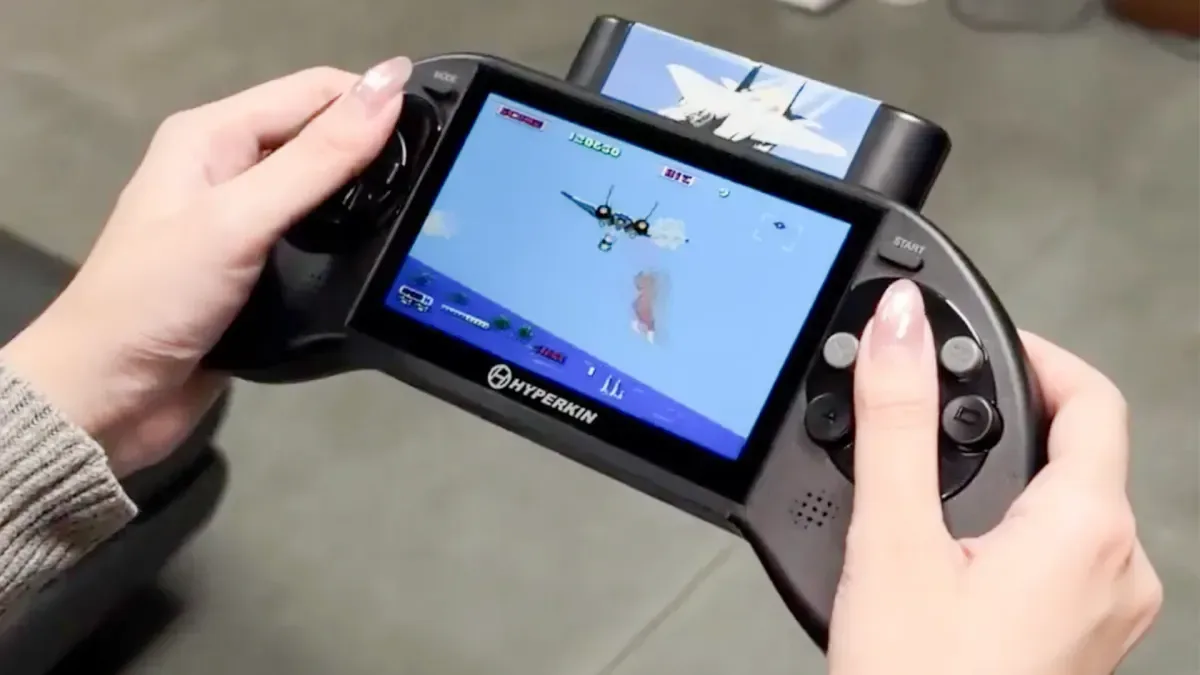
After a long and visibly uneven route to market, Hyperkin’s Mega95 handheld appears to be nearing its most consequential milestone yet. The company says research and development, along with community testing, are complete; mass production has begun; and the product’s packaging is being finalized. Its next promised step is preorder information, described only as coming soon.
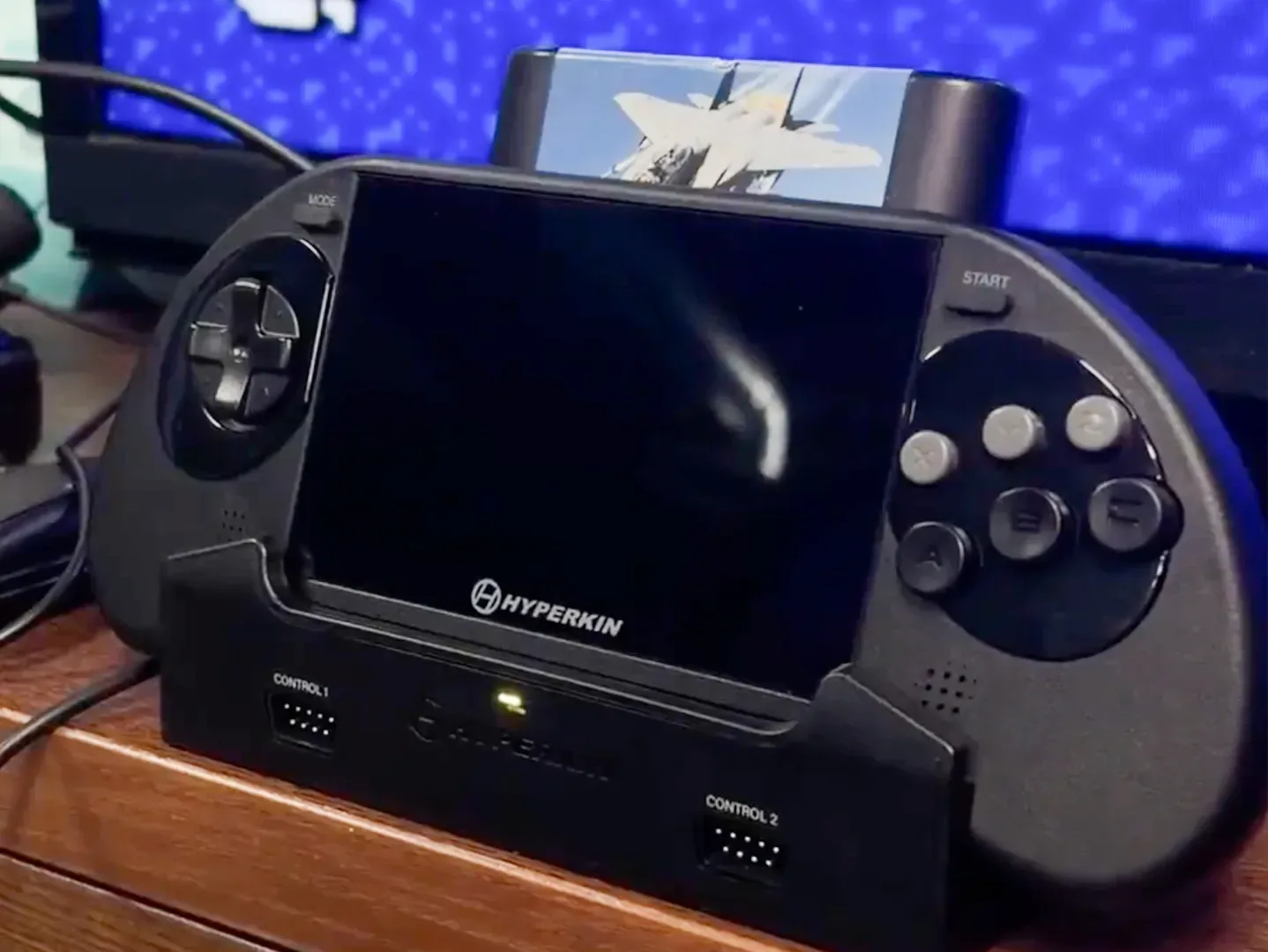
The Mega95 is intended for people with original SEGA Genesis or Mega Drive cartridges rather than a purely download-based library. That makes the update important for players who still own loose games and want a new way to use them: a large, dedicated handheld that can also be placed in a dock for television play. Hyperkin has shown the system operating in a dock connected to a high-definition TV, with multiple controller ports available for a more console-like setup.
There is still a crucial distinction between a production update and a retail launch. No price, firm preorder date, release date, regional plan, battery-life figure, compatibility list, or detailed dock specification has been provided in this update. “Mass production” indicates that manufacturing is underway, but it is not itself a guarantee that finished retail units are ready to ship. For prospective buyers, the sensible takeaway is that the Mega95 looks closer than it has before, while the practical buying details remain outstanding.
What Hyperkin has confirmed about the Mega95
The latest update establishes several concrete points. Hyperkin says its R&D work and community testing have concluded, and that it has moved into mass production. It has also shown the handheld in use, offering a clearer look at its physical size, controls, screen, cartridge-focused design, and docking concept than earlier promotional material allowed.
For more context, explore John Byrne’s X-Men: Elsewhen Vol. 2 Update Leads a Comics News Cycle Spanning Batman, Avengers and Doctor Who.
The system has a 5-inch display with selectable 16:9 and 4:3 display modes. Those numbers refer to aspect ratio, the proportional relationship between the width and height of an image. A 4:3 presentation is narrower and closer to the shape associated with many older television displays, while 16:9 is the wider format commonly used by modern screens.
The option matters because display shape can affect how older games are framed. A player may prefer 4:3 when aiming for a more traditional image shape, while 16:9 offers a wider presentation. The announcement does not explain precisely how every game will be handled in either setting, whether there are scaling controls beyond the two modes, or what visual processing is used. It is therefore best viewed as a confirmed display-format option, not a complete picture-quality specification.
Hyperkin’s shown dock serves another clear purpose: it lets the Mega95 shift from handheld use to TV output. The presence of multiple controller ports suggests local multiplayer or shared-screen play is part of the intended living-room experience, where a game supports it. The company has not yet detailed the supported controllers, output behavior, whether the dock is included with every unit, or which accessories may be sold separately.
Related coverage includes Hyperkin’s Mega95 Moves Into Mass Production.
A deliberately large portable system
The Mega95 is not being positioned as a tiny, pocketable device. Its 5-inch screen and broad controller-like body make it a substantial handheld, and the visual design deliberately recalls a Genesis/Mega Drive controller. That approach has an obvious trade-off: portability is reduced compared with a smaller machine, but the layout can allow more room around the controls and a larger viewing area for cartridge games.
For owners of physical cartridges, that size calculation goes beyond the handheld itself. Original Genesis and Mega Drive carts add their own height and weight once inserted, so a compact silhouette would have been difficult to preserve anyway. Hyperkin’s stated emphasis is on a larger display and comfortable longer sessions rather than shirt-pocket convenience.
Ergonomics—how comfortably a device fits the hands and how easily its controls can be reached—will be especially relevant here. The available footage provides a look at the intended shape and button arrangement, but it cannot settle questions such as long-session comfort, shoulder-button feel, cartridge stability, screen brightness, or the real-world quality of the directional controls. Those are evaluations that will need to wait for finished hardware rather than be inferred from a manufacturing announcement.
Why the wait has been unusually long
The Mega95 was first announced in January 2024. Since then, Hyperkin has acknowledged development difficulties, including an issue with the quality level delivered by a recent factory partner. That background gives the current manufacturing update more weight than a routine teaser: getting from prototype and testing stages to a product that can be consistently produced at acceptable quality is often the hard part of bringing hardware to retail.
In plain terms, a factory-quality problem is not just cosmetic. A manufacturer needs repeated units to meet the required standard before it can confidently scale production. For a cartridge handheld, consistency could be relevant to the casing, controls, screen assembly, charging hardware, docking fit, and cartridge connection, among other elements. Hyperkin has not identified which aspects were affected by the previous partner, so it would be inappropriate to assume a specific flaw. What is clear is that the issue contributed to the delay.
The company’s statement that community testing is complete is also meaningful, though limited in what it tells buyers. Community testing generally means people outside the core development team have had an opportunity to use hardware and provide feedback before mass production. It can expose usability and compatibility concerns that might not show up in internal testing alone. However, Hyperkin has not published the testing methodology, the cartridges involved, feedback results, or changes made as a result. Completion of the process is confirmed; its detailed findings are not.
Physical cartridges are the Mega95’s central proposition
Many contemporary retro-focused handhelds center on digital files, software libraries, or emulation-oriented setups. The Mega95’s appeal is different: it is built around using authentic Genesis/Mega Drive cartridges in a handheld form factor. That makes the device potentially attractive to people whose games are already sitting on shelves, in storage boxes, or beside an existing console.
It also means cartridge compatibility will be one of the biggest unanswered questions until Hyperkin releases a fuller technical breakdown. “Authentic carts” covers a broad physical ecosystem, and buyers will reasonably want to know how the final device behaves with different cartridge shapes, regions, special hardware, and older games. None of those particulars have been confirmed in the current update, so prospective owners should avoid treating the mass-production news as a completed compatibility guarantee.
The update also leaves implementation details open. Discussion around hardware such as this can involve a system-on-chip, commonly shortened to SoC. An SoC is a compact component that combines key computing functions in one package. It is relevant to how a device operates, but Hyperkin has not set out a full technical explanation of the Mega95’s cartridge handling or its final internal hardware in this announcement. The useful point for now is simpler: the product is designed to accept original carts, while its complete technical behavior remains to be detailed.
What the dock changes for prospective owners
The dock is more than a charging stand in the way it has been shown. It gives the Mega95 a second use case: take the cartridge handheld from the couch, plug it into a television, and use controller ports for a setup closer to a conventional home console. For games that benefit from a bigger screen or shared play, that flexibility may be as important as the portable screen.
There are still practical questions buyers should keep in view. Hyperkin has shown television connectivity and controller ports, but has not published information on output resolution, latency, supported controllers, dock packaging, power requirements, or whether the handheld’s 4:3 and 16:9 options behave identically on a TV. Latency means the delay between pressing a button and seeing an action on screen; it is particularly noticeable in fast, timing-sensitive games. There is no basis yet to judge it on the Mega95.
Similarly, battery life remains unconfirmed. A large display, physical cartridge use, and TV-docking capability make it understandable that people will ask about endurance and charging, but no official estimate has been provided. Buyers should wait for a stated battery specification and, later, independent use reports before making a decision based on portable play time.
What to watch for when preorder details arrive
The transition to mass production is the strongest sign so far that the Mega95 is moving beyond a prolonged pre-release phase. Yet it is also the point at which product pages and preorder notices should provide the specifics missing from the brief status update. The most useful information will be factual, straightforward details rather than more imagery.
- Price and territories: where the Mega95 can be ordered and what it will cost.
- Release timing: a shipping window or date, rather than a general promise of news.
- Box contents: whether the dock, cables, power hardware, or controllers are included.
- Compatibility: the supported Genesis/Mega Drive cartridge range and any known exceptions.
- Display and TV behavior: how 4:3 and 16:9 modes work on the handheld and through the dock.
- Battery and charging: capacity or expected run time, plus charging details.
- Warranty and support: particularly relevant after the device’s extended development period and acknowledged manufacturing challenges.
For now, Hyperkin’s update is promising but deliberately narrow. The Mega95 has reportedly completed R&D and community testing, entered mass production, and has packaging nearing completion. Its big-screen cartridge format, selectable aspect ratios, and TV dock with multiple controller ports give it a clear identity. The details that determine whether it is a straightforward recommendation—price, availability, battery performance, packaging, and proven compatibility—are still to come with the preorder announcement.