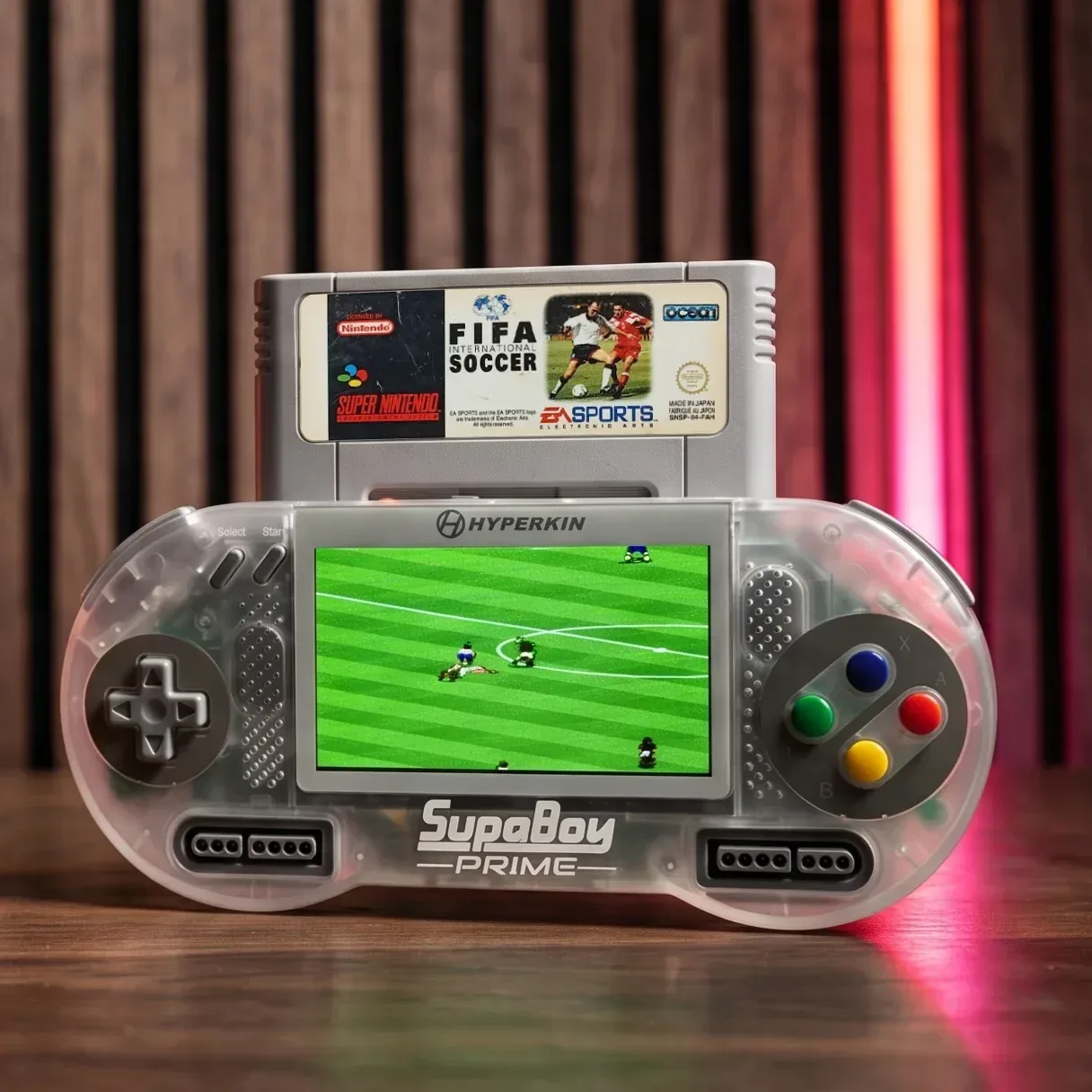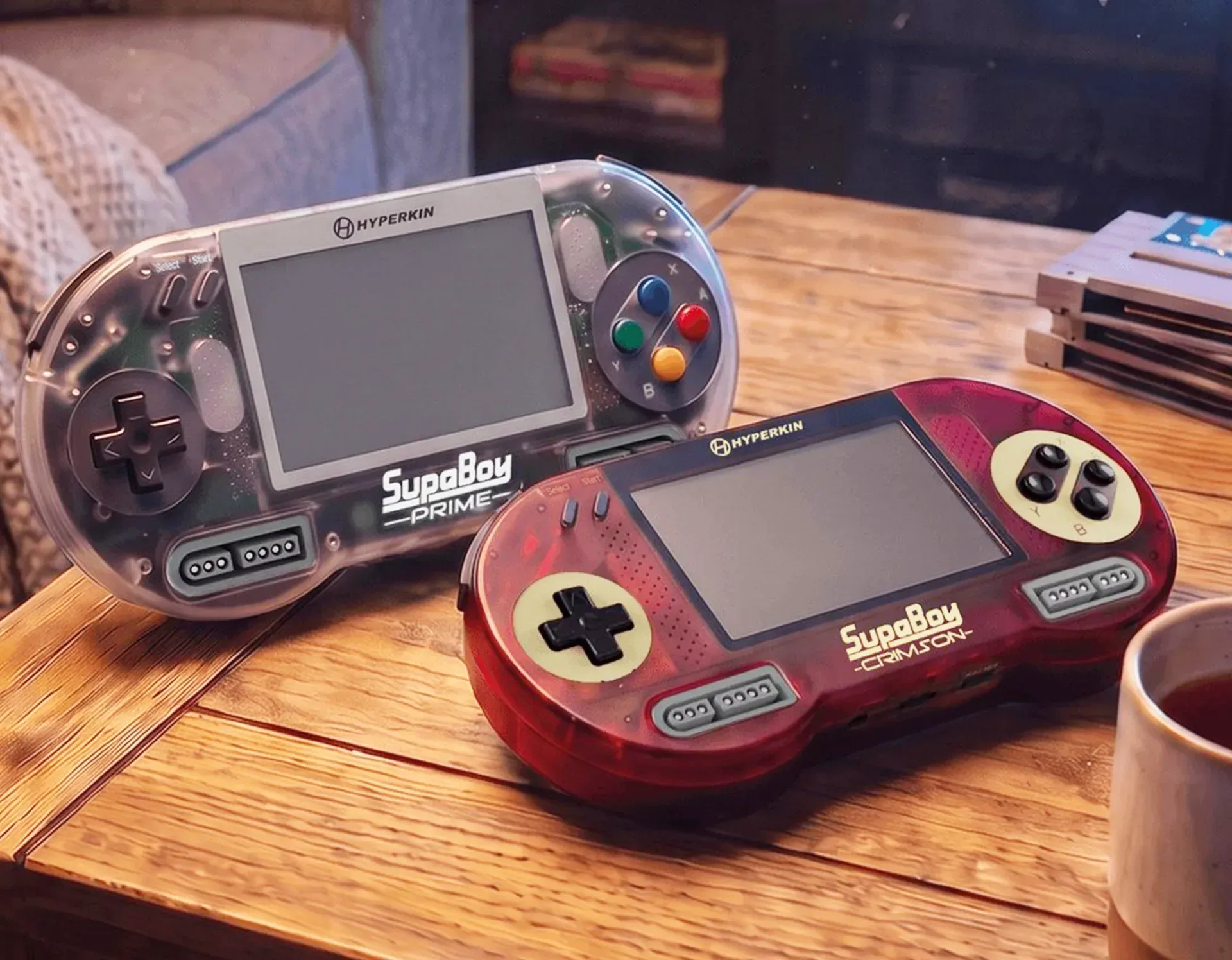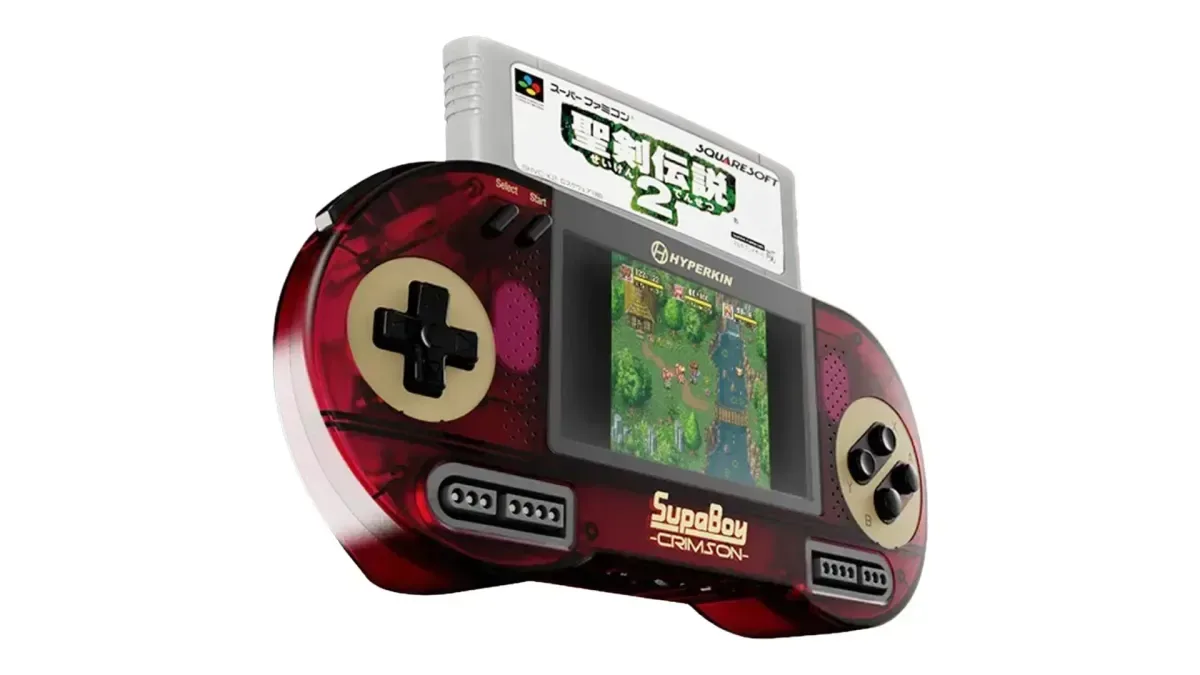
Hyperkin’s SupaBoy S is receiving a visual refresh rather than a hardware overhaul. New Crimson and Prime editions are now available to pre-order for $129.99, retaining the same cartridge-playing handheld design and feature set as the existing SupaBoy S. Shipping is expected to begin on October 28, 2026.
That distinction matters: these are not upgraded models with a new screen, revised battery capacity, additional ports or expanded compatibility. Hyperkin is presenting Crimson and Prime as colour variants of its long-running Super Nintendo-compatible portable. For players who already own a SupaBoy S, the reason to consider one is the new exterior treatment. For those who do not, the appeal remains the particular niche the device occupies: using original Super Nintendo Entertainment System and Super Famicom game cartridges away from the television.
Crimson and Prime each incorporate transparent elements and visual references to familiar Nintendo and Famicom-era colour styling. They keep the SupaBoy S’s 4.3-inch display, physical cartridge format, AV output, two front controller ports and stated battery capacity. In other words, the shell is getting the makeover; the guts have politely declined to attend the salon.
A handheld built around physical SNES cartridges
The SupaBoy line began in 2011, while the refined SupaBoy S arrived in 2016. The S model added a larger 4.3-inch display and quality-of-life refinements. Nearly a decade later, the new editions leave that established platform in place.
Its defining feature is not merely that it plays games associated with the 16-bit era. It accepts original SNES and Super Famicom cartridges. That is a materially different proposition from a handheld loaded with a digital library: the cartridge itself remains part of the experience. Owners can take a game from their shelf, insert it into the device and play it on the built-in screen without requiring a television.
The stated support is region-free across NTSC and PAL Super Nintendo and Super Famicom cartridges. NTSC and PAL are television and video standards historically tied to different territories. In practical terms, region-free compatibility is intended to make a wider mix of cartridges usable on one SupaBoy S, rather than forcing a buyer to limit their library to a single regional format. It is a useful feature for players whose shelves include both SNES and Japanese Super Famicom releases, or PAL cartridges alongside either of them.
Compatibility is the key word, and it should be read carefully. Hyperkin’s listed support makes the device potentially useful for varied cartridge libraries, but prospective buyers should not turn a general feature claim into an assumption about every individual game, cartridge revision or accessory. The supplied information identifies the supported formats and accessories, not a title-by-title compatibility database.
The practical setup options
Despite being a handheld, the SupaBoy S is designed to move between portable and home setups. Its AV output can connect the system to a larger display. AV, short for audio/video, refers here to the analogue output connection used for sending picture and sound from the handheld to a television. That makes the device less of a one-location novelty: a cartridge can be played on the 4.3-inch screen and then moved to a TV arrangement without changing machines.
Related coverage includes Hyperkin's SupaBoy S Returns in Crimson and Prime Colours.
The inclusion of AV output will be especially relevant to people using older displays, including CRT televisions. A CRT is a cathode-ray-tube television, the bulky tube display technology commonly associated with the period in which SNES games originally appeared. The output gives owners a route to integrate the SupaBoy S into a retro-focused living-room setup, although the available information does not specify display quality, cable contents or behaviour with particular televisions. Buyers with a very specific display setup should therefore confirm the connections and requirements before treating the handheld as an automatic fit.
There are also two front-mounted controller ports for original Super Nintendo controllers. This is a notable choice because it turns a cartridge handheld into a possible shared-play machine when connected to a TV. Rather than relying only on the built-in controls, players can attach two compatible original controllers for multiplayer sessions. The result is a device with two distinct use cases:
- Portable cartridge play: insert an SNES or Super Famicom game and use the integrated screen.
- TV play with controllers: connect via AV output and use the front ports for original controllers.
That flexibility is arguably the central reason the SupaBoy S still has a place in a crowded retro-hardware field. It does not ask owners to choose exclusively between a shelf-bound console and a tiny handheld. It tries to accommodate both, with the physical game card—well, cartridge—at the centre of the arrangement.
Aspect ratio: a small setting with a meaningful effect
Hyperkin also lists a display toggle between 4:3 and 16:9, activated by holding the brightness button for three seconds. Aspect ratio describes the relationship between a screen’s width and height. A 4:3 image is closer to the proportions associated with older standard-definition televisions, while 16:9 is the wide-screen shape familiar from modern TVs and monitors.
For SNES and Super Famicom software, 4:3 is the option most directly aligned with the historical television presentation. Selecting 16:9 widens the image to suit a wider screen preference, but it is important to distinguish a change in display shape from a new version of the game. The setting is a viewing choice offered by the hardware, not evidence that the original software was created for modern wide-screen presentation.
This is the kind of modest convenience feature that is easy to overlook in a product listing but helpful in daily use. A portable intended for old cartridges will encounter different player preferences and display arrangements. Putting the switch behind a deliberate button hold also suggests it is meant to be changed occasionally, rather than accidentally in the middle of a game.
Accessories broaden the appeal, but do not alter the model update
The SupaBoy S is stated to work with flashcarts such as Everdrive, as well as Game Genie and the Super Game Boy adapter. Each serves a different purpose, and their mention says more about the handheld’s flexible cartridge slot than about any new function in Crimson or Prime.
- Flashcarts: cartridge-shaped devices that can be used with software stored on the flashcart. Hyperkin specifically cites Everdrive as an example.
- Game Genie: a cartridge accessory associated with applying game modifications or codes.
- Super Game Boy adapter: an adapter that is also listed as supported by the SupaBoy S.
The support list may be especially interesting to established hardware users who already own these accessories. Still, it should not be mistaken for a change unique to the new colours. Hyperkin says the Crimson and Prime versions keep the existing hardware, specifications, ports and battery capacity. Their compatibility profile is part of the continuing SupaBoy S design.
For a broader view of current projects keeping older hardware in active use, see this look at a new game targeting Amiga hardware. The common thread is not that the devices are alike, but that older game formats and platforms continue to support new ways of playing, displaying and preserving interactive software.
What buyers are actually getting
Hyperkin’s new editions are straightforward products, and that clarity is useful. Buyers are getting the familiar SupaBoy S package in either Crimson or Prime: a handheld for original SNES and Super Famicom cartridges with a 4.3-inch screen, NTSC and PAL compatibility, AV output, two original-controller ports, a 4:3/16:9 display mode toggle, and stated support for selected cartridge accessories.
They are not being offered an internal redesign. Anyone waiting for a revised display, different battery capacity, altered port selection or a newly described feature set should treat these as cosmetic releases, because Hyperkin has said the underlying design and specifications remain unchanged.
That does not make the release insignificant for the right audience. A physical-cartridge handheld is as much an object that sits alongside a game library as it is a way to access that library. The transparent details and colour references give returning hardware a new personality without forcing collectors and players to replace their cartridges, controllers or accessories. Crimson and Prime are essentially a fresh coat of paint on a machine that has stuck to its peculiar, practical mission: letting Super Nintendo and Super Famicom cartridges leave the couch without abandoning their plastic dignity.