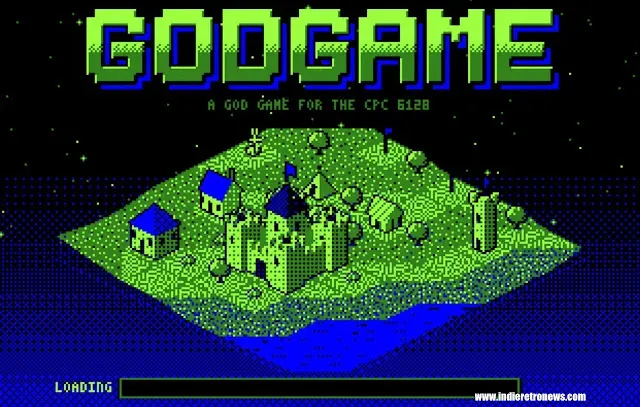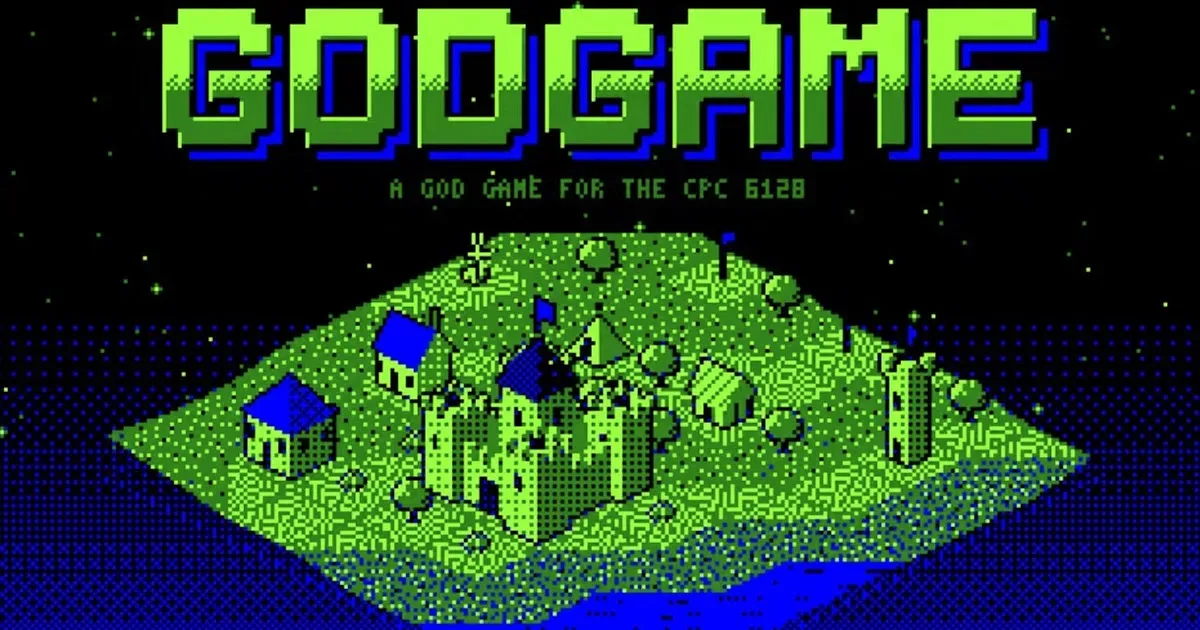
A new strategy project called GODGAME is being developed for the Amstrad CPC 6128, with compatibility also aimed at CPC systems carrying 128K of RAM. Created by SoftDevil, the game takes clear inspiration from the god-game tradition associated with Populous, but its currently described systems place population, settlement growth and attrition at the center of the conflict.
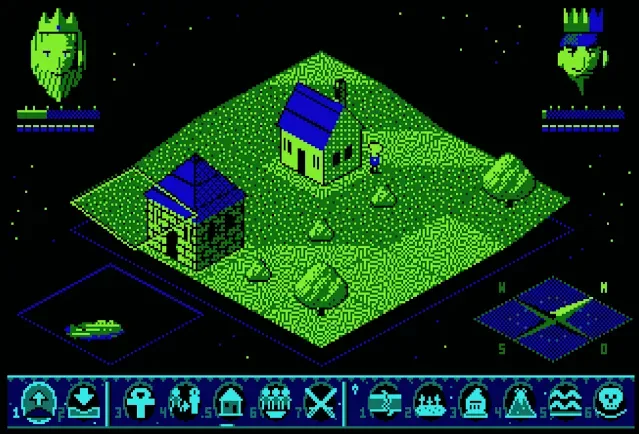
Players take the role of a benevolent deity represented by a bearded, crowned ruler portrait in the upper-left area of the interface. The stated objective is to guide a loyal population as it occupies flat land and develops residential villages. That settlement activity is not just visual dressing: the number of people living in houses, combined with the strength of those citizens, determines the player’s overall divine power.
The opposition is another deity, and the contest is framed as a struggle of demographic endurance. Lose every follower and GODGAME presents a defeat state; exhaust the rival’s population first and victory is awarded to the player. It is a clean, immediately legible premise, but one that could give everyday land management unusually high stakes on hardware of this era.
A god game where the population is the resource
“God game” is a broad label, generally used for strategy games in which the player influences a settlement or society from a position above its individual inhabitants rather than controlling one hero directly. In GODGAME’s early outline, that perspective is expressed through guiding people toward suitable building land and improving the conditions for a village to grow.
The important detail is the link between population and power. Rather than presenting population solely as a score, GODGAME makes it the basis of the deity’s strength. That suggests a strategic loop in which housing and citizens are the foundations of survival. A thriving settlement improves the player’s position; a shrinking one risks an irreversible decline.
There is no detailed explanation yet of every action, unit behavior, terrain tool or combat rule. Those unanswered questions matter, because the balance between construction, territorial pressure and direct confrontation will define how closely the game’s final rhythm resembles its inspiration. Still, the disclosed win condition makes the intended focus clear: players will be measured by whether their people can persist and outlast the rival’s.
In practical terms, this means that flat terrain has a strategic purpose, not merely a decorative one. Players are asked to help followers settle usable ground before they can establish residential villages. The result is a familiar but effective strategic tension: expansion needs space, and the value of that space is realized only when it supports a growing population.
Populous is the reference point, not a complete description
SoftDevil has identified Populous as a major influence, which provides helpful context for the project’s deity-versus-deity setup and its concern with manipulating land for settlements. But GODGAME should still be understood as an in-development work rather than a confirmed recreation of any particular design.
The available details establish inspiration, a setting and an overall progression model; they do not establish a final feature list. There is no confirmed release date, no announced distribution format and no definitive rundown of modes, maps or additional systems. For interested CPC players, that distinction is worth keeping in view. The appealing elements are already visible, while the exact form of the finished game is still open to change.
That open status is especially relevant because the creator is asking the Amstrad community for constructive feedback and feature suggestions. Community input can influence a project’s priorities, but it should not be read as a promise that every requested feature will arrive. It does mean the public discussion is part of the development process at this stage.
Technical work centers on Z80 efficiency
Alongside the gameplay outline, SoftDevil has shared a small but revealing look at the technical work behind GODGAME. Development has involved counting instruction cycles and replacing loops with unrolled code, while older Z80 programming discussions are being used as a resource for optimization ideas.
Those terms describe a classic low-level performance approach. An instruction cycle is the time a processor spends carrying out an individual machine instruction. When a program must update a busy game screen, simulate inhabitants and react to player input, the cumulative cost of many small operations can be decisive. Counting cycles is therefore a way of identifying where code may be too expensive to run as often as the game requires.
A loop repeats the same instructions until a condition is met. It is an efficient organizational tool, but each repeat can carry overhead: the program has to update its counter and check whether it should continue. Loop unrolling replaces some of that repeated control work with a longer sequence of explicit instructions. The trade-off is straightforward: it can run faster, but it uses more program space. On a constrained retro machine, choosing when that trade is worthwhile is part of the craft.
None of that guarantees how GODGAME will ultimately perform, but it does show that optimization is an active concern rather than an afterthought. A population-led god game has obvious reasons to be sensitive to execution time. Villages and followers imply many pieces of information that may need regular updating, even if the game’s final internal simulation is much simpler than its on-screen premise suggests.
A proportional font is another notable detail
The project also uses a custom font engine described as a true proportional font, based on the same engine used in an Elite clone. A proportional font gives different characters different widths. In plain terms, an “i” can occupy less horizontal room than an “m,” unlike a fixed-width font where every character is allotted the same space.
That may sound like a modest interface flourish, but it has practical value. It can make messages, labels and status information more compact and more naturally spaced. It also requires additional handling compared with drawing every letter in identical character cells, since the program must know the width and placement of each glyph.
For GODGAME, whose interface includes a deity portrait and needs to communicate conditions such as defeat and victory, readable presentation could be important. The currently shown custom-font work is not a substitute for core gameplay, of course, but it indicates that the project is giving attention to how the game communicates as well as how it calculates its systems.
AI disclosure remains deliberately incomplete
SoftDevil has also said that AI was used during development, while stressing that the use may not be what people expect. A fuller explanation is planned nearer the end of the project.
At present, there is not enough information to characterize that use further. It would be inaccurate to assume that it refers to game code, art, writing, design, testing or any other specific part of production. The meaningful fact is simply that the developer has flagged the involvement and intends to provide more transparency later.
That restraint is sensible for anyone tracking the project: it is better to wait for the promised clarification than turn a brief disclosure into a claim about the game’s assets or authorship. GODGAME’s visible technical notes, meanwhile, already point to conventional hands-on CPC development concerns such as Z80 timing and display text rendering.
What to watch as GODGAME evolves
GODGAME currently has a strong, compact pitch: help a population establish villages, turn that growth into divine strength and defeat a rival god by ensuring your followers remain when theirs do not. The concept fits its chosen platform particularly well because it does not depend on spectacle alone. Its appeal will rest on whether the interaction between usable land, housing, citizens and opposing pressure generates compelling decisions.
Future updates will be most useful if they clarify the moment-to-moment player tools and the relationship between each side’s settlements. Are followers mainly directed through terrain preparation, or will players have broader intervention options? How does citizen strength change? Can a player recover after losing ground, or does the population model create a sharp snowball effect? Those are not details confirmed yet, but they are the questions that will shape the strategy experience.
For now, the project is best seen as a promising CPC 128K development effort with a recognizable strategic lineage and a clearly stated population-based objective. It also arrives at a time when smaller-scale god games continue to find room beside larger strategy releases; for a modern example of a differently themed divine concept on other platforms, see Gunboat God’s announced Switch and mobile launch.
SoftDevil is inviting feedback while GODGAME remains in progress, so the details may evolve. The foundation, however, is already defined: an Amstrad CPC strategy game where a deity’s authority depends on the people who have a place to live.