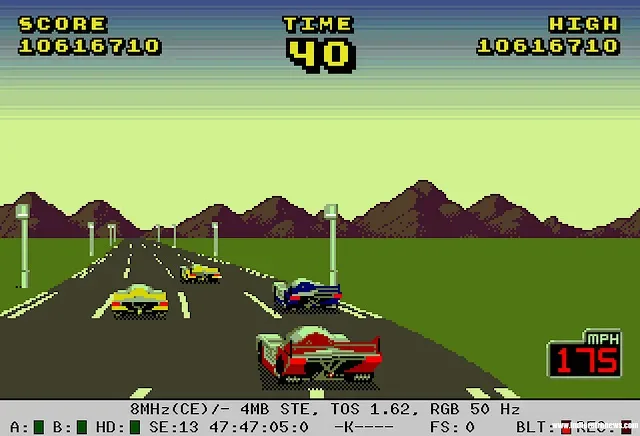
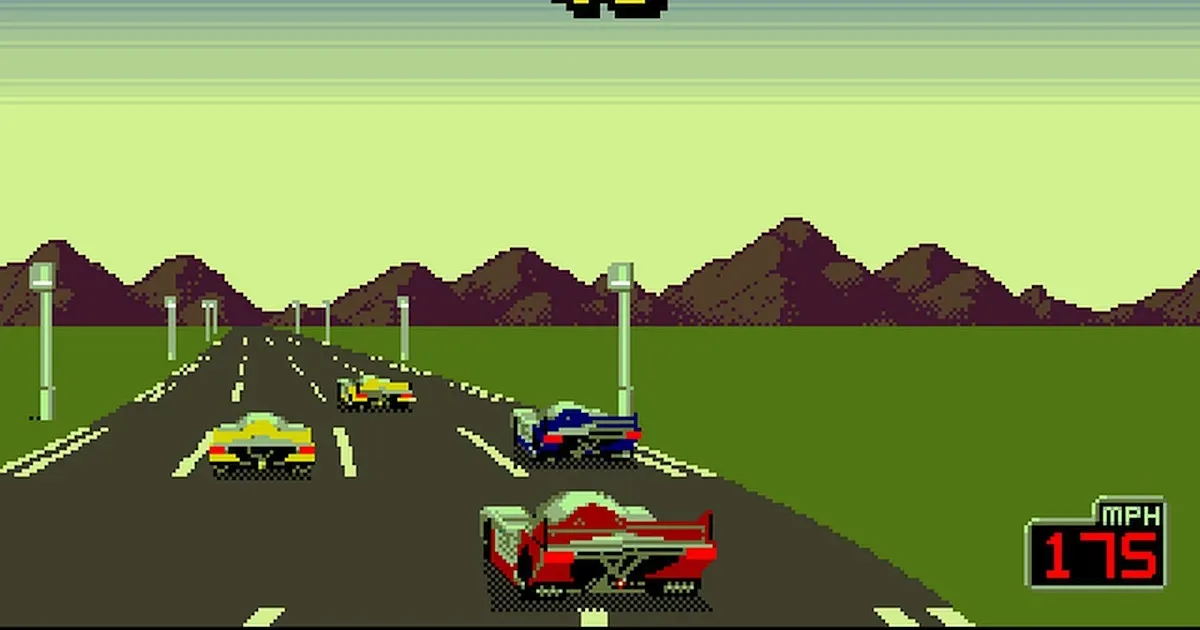
FASTER, Jonathan Thomas’ high-speed 2.5D racing game for the Atari STE, has been brought to the Commodore Amiga. The project’s pitch is refreshingly direct: an arcade racer made around immediate action rather than a long list of modern modes, tutorials, achievements, or cinematic interruptions.
That design stance matters as much as the technical specifications. FASTER is presented as a compact, 1980s-style racing experience where the point is to get on the road and react quickly. Its arrival on Amiga means two closely associated home-computer audiences can now approach the same core idea: an original racer designed to make older hardware look and sound busy at speed.
A racer designed for motion first
The game is described as a 2.5D racer. The term generally refers to visuals that create an impression of depth and forward movement without rendering a fully three-dimensional world in the contemporary sense. In racing games, that can mean the road, scenery, opponents, and perspective cues work together to sell speed while keeping the underlying presentation within a more constrained technical framework.
FASTER’s stated target is 50 frames per second on an 8MHz Atari STE or Amiga. Frame rate is the number of individual images shown every second; a higher, stable rate can make scrolling and animation appear more fluid. For an arcade racer, that smoothness is especially important. Racing depends on rapidly reading bends, traffic, lane position, and changing scenery. If the display updates consistently, the movement of the road and other vehicles can feel more immediate.
The available details do not establish every difference, if any, between the Atari STE and Amiga editions. What is clear is that the Amiga version carries forward the game’s central emphasis on fast visual response and uncomplicated arcade play, rather than positioning itself as a feature-heavy simulation.
What is driving the visual presentation
FASTER was built from scratch for the Atari STE using modern development tools and techniques alongside classic hardware. Its technical feature list points to a project intent on making the screen feel densely animated instead of merely displaying a sparse road and a single car.
- 50fps action: the game is designed to run at 50 frames per second on 8MHz Atari STE or Amiga hardware.
- More than 15 large, full-colour sprites: multiple prominent moving graphic objects can appear at once.
- Over 30 colours on screen: the Atari STE version makes use of that system’s expanded palette.
- A 24-hour lighting cycle: the visual conditions shift from day through night as racing continues.
- Concurrent audio layers: digital engine sounds, effects, and a YM soundtrack are intended to play together.
- Screen shake: hardware scrolling is used for impact-oriented feedback.
A sprite is a movable graphic element, such as a vehicle or other object, that is handled separately from the background. The reference to more than 15 large full-colour sprites does not by itself tell us precisely what every object represents during play, but it does indicate the game is attempting to keep the racing scene active. In a genre built around overtaking and split-second spatial judgement, a crowded display can support the feeling of speed—provided it remains readable.
The Blitter is also part of the project’s technical vocabulary. In broad terms, it is dedicated hardware used to move or manipulate blocks of graphics data more efficiently than relying on the main processor alone for every such operation. FASTER uses the Blitter chip for its packed on-screen sprite work. The practical appeal is straightforward: offloading particular graphical chores can help a game devote more of its overall budget to motion, effects, and a busier display.
Related coverage includes Atari STE arcade racer FASTER comes to Commodore Amiga.
Colour is another part of the intended showcase. The game lists more than 30 simultaneous colours and specifically notes the Atari STE’s expanded palette. A palette is the set of colours a machine can select for its graphics. The number of colours visible at once is not a complete measure of artistic quality, but it affects how much contrast, shading, and atmosphere developers can put into a scene. That is particularly relevant to FASTER because lighting changes over a full day-to-night cycle are among its advertised visual effects.
Day-to-night changes are more than decoration
The full 24-hour cycle suggests that the race presentation changes as time advances, moving between daylight and darkness rather than holding one fixed look. The supplied information does not spell out whether lighting affects handling, track layout, opponents, or race rules, so it would be premature to treat it as a gameplay system. Its confirmed role is visual: it provides a changing backdrop for the action.
Even as a presentational choice, that can be meaningful in a stripped-back racer. A game deliberately avoiding a broad layer of auxiliary modes needs its moment-to-moment action to carry the experience. Shifting light conditions offer variety without requiring an achievement track, cutscene structure, or extensive menu of side activities. In other words, FASTER’s visual changes appear consistent with its stated preference for direct arcade play over elaborate framing.
The same applies to the screen-shaking effect. Hardware scrolling is used to create the shake, which is described as visceral feedback. This is a presentation tool, not proof of a specific damage or collision model. But it signals an effort to communicate force through the display itself. In an arcade racer, that kind of feedback can make speed and impacts feel more emphatic even when the game’s rules remain intentionally simple.
Sound built in layers
FASTER also aims to combine several kinds of sound at once: digital engine roars, sound effects, and a classic YM soundtrack. The YM reference concerns the Yamaha sound hardware associated with the Atari ST family, and here it denotes the style of musical soundtrack being used alongside the other audio elements.
Layered audio is notable because a racing game’s atmosphere often comes from the relationship between music, engine noise, and short effects rather than any one element in isolation. The engine establishes motion, effects punctuate events, and the soundtrack provides momentum. FASTER’s specification is not simply that it has music and effects; it is that these components are designed to run simultaneously.
That focus on simultaneous activity closely mirrors the visual side of the game. Multiple sprites, a shifting lighting scheme, hardware-based shake, and concurrent sound layers all point in the same direction: a racer trying to create a strong sense of continuous action on classic home-computer hardware.
From Atari STE competition winner to Amiga release
Before the Amiga edition, FASTER’s Atari STE version took first place in the Atari ST/STE games competition at Silly Venture 2024 WE. That result gives the project a concrete point of recognition within the Atari ST/STE scene, separate from the new platform release.
The port is also a reminder that active development for vintage machines is not limited to preservation or re-releases. New games can be purpose-built around the quirks and strengths of the original systems. In FASTER’s case, the listed goals are explicit: use current development approaches to push the Atari STE and Amiga toward fluid, colourful, effects-heavy arcade racing.
For players interested in newer hardware shaped around older gaming tastes, there is also a different angle in this look at the AYANEO Pocket Air Mini. FASTER, however, is not described as a retro-inspired game running on a modern device; it is a new production aimed directly at classic Atari STE and Commodore Amiga hardware.
What to expect—and what not to assume
The strongest expectation to take into FASTER is a pure arcade proposition: fast movement, responsive-looking scrolling, busy graphics, changing lighting, and layered sound. Its creator’s stated philosophy specifically pushes back against expecting endless modes, tutorials, achievements, and cutscenes.
That does not mean the game lacks ambition. Rather, its ambition is concentrated in performance and audiovisual delivery. The 50fps target, Blitter-supported sprites, use of the STE palette, day-to-night cycle, simultaneous sound components, and hardware-scrolling shake are all concrete examples of that focus.
Players should not infer unconfirmed details such as track count, car selection, multiplayer support, storage format, price, or platform-specific feature differences from those technical claims. Those details have not been established here. What has been established is enough to define FASTER’s identity: a newly made 2.5D racer for classic machines that treats speed, spectacle, and immediate arcade action as the main event.