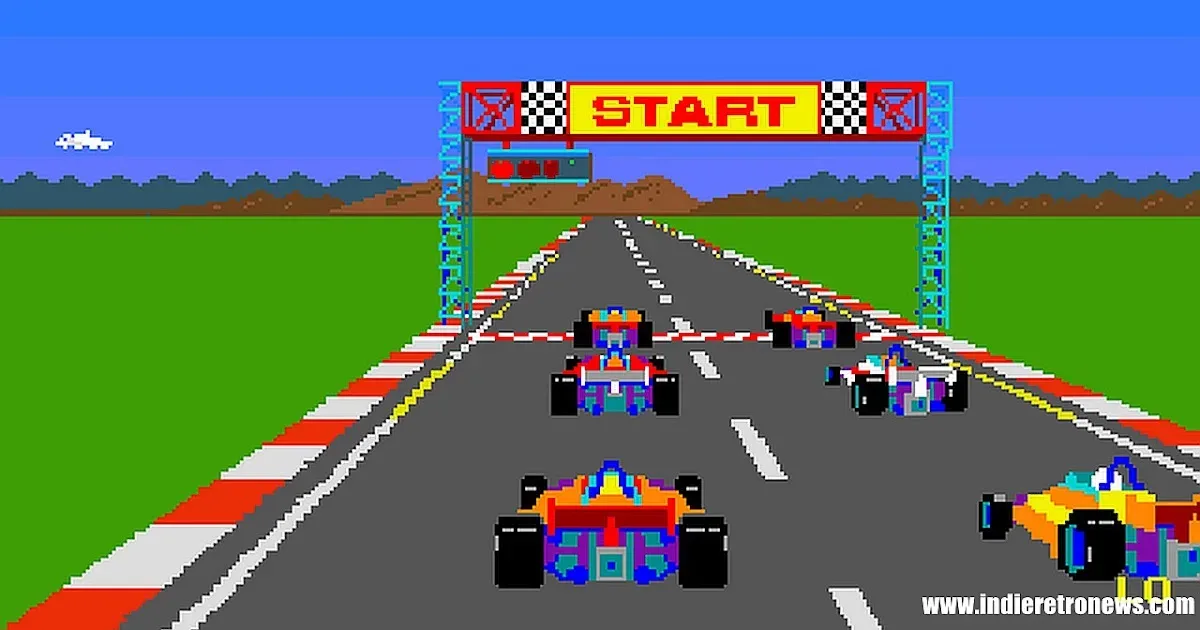
Pole Position Remastered, Jonathan Thomas’s new rebuild of Namco’s landmark 1982 arcade racer, has been released for the Atari STE and Commodore Amiga. The Amiga version supports OCS, ECS and AGA machines, while the game is designed to run on standard 1MB configurations. Systems fitted with 2MB or 4MB of memory can deliver smoother performance.
This is not presented as a lightly adjusted edition of an old home-computer conversion. Thomas has rebuilt the project from the ground up following his original Atari STE port from 2017. That earlier effort was made through manual reverse engineering; the 2026 remaster draws on his deeper familiarity with the target hardware and AI-assisted coding work.
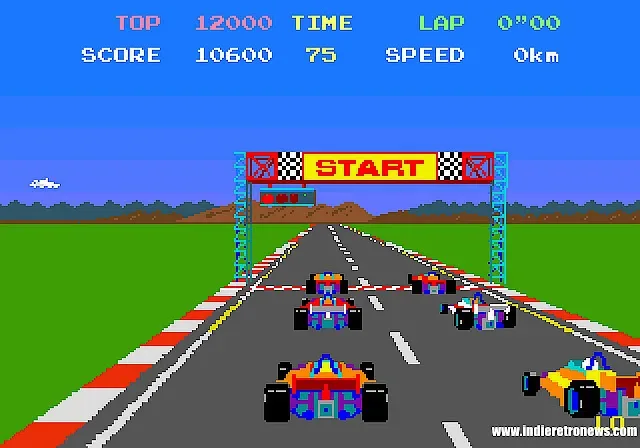
The stated goal is unusually specific: reproduce the original arcade machine’s game logic, graphics and sound while using the capabilities of Atari and Amiga hardware to get as close as possible to the coin-op experience. Its headline technical features are real-time sprite scaling and a 320×224 widescreen overscan display—two details that go directly to why Pole Position looked so striking in an arcade cabinet.
A fresh build rather than a nostalgic repaint
“Remastered” can mean many things in retro circles. Sometimes it describes a patch, a new presentation layer or an existing port given a few quality-of-life changes. Here, it means a full reconstruction of Thomas’s earlier work. The project revisits the foundation: arcade-derived logic, visual data and audio data are all part of the intended result.
That distinction matters for a game such as Pole Position. Its appeal rests less on a large volume of content than on the tight relationship between speed, road movement, traffic, timing and audiovisual feedback. A version can have the right car, track and logo-like presentation yet still feel substantially different if its handling rhythm, qualifying demands or road animation do not line up with the arcade design.
By aiming to bring across the original game logic as well as its graphics and sound, the remaster is pursuing fidelity at the systems level rather than just surface resemblance. That does not make “almost authentic” the same as a claim of perfect arcade equivalence, and the project is described in those measured terms. Still, the approach explains why this release is more consequential than a routine revival for two classic computer families.
Why sprite scaling is central to the experience
Sprite scaling is the process of making a moving image appear larger or smaller. In a racing game, it helps sell the illusion that cars, roadside objects and other track elements are approaching or receding at speed. Real-time scaling means that visual size is calculated and displayed during play instead of relying solely on a small set of pre-drawn sizes.
For Pole Position, that illusion is inseparable from the action. The player is not exploring a static circuit from a distant overhead camera. The game’s impact comes from being planted behind the wheel, seeing traffic swell into view, judging gaps quickly and reacting before the road becomes a crash scene. The arcade original made that forward-motion spectacle part of its identity.
Related coverage includes Pole Position Remastered Brings Namco's Arcade Racer to Amiga and Atari STE.
Achieving that effect on older home platforms is a meaningful technical target. The remaster’s real-time sprite scaling is therefore not merely a visual bullet point; it is one of the mechanisms intended to preserve the arcade racer’s sense of momentum. The accompanying 320×224 widescreen overscan presentation likewise prioritizes a broad, arcade-oriented playfield.
Overscan refers to using screen area beyond the conventional display boundaries normally exposed by a system’s standard video mode. In practical terms, the 320×224 widescreen overscan display is intended to provide a crisper, wider view than a more restrictive standard layout. For a driving game built around rapidly reading the road ahead, the shape and clarity of the visible field are part of the presentation rather than a cosmetic afterthought.
What Atari STE and Amiga owners need to know
The release covers the Atari STE and the Commodore Amiga’s OCS, ECS and AGA range. That broad Amiga support is important because it does not confine the game to the later AGA line. Meanwhile, the stated 1MB baseline means the project is playable on a standard machine configuration rather than requiring expanded memory simply to function.
Memory still matters. Thomas says 2MB and 4MB machines benefit from smoother performance. That wording is useful for setting expectations: owners of 1MB systems are not being told they are excluded, while players with expanded systems have a clear reason to expect a more fluid result.
Smoothness is particularly relevant in this genre. In a racer where the road and traffic must continuously communicate speed and danger, performance affects more than how impressive the screen looks in isolation. It can affect how legible the action feels from moment to moment. The remaster’s hardware guidance makes the trade-off straightforward: it is built to be accessible on 1MB machines, with additional memory offering a performance advantage.
Atari ST enthusiasts have recently had other reason to watch new work on the platform. Another Atari ST project has also focused on hardware-specific performance gains, underscoring how much interest remains in revisiting arcade-style design through the strengths of vintage systems.
The arcade legacy being revisited
Pole Position was designed by Sho Osugi and released by Namco in 1982. It followed earlier electro-mechanical racing games including F-1, but it became a much larger arcade force. Atari, Inc. distributed the game in North America.
Its commercial footprint was extraordinary. The game was Japan’s highest-grossing arcade title in its release year, rose to become the world’s most popular coin-op in 1983, and led North American arcade earnings through both 1983 and 1984. It remained among the region’s five highest-earning arcade games into 1985.
Those results help explain why preserving its feel remains an attractive challenge decades later. Pole Position was not simply an early racing game that happened to find an audience. It was a global arcade phenomenon whose visual speed and driving perspective helped define what players expected from a coin-operated racer of its era.
That history also gives context to the remaster’s priorities. An arcade game known for its sensation of speed needs more than a compatible control scheme to make the trip home convincingly. Scaling, display area, timing and sound all bear on the result. Thomas’s decision to rebuild the original port around exact arcade materials addresses the aspects most likely to shape the game’s identity.
AI assistance, disclosed without obscuring the craft
The project includes a clear disclosure that AI assistance was used for code. That is a relevant piece of production information, but it should not erase the rest of the stated development work. Thomas’s 2017 STE port was manually reverse engineered, and this remaster is described as the product of a ground-up rebuild informed by his own knowledge of the hardware.
In this context, “AI-assisted” describes a tool used during coding, not an explanation of the port’s historical research, platform understanding or implementation goals. The release’s claims of arcade-derived logic, graphics and sound, along with its support for several distinct vintage hardware configurations, point to a project with clear technical constraints that still require deliberate development choices.
For players, the practical takeaway is simpler than the debate around any one tool: Pole Position Remastered is a newly released, hardware-conscious attempt to bring one of arcade racing’s foundational games to the Atari STE and Commodore Amiga with its defining visual motion intact. Standard 1MB systems can run it, and expanded-memory machines stand to gain smoother action.
Why this release is worth watching
New software for legacy computers is often most interesting when it treats their limitations as design problems rather than excuses. This rebuild has a focused target: recreate an arcade classic’s logic, sights and sounds while making real-time scaling and a 320×224 overscan display work on machines from the Atari and Commodore ecosystems.
It is also a tribute with a practical purpose. A 1982 coin-op hit is being kept playable in a form tailored to vintage home hardware, rather than merely remembered as an influential cabinet. For STE and Amiga owners, the meaningful details are already on the table: compatible hardware, a 1MB entry point, better performance with 2MB or 4MB, and a remake built around the features that made the original racer move.