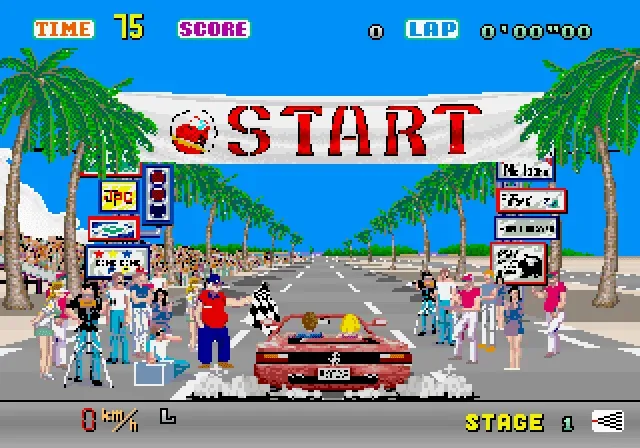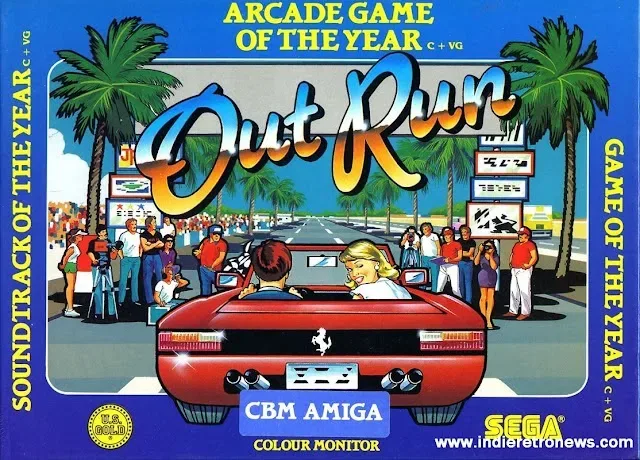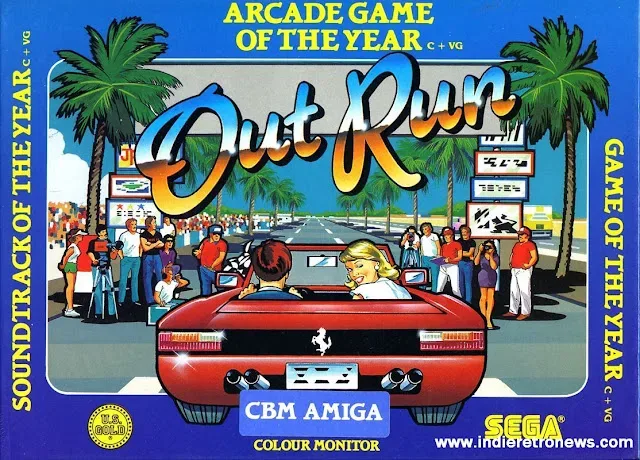
Few arcade games advertise their identity as efficiently as OutRun. A bright red convertible, long stretches of road, branching routes, traffic to thread through, and music that makes every near-miss feel suspiciously glamorous: Sega’s 1986 racer has remained a defining piece of arcade design for four decades. Now its anniversary has brought a modest but potentially important update to OutRun: Amiga Edition, a fan-made Amiga conversion built by reassembler.
The newly released build does not add tracks, modes, cars, or other headline-grabbing extras. Instead, it concentrates on something much more useful to anyone running it on original Commodore hardware: performance. The update is said to improve speed by up to 50% on real machines, depending on the situation. For a game whose entire personality is tied to the sensation of velocity, that is not the sort of anniversary present likely to be ignored.
It is also a fitting moment for this particular project. The original arcade OutRun, designed by Yu Suzuki and released by Sega in 1986, was a huge commercial success and a landmark racing game. Its memorable audiovisual presentation and route-selection structure helped distinguish it from racers centered solely on lap times or beating a fixed number of opponents. The destination was always ahead; the road was always asking whether players had the nerve to keep moving.
A performance update rather than a content overhaul
Reassembler has framed this release as a small, meaningful update made while work has also been going into Aonic, a port of Sonic the Hedgehog for the Amiga 1200. That context explains the narrow scope. This is not presented as a new feature package, and there are no gameplay changes listed alongside the performance work. Players satisfied with the earlier version do not necessarily need to update.
For those who do want the newer build, the changes fall into three technical areas:
- an adjustment to chunky-to-planar, or C2P, handling so portions of the display that have not changed do not need to be refreshed on every frame;
- improved handling of transparent pixels and shadows used by sprites;
- and a rewrite of frame rendering that removes the engine’s previous wait for the next screen refresh.
Those details may sound like the sort of thing that belongs on a workbench next to a screwdriver and a mug reading “I brake for copper traces,” but they connect directly to the experience on screen. A driving game continually redraws road surfaces, roadside scenery, other vehicles, shadows, and the player’s car while trying to preserve the illusion of a landscape rushing toward the viewer. Reducing unnecessary display work and making sprite processing more efficient can free up valuable time for the machine to keep the race moving.
The claimed gain is deliberately phrased as up to 50%, not as a universal fixed increase. That distinction matters. Performance can vary by hardware configuration and by what the game is doing at a given moment. Still, the target is clear: make the conversion feel more responsive and more consistently fast on the real Amiga systems it was designed to support.
What OutRun: Amiga Edition is—and is not
OutRun: Amiga Edition is described as an optimized port of Sega’s 1986 arcade game for mid-spec Commodore Amiga computers. It uses the original 68000 assembly code as a foundation, but it is not an emulator. It is also not built from Cannonball, MAME, or another existing OutRun project. Instead, it has been rewritten in assembler from the ground up with performance as a central goal.
Related coverage includes OutRun: Amiga Edition Update Targets Up to 50% Faster Performance.
That distinction is meaningful in the Amiga scene. Emulation is often the sensible path for preserving and accessing arcade software, but an optimized native conversion is pursuing a different question: how close can the arcade game’s look and motion come on the target machine when the software is designed specifically around that machine’s strengths and limitations?
The project acknowledges that compromises are necessary because the original arcade board and Commodore Amiga hardware are not the same thing. Even so, its stated ambition is to look and play almost identically to the arcade original. That is a large goal for a game often remembered as difficult to translate faithfully to home systems, particularly when fluid movement is a key part of the visual appeal.
Rather than attempting to turn the Amiga into an arcade cabinet by brute force, the project’s approach is to tailor the game engine for the computer’s actual architecture.
That is why a release focused solely on optimization can be more exciting than a menu full of cosmetic additions. In a project like this, every saved operation can matter. The road does not care that a processor had a complicated afternoon; it still expects to reach the horizon at full confidence.
Existing users have an easier route
There is one practical detail for current players: anyone already using version 0.9.2 does not need to regenerate game assets to use this update. That should make the jump to the new build less cumbersome for those who have already completed the setup process.
New users should be aware of a more important requirement. The project may require original graphics and audio data from the arcade ROMs. Those materials are not included, and users must source them themselves. The update does not change that situation. It is a technical distribution detail worth understanding before treating the release as a standard all-in-one download.
For Amiga enthusiasts, that setup requirement is part of a familiar reality: preservation-minded and hardware-focused projects frequently occupy a space where the executable work and the copyrighted game data are kept separate. It may be less plug-and-play than loading a modern storefront release, but it also reflects the unusual care being taken to rebuild the game code for a vintage platform rather than simply wrap it in a different runtime.
Why the 40th anniversary suits this particular update
Anniversaries tend to invite retrospectives, re-releases, commemorative artwork, and social-media screenshots of favorite stages. Here, the celebration takes a more mechanical form. The road runs quicker. The renderer behaves differently. Sprite transparency and shadows are processed more efficiently. It is the video-game equivalent of celebrating a classic sports car by carefully tuning the engine instead of hanging a banner over the garage door.
That feels appropriate for OutRun. The original was never only about arriving first. Its appeal was bound up in momentum, scenery, music, and a stylized version of travel that made the act of driving the attraction. An Amiga version that can devote more of its available resources to preserving that movement is doing more than polishing a technical curiosity; it is trying to protect the quality that made the arcade game memorable in the first place.
The broader retro-computing scene continues to produce projects that revisit machines long assumed to have already shown every trick they had. Sometimes that means entirely new games; sometimes it means better ways to approach old games. Recent activity around systems such as the ZX Spectrum shows that the appetite for fresh work on legacy platforms remains substantial, as seen with a recent ZX Spectrum release built around a nervous piglet and very intrusive enemies. The machines may be vintage, but the desire to refine, experiment, and surprise clearly is not.
A sensible upgrade for players chasing smoother roads
The absence of new features makes the update easy to describe. If the prior build already met a player’s needs, there is no stated requirement to replace it. If improved performance on physical Amiga hardware sounds appealing, this anniversary build is the version to investigate. Existing 0.9.2 users also have the advantage of not needing to regenerate assets.
That restrained approach is refreshing. The release does not pretend to be a sequel, a remake, or a new version of OutRun with a novelty paint job. It is an optimization pass on an already ambitious port: a practical effort to make a 1986 arcade icon run more effectively on the Commodore Amiga in 2026.
Forty years after Sega sent players speeding toward one of several possible destinations, the appeal remains obvious. The route still branches. The timer still nags. The traffic still appears to have been trained at the Academy of Lane Changes. And, with this new OutRun: Amiga Edition update, the Amiga’s trip down that sunlit highway may be considerably swifter.