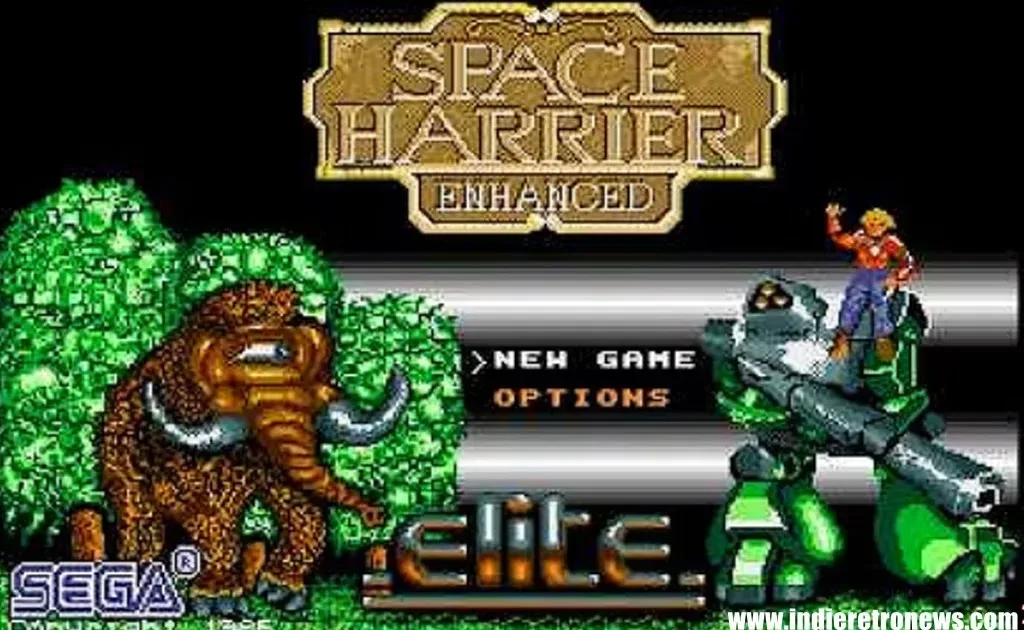
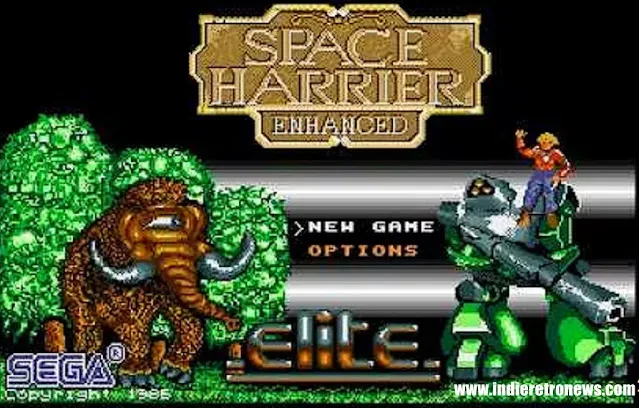
Space Harrier Enhanced is an ambitious refresh of the 1988 Atari ST conversion, aimed at making the high-speed arcade game feel more responsive and substantially smoother on Atari hardware. Developed by Obsolete Media, the project reports an engine performance increase of 75%, raising the game from 8.81 frames per second to 15.55 FPS, while reducing measured mouse latency from 124 milliseconds to 77 milliseconds.
Those are not merely decorative statistics in a game built around constant movement, rapid enemy fire and split-second avoidance. The original ST version had its admirers, but its low update rate and demanding feel stood in contrast to the 1989 Commodore Amiga release. Space Harrier Enhanced began as an exploration of what a 1989-style re-release, taking advantage of the Atari Blitter chip and STe hardware, could have looked like. It has become a broader revision that touches performance, presentation, controls and difficulty options.
A faster view of the action
Frames per second, usually shortened to FPS, describes how often a game updates the images it displays in one second. A higher number does not automatically settle every question about how a game plays, but an increase from 8.81 FPS to 15.55 FPS means the action is being presented more frequently. In a forward-scrolling arcade shooter such as Space Harrier, that has a direct practical implication: hazards and enemy movement should appear less delayed between screen updates.
The stated gain is especially notable because Space Harrier’s appeal rests on speed. It is not a turn-based game where a player has time to parse each situation at leisure. The game continually asks the player to steer through incoming threats while attacking at the same time. If the screen refreshes its action less often, players have less visual continuity when judging where danger is heading. Raising the update rate does not remove the challenge, but it can make the challenge easier to read.
Mouse response has also been a major focus. Space Harrier Enhanced reduces mouse latency from 124 ms to 77 ms. Latency is the time between an input and the corresponding response in the game. The 47 ms reduction is meaningful in a game that depends on directional correction. It should make steering feel more immediate, particularly when a player has to shift position quickly rather than hold a long, simple movement.
The project also adds single-pixel background scrolling. Rather than limiting scrolling to larger visual steps, this lets the background move in very small increments. It is the sort of change that may be difficult to isolate from screenshots, yet it complements the faster engine: a smoother-moving background can make a fast game’s motion feel more continuous. Full-screen support has been added as well.
What changes for ST and STe players
The enhanced version is designed around both the Atari ST and the more capable Atari STe, with the latter receiving additional features. The Blitter chip is central to the premise. In simple terms, a blitter is hardware that can assist with moving or copying graphical data, work that can otherwise consume time needed for other parts of a game. Here, the question behind the project was whether a later-era revision using that capability could have narrowed the gap with the Amiga version.
On the STe, Space Harrier Enhanced adds higher-quality audio samples, smooth stage fades and new colorful background modes. Those background modes take inspiration from the Amiga version and modern reimaginings. The result is not presented as a replacement history for the original conversion; it is a deliberate alternate path, built around the idea of an enhanced re-release that never arrived at the time.
Related coverage includes Space Harrier Enhanced Speeds Up Atari ST Classic With Major Performance Overhaul.
Loading has been addressed too, with faster loads and a progress bar. A progress bar does not itself reduce loading time, but it makes the wait legible by showing that loading is under way and how far it has progressed. The edition also saves high scores to disk, giving achievements persistence beyond a single session.
For retro-computer players, upgrades like these matter because they improve the overall rhythm around a game rather than only its headline visual effect. Faster loading shortens the path back to another attempt. Disk-saved scores preserve a reason to return. Full-screen options, updated scrolling and STe presentation additions help bring the game’s display and controls closer together as a cohesive experience.
Fairer challenge, without flattening the arcade spirit
Space Harrier Enhanced also makes a case that a more faithful arcade-like experience is not exclusively about speed. It introduces an optional two-hit energy system intended to make play fairer and closer to the cabinet’s feel. Crucially, it is optional. Players who want a different level of resilience can select it, while the available menu settings give users control over how they approach the game.
Bosses now use arcade-style flashing weak points. A weak point is the part of an enemy that players need to target to damage it effectively. Making that area flash gives a clear visual signal amid the on-screen chaos. That does not reduce the need to evade or aim, but it can reduce ambiguity about the intended target.
The new title menu includes settings for lives, starting stages, screen sizes and music. Starting-stage selection is particularly useful in an older arcade-style game because it allows players to revisit later material without necessarily replaying every earlier section. Adjusting the number of lives lets players tune a session for practice or a more traditional attempt. These are practical accessibility and replay options, even though the project does not position them with modern terminology.
An automatic attract mode is included as well. Attract modes are demonstrations that run when a game is left idle, a familiar feature of arcade machines. In this context, it helps reinforce the project’s cabinet-oriented intent while offering a way to see the game in motion before taking control.
A compact project with a technical focus
Obsolete Media completed the work over roughly seven weeks, spanning late September to mid-November 2026. The reported process involved 70 hours of hands-on direction, benchmarking and playtesting, alongside 927 prompts used with ChatGPT while overhauling the code.
That breakdown is worth reading carefully. The prompt count describes one part of a workflow, not an automatic measure of the game’s quality or a substitute for technical validation. The hands-on work is equally important to the story: benchmarking establishes measurable performance comparisons, while playtesting is how a creator assesses whether the changed timing, control response and balance actually work together during play.
The delivered numbers give the project a clear benchmark-driven identity. The original 8.81 FPS and revised 15.55 FPS figures make the performance claim concrete, while the 124 ms and 77 ms latency measurements define the control-oriented goal just as clearly. Improvements to frame rate and input delay often interact in the player’s perception: smoother on-screen motion can make a game easier to interpret, while faster input response makes it easier to act on that interpretation.
There is also an important distinction between the standard ST-oriented changes and the extras for STe users. The base overhaul includes the faster engine, lower mouse latency, full-screen support, smoother background scrolling, loading improvements, saved scores and gameplay/menu changes. STe ownership adds a further audiovisual layer through improved samples, stage fades and additional colorful backgrounds. That structure gives the project a broader purpose than a hardware-exclusive showcase while still recognizing the STe’s advantages.
Why this revision is notable
Retro releases and revisions can sometimes be reduced to a list of technical features. Space Harrier Enhanced’s details point toward a more specific goal: improve the connection between what players see, what they input and how clearly the game communicates its rules. The increased update rate addresses motion. The latency reduction addresses control. Flashing boss targets address readability. The two-hit option and adjustable lives address difficulty. Faster loading and saved scores address the surrounding routine of playing again.
That does not mean every player will want identical settings. A person looking for a challenging arcade-style run may make different choices from someone using a later starting stage to practice. The menu’s value is that it supports both approaches without treating one as the only valid way to play.
The Atari ST and Amiga comparison also provides useful context for the project’s direction. The 1988 ST conversion existed before the 1989 Amiga release, and Space Harrier Enhanced explicitly imagines an alternate follow-up that made use of the Blitter and STe hardware. It is not trying to erase the original port’s place; it is examining how much more responsive and polished that branch of the game could be with targeted revisions.
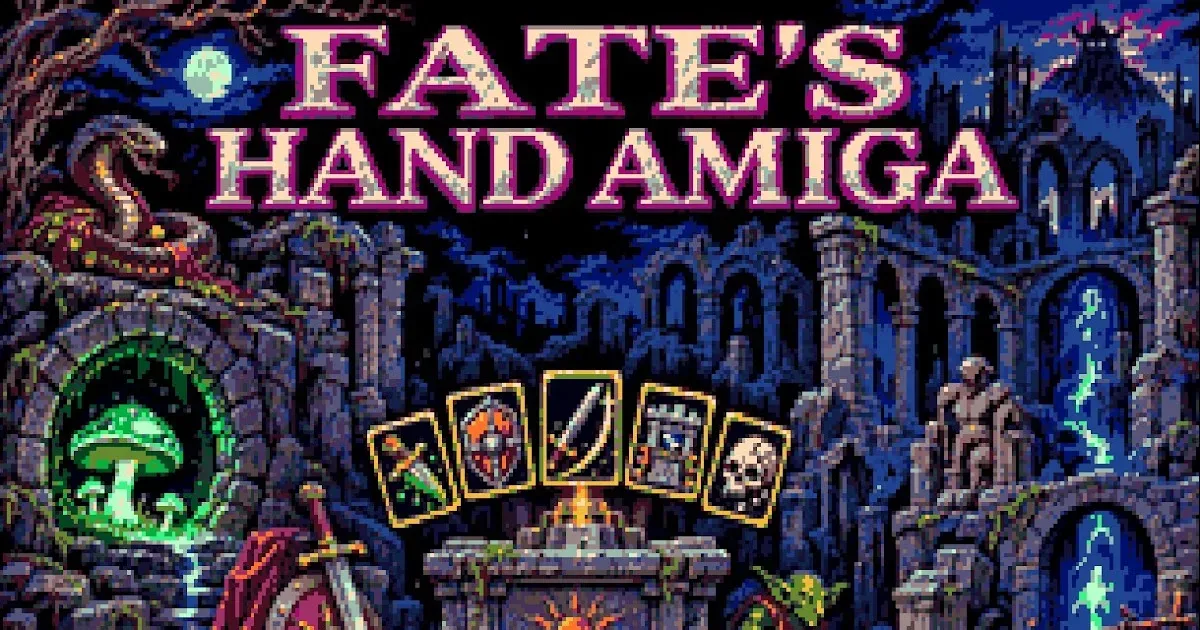
For readers interested in another current example of software arriving on classic Commodore hardware, Fate’s Hand Amiga brings a 40-stage deck-building quest to the Amiga. Space Harrier Enhanced approaches the retro scene from a different direction: not a new game for an older system, but a comprehensive attempt to revisit an existing conversion through the performance and hardware opportunities that were available to it.
Ultimately, the strongest case for Space Harrier Enhanced is its combination of measurable targets and player-facing adjustments. It reports a markedly faster engine, lower mouse delay and a range of quality-of-life additions, then pairs those changes with STe-specific flourishes and configurable challenge options. For Atari ST and STe enthusiasts, it is a focused technical reworking of a classic conversion that asks a compelling counterfactual: what if this version had received one more serious pass in its own era?