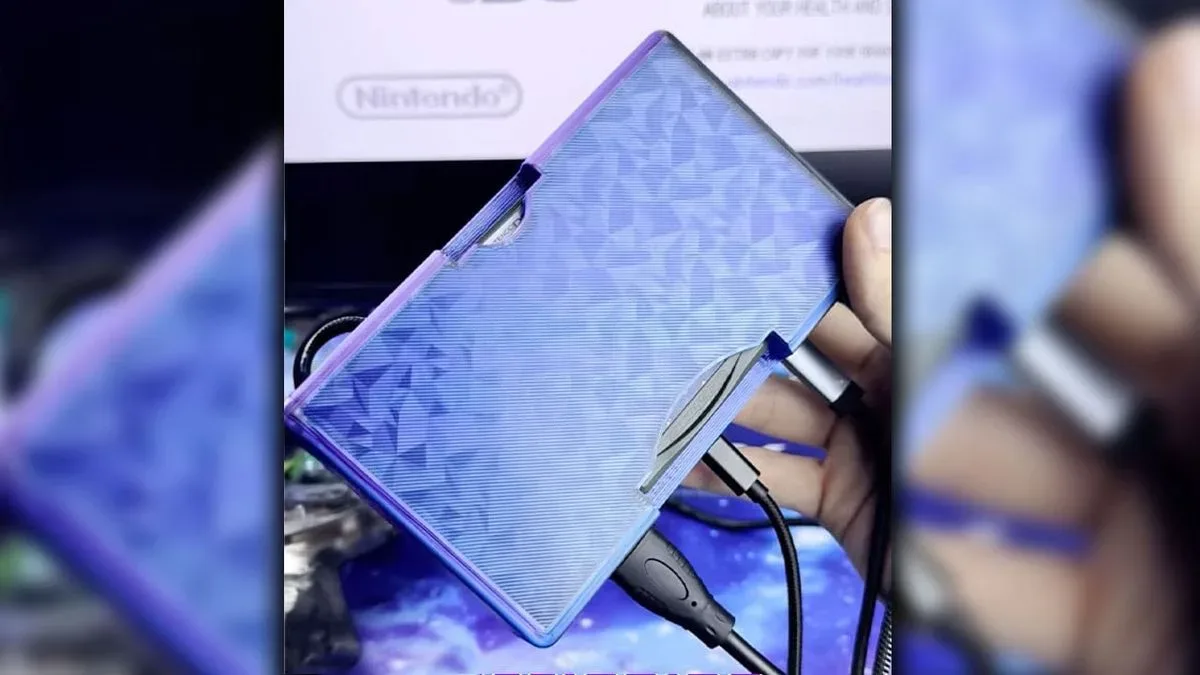
A Nintendo DS was designed around a simple proposition that has remained unusually difficult to recreate away from the handheld: two screens, one of them touch-enabled, working in tandem with physical buttons. A new prototype called the Dual Station approaches that challenge from a different direction. Rather than emulating the system or merely displaying a handheld on a larger screen, it uses an original Nintendo DS motherboard inside a home-console-style build.
Created by modder Kouzex, the Dual Station is intended to let owners use original DS and Game Boy Advance cartridges on a TV or monitor through HDMI. It also supports wireless controllers and offers selectable single-screen and dual-screen modes. The feature that gives the project its real identity, though, is touchpad support: a compatible PlayStation 4 or PlayStation 5 controller can be used to tap, type, swipe and draw in ways normally handled by the DS stylus.
It is still a prototype, and Kouzex is currently designing kits for people who may want to build a Dual Station themselves. That status is important. The available details establish the project’s direction and core functionality, but do not yet establish a release date, price, final kit contents or broad availability.
What the Dual Station is trying to solve
The DS is not simply a handheld that can be transplanted onto a television without compromise. Its games were made around two separate displays and around direct stylus interaction. For some titles, the lower screen is a map, menu or inventory space. In others, it is central to play, asking users to write, select, manipulate objects, enter text or draw. Moving the image to a TV handles visibility, but not necessarily the input problem.
The Dual Station’s design addresses both sides of that equation. HDMI is the video connection used by modern televisions and monitors, so it provides a straightforward route from the rebuilt system to a larger display. Meanwhile, the option for single-screen or dual-screen display modes acknowledges that DS software does not use its two panels in one universal way.
A single-screen arrangement may be useful when one screen carries the main action and the other is needed only intermittently. A dual-screen arrangement, by contrast, preserves the basic visual relationship that defines the platform. The key point is not that either layout is automatically ideal for every game; it is that a fixed one-screen presentation would not fit the DS library particularly well.
The project also includes a DS game slot and a GBA game slot. That keeps the physical cartridge experience at the center of the setup. Owners would use original carts rather than needing to rely on a software library supplied by the device itself.
Why using an original motherboard matters
The Dual Station is built around the motherboard from a Nintendo DS. In practical terms, the motherboard is the original system’s main circuit board: the component that carries the console’s essential electronics. Rehousing it in a new enclosure changes the form factor, ports and control arrangement, while retaining the underlying DS hardware.
Related coverage includes Dual Station Prototype Turns an Original Nintendo DS Motherboard Into an HDMI Home Console.
That makes this a hardware modification project rather than a conventional new console. It is also distinct from an emulator-based setup. Emulation generally means software reproducing the behavior of another machine. Here, the goal is to adapt genuine DS hardware for a different setting: a television, monitor and wireless controller rather than the original clamshell body and built-in controls.
For players with a DS that has suffered case, hinge or screen damage, a motherboard-focused build could potentially offer a new use for surviving internal hardware. However, prospective builders should not assume that every damaged unit is suitable or that the kit will repair a non-functioning board. No compatibility criteria, assembly requirements or restoration guidance have been detailed for the planned kits.
It is also worth separating the project from the idea of dismantling a working handheld. The Dual Station concept does not require someone to break up an intact DS specifically for the conversion. The relevant component is the motherboard, opening the possibility of using one sourced separately. That is a meaningful distinction for hobbyists who would rather preserve complete systems.
The touchpad is the crucial controller feature
Wireless controller compatibility is useful on its own, but it does not fully solve DS controls. The platform’s original stylus is a direct pointing tool. A standard gamepad has buttons, sticks and directional controls, yet none of those inherently replicate touching a position on a screen.
The Dual Station’s touchpad support is therefore the technical feature to watch. When using a PlayStation 4 or PlayStation 5 controller, the touchpad can be used for actions including tapping, typing, swiping and drawing. Those are exactly the categories of interactions that would otherwise make a couch-based DS setup feel incomplete.
That does not mean a controller touchpad and a handheld stylus are identical experiences. A stylus is held directly over a dedicated lower display; a controller touchpad is operated indirectly while watching a TV or monitor. The physical feel, precision and comfort may differ depending on the game and task. The available information does not make performance claims about sensitivity, latency, calibration or game-by-game behavior, so those questions remain for the eventual kit and its builders to answer.
Still, the design choice is significant. A DS-to-TV modification without a credible touch solution would be best suited to games that barely use the lower screen. Including touchpad input broadens the kinds of software the device is attempting to accommodate.
What remains unknown before a kit arrives
The Dual Station is promising precisely because it has moved beyond a rough idea into a working prototype direction, but prototype projects should be viewed with the appropriate caution. Hardware design often involves refinement after the first build, especially where custom cases, controller support, video output and user assembly intersect.
Several practical details have not been specified. There is no confirmed timetable for the kit, no stated cost, no final list of included parts and no public indication of the level of soldering or technical experience required. There is also no detailed compatibility list for wireless controllers beyond the stated PlayStation 4 and PlayStation 5 touchpad use case.
Potential builders should also avoid treating “HDMI output” as a blanket statement about image presentation. The prototype is described as outputting to TVs and monitors, but no further technical specifications have been provided about display resolution, aspect presentation, scaling options or how the two DS screens are arranged in each mode. Those details can substantially affect the experience, particularly when a game uses both panels at once.
None of that detracts from the underlying idea. It simply defines the difference between an exciting prototype and a retail-ready product. The appropriate expectation now is a buildable-kit project in development, not a guaranteed plug-and-play system that can be ordered immediately.
A practical new role for aging handheld hardware
Kouzex has previously explored ways of changing how established Nintendo hardware is used, including a Switch-style docking concept for the Nintendo 3DS and a Wiimote Joy-Con project. The Dual Station continues that broader interest in rethinking the physical relationship between older systems, controllers and displays.
In that sense, the appeal is larger than HDMI alone. The DS has always been strongly associated with portability, its folding form and stylus-first interaction. A rebuilt home console asks what happens when those constraints are removed but the original board and cartridges remain central. The answer appears to be a setup aimed at shared screens and wireless play while preserving the two-screen logic that made the hardware distinctive.
That sort of reuse also fits an era in which the cost and longevity of hardware are increasingly part of the conversation. Longer hardware generations and rising costs have become a major industry discussion, while projects like Dual Station show the enthusiast side of extending older devices’ usefulness rather than treating their original shell as their final form.
For now, the Dual Station is best understood as an inventive DS motherboard conversion with a particularly thoughtful answer to touch input. Its DS and GBA slots, wireless controller support, HDMI connection and switchable display modes make it an ambitious repackaging of familiar hardware. Whether it becomes a broadly practical DIY kit will depend on the still-unannounced details of its final design, assembly process and availability.