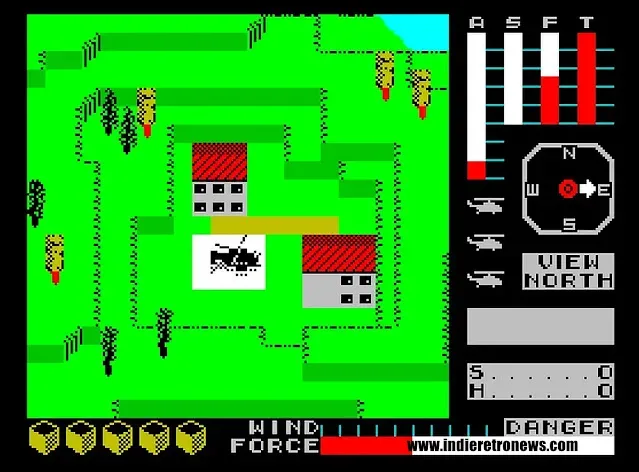
More than four decades after Cyclone first appeared on the ZX Spectrum in 1984, the helicopter rescue game has received an unofficial Amstrad CPC 128K conversion. Developer NBSystems is behind Cyclone CPC, a version intended to fill a conspicuous gap in the game’s original 8-bit history: despite its Spectrum roots, Cyclone did not arrive on the CPC during its original era.
The new port retains the game’s core premise while building a presentation specifically for Amstrad hardware. NBSystems’ version includes CPC-focused visuals, new graphics, smoother movement and an original soundtrack. That makes this more than a simple change of platform label: it is a dedicated attempt to translate a classic design to a machine that missed out the first time around.
A rescue mission with weather as the enemy
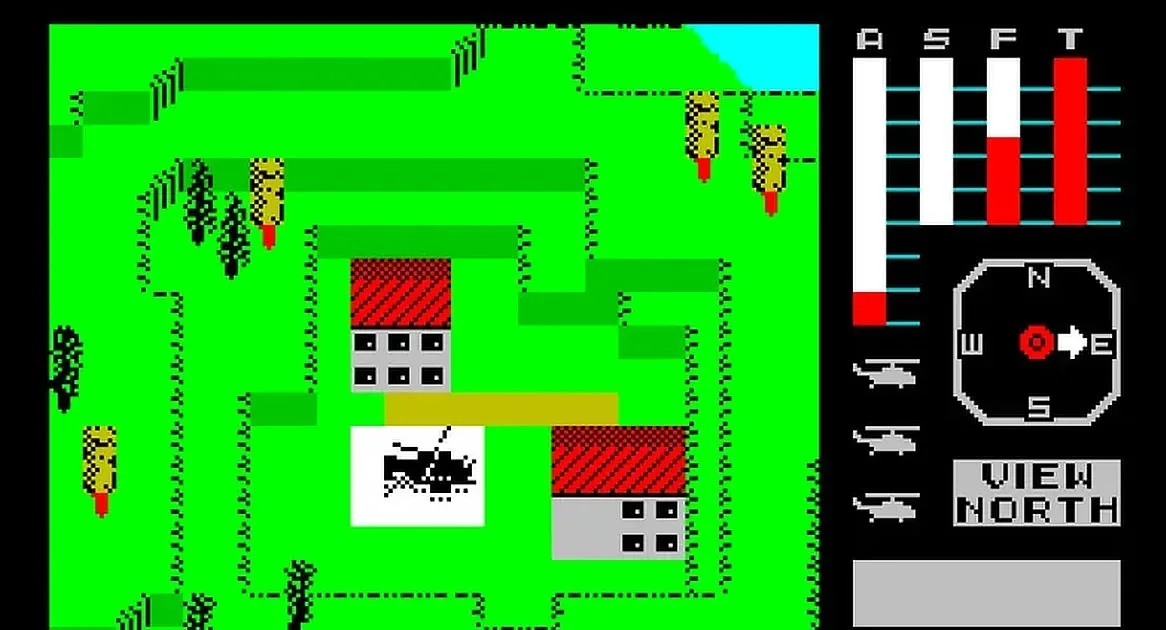
Cyclone puts players in control of a rescue helicopter operating across an archipelago of 14 islands. The objective is to locate and recover five crates of essential medical supplies. The assignment sounds straightforward only until the title’s central threat enters the picture: a roaming cyclone can destroy the helicopter at any moment.
That hazard gives the game its urgency. Players are not merely travelling from point to point to gather objectives; they must also judge when to press onward, when to alter course, and how to avoid a lethal moving danger while crossing a broad island chain. In practical terms, the rescues and the navigation are inseparable. A route that seems efficient can become risky if the cyclone closes in, while a cautious detour may cost valuable momentum.
The phrase multidirectional action describes games that allow movement in more than the simple left-and-right plane associated with many side-scrollers. Here, it suits a helicopter game built around navigating a wider landscape rather than following one fixed corridor. The archipelago structure also means the player’s attention is divided between immediate piloting and the larger task of finding every required crate.
From Tornado Low Level to Cyclone
The original Cyclone was created by Costa Panayi, a co-founder of Vortex Software, as a sequel to Tornado Low Level. Its relationship to that earlier game helps explain the emphasis on aerial control and a hostile weather phenomenon. Yet Cyclone establishes its own rescue-focused structure, centring the search for medical supplies across multiple islands and the ongoing pressure of the cyclone.
Its premise is particularly well suited to the tension of 8-bit action design. The mission has a clearly stated goal—recover five crates—but the threat is not restricted to a single set-piece or a final encounter. The cyclone roams, turning the environment itself into an active source of danger. Rather than simply memorising where an obstacle sits, players must react to a changing situation while maintaining control of the helicopter.
That balance between exploration and threat management is why a faithful gameplay loop matters in a new version. The CPC conversion is described as retaining the original loop while modernising its Amstrad presentation. For players familiar with the Spectrum game, the attraction is the chance to revisit its rescue mission in a format designed around a different machine. For those encountering it for the first time, the essentials remain clear: search the islands, retrieve the supplies, and do not let the storm end the flight.
Related coverage includes Cyclone Finally Reaches Amstrad CPC 128K in Unofficial NBSystems Port.
What the CPC 128K conversion changes
NBSystems’ port is positioned as an Amstrad-specific production rather than an attempt to erase the Spectrum original. The supplied details identify four headline enhancements: CPC visuals, new graphics, smoother movement and an original soundtrack. Each speaks to the adaptation work involved when a game moves between distinct 8-bit platforms.
CPC visuals means the presentation has been built with the Amstrad CPC in mind. New graphics likewise indicate visual material made for this conversion, rather than relying solely on the original game’s artwork. These details are important because the project is not framed as a historical re-release of an existing CPC edition; it is an unofficial port finally bringing a game to a platform it skipped in its initial run.
Smoother movement refers to how consistently and fluidly the helicopter appears to travel on screen. In an action game where navigation is the main activity and the cyclone is a constant danger, movement readability has practical consequences. Clearer motion can make it easier to judge position, change direction and react to the wandering storm. It does not change the mission objective, but it can change how comfortably players engage with its demands.
The original soundtrack is another defining addition. Music is a major part of the identity of a new platform version, especially when its stated goal is to give a long-absent game a proper CPC presence. The soundtrack is presented as new material for this release, complementing the graphics and movement work rather than simply duplicating the Spectrum experience.
Why an unofficial port matters
An unofficial port is a conversion produced outside an original commercial release cycle. In this case, that status is central to the story: Cyclone is reaching the Amstrad CPC 128K long after the period in which an official CPC edition would ordinarily have been expected. The project therefore serves both as a playable game and as a corrective to an old platform omission.
It also underlines how retro platforms continue to receive new work. The hardware is historic, but the audience for fresh conversions and platform-tailored versions remains active enough for developers to revisit games that were previously unavailable on a particular machine. This is not the same thing as a remake with a newly described feature set or a replacement for the original. The available information instead points to a respectful conversion: the classic gameplay framework is retained, while the Amstrad edition gains presentation work designed for its new home.
For CPC players, the benefit is direct. A game associated with the ZX Spectrum can now be approached as a CPC 128K experience, with its own graphics, soundtrack and movement refinements. For retro-game followers more broadly, it is another reminder that platform libraries are not always frozen at the point commercial support ended. A missed game can still find its way to the machine it bypassed.
The challenge at the heart of Cyclone
The rescue structure gives Cyclone CPC a useful mix of priorities. The five medical crates define completion, while the 14-island setting creates the space in which the search takes place. The cyclone supplies the pressure that prevents the task from becoming a leisurely tour of the map.
- Primary objective: recover five crates of medical supplies.
- Play space: an archipelago consisting of 14 islands.
- Vehicle: a rescue helicopter.
- Persistent danger: a roaming cyclone capable of destroying the helicopter.
- Core skill: balancing deliberate navigation with the need to complete urgent rescue runs.
Those elements create a compact but meaningful decision loop. The player needs to cover ground, but cannot treat the islands as a static checklist. They need to focus on the supplies, but cannot disregard the storm’s location. This is where the name Cyclone is more than a theme: the weather threat shapes the pace of every attempt.
The port’s smoother movement may be especially welcome in that context, because the game asks for continuous piloting under pressure. Meanwhile, the new CPC graphics and music give the version an identity of its own without changing the fundamental rescue-em-up concept that defined the original.
A new reason to revisit 8-bit flight action
Cyclone CPC joins the ongoing stream of projects that keep older computer formats in circulation through new software rather than nostalgia alone. The CPC 128K conversion gives a 1984 game a new route to players who prefer Amstrad hardware, while preserving the premise that made it distinctive: a helicopter, scattered medical supplies, a chain of islands and a deadly storm that refuses to stay out of the way.
It is also a useful companion piece to the wider interest in new games and projects for vintage computers. For another example of a contemporary retro-platform effort, see Woody’s World, an ambitious Amiga platformer built for curious players.
NBSystems’ work does not need to rewrite Cyclone to make the conversion notable. Bringing the game to the CPC 128K at all addresses the historical absence, and the added visuals, graphics, movement polish and original music give that arrival a distinct character. Four decades after its Spectrum debut, the storm has finally reached the Amstrad—along with the helicopter mission at its centre.