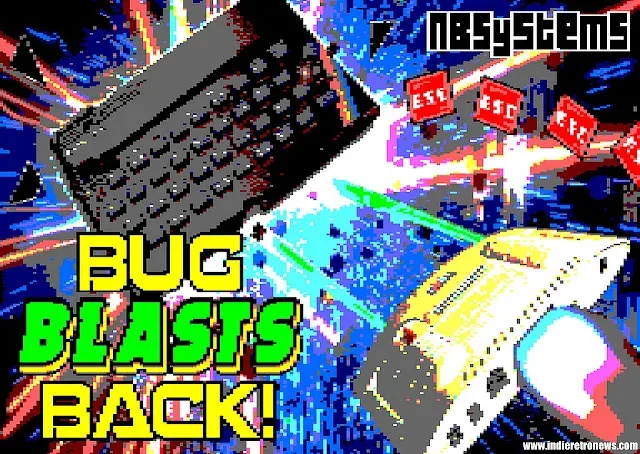
Bug Blasts Back! is a newly revealed vertical shoot-’em-up for the Amstrad CPC from NovaBug, also identified as NB Systems. The game frames its retro hardware action as a defiant counterattack: players pilot the GX-4K fighter on the orders of Field Marshal Novabug, taking on rival factions accused of overlooking the “CPC Empire” for more than four decades.
That premise is knowingly theatrical, but it also gives the project a clear identity. Rather than simply presenting a new game for old hardware, Bug Blasts Back! uses the machine’s place in 8-bit culture as part of its fiction. The Amstrad CPC is not merely the platform running the game; it is the side being defended.
NovaBug describes Bug Blasts Back! as its debut vertical shooter for the CPC. Its stated feature set includes six levels, more than 14 enemy types and hazards, major boss encounters, three selectable difficulty settings, a demo mode, a high-score table and an original soundtrack. The developer also says the game runs with smooth scrolling at 50 frames per second.
A vertical shooter built around forward pressure
A vertical shoot-’em-up, often shortened to shmup, is a game in which the action advances up the screen rather than across it. The player’s ship typically has to deal with incoming enemies, projectiles and stage obstacles while the playfield continues to move. That design puts a premium on rapid reading: a threat can come from an enemy formation, a fixed hazard in the scrolling environment, or the overlap between both.
Bug Blasts Back!’s six-level structure suggests a concise arcade-style campaign rather than an open-ended format. The supplied details do not define each level’s setting, enemy patterns, weapons or scoring rules, so those elements remain unknown. What is clear is that the game intends to vary the opposition with more than 14 distinct enemy and hazard types, before escalating to large boss battles.
Bosses have an especially important role in this kind of game. They act as a punctuation mark at the end of a stage and usually ask the player to recognize attacks, find safe routes through them, and keep firing under pressure. The description calls Bug Blasts Back!’s bosses “massive,” but does not provide mechanical details. Players should therefore treat that as a statement of scale and presentation, rather than a confirmed measure of sprite size, encounter length or difficulty.
What 50FPS scrolling means here
The developer’s 50FPS claim refers to the game updating at 50 frames per second. In practical terms, that target is intended to make the vertical movement of the stage and the response of on-screen action look fluid. Scrolling is more than a visual flourish in a shooter: it determines how quickly new space, enemy waves and hazards arrive, which in turn shapes the rhythm of play.
“Smooth scrolling” should not be confused with an automatic guarantee that every part of a game feels easy or slow. A smooth presentation can make dense action easier to parse, but challenge still depends on elements such as enemy placement, projectile speed, collision rules and the player’s available movement. None of those systems has been detailed for Bug Blasts Back!, so the 50FPS figure is best understood as a technical performance target cited by its creator.
Related coverage includes Bug Blasts Back! Takes the Amstrad CPC Into a New Vertical Shooter Campaign.
It is nonetheless a meaningful point of emphasis for a vertical shooter on vintage hardware. In a genre based on moment-to-moment positioning, consistent screen movement supports the central loop of spotting danger, moving the ship, firing back and preparing for the next section of the level.
Difficulty settings, demo mode and score chasing
NovaBug says the game will include three difficulty settings. Multiple settings can serve two audiences at once: newcomers can choose a more approachable starting point, while experienced players can pursue a higher-pressure version of the same campaign. The announcement does not say exactly what changes between the modes. Enemy density, lives, damage, scoring and attack patterns are all common ways a shooter can tune difficulty, but no particular approach has been confirmed here.
The high-score table is another strong fit for the format. A score table turns a completed run into something that can be revisited and improved, whether the objective is surviving further into the campaign or optimizing performance across all six stages. It is worth noting that a high-score feature does not by itself reveal the game’s scoring system. There is no confirmed information on multipliers, bonuses, chaining, extra lives or stage-clear awards.
A classic demo mode is also listed among the features. In retro game terminology, a demo mode commonly refers to an attract sequence that shows the game in motion, sometimes by playing back an example run. The supplied information does not specify how Bug Blasts Back! implements its demo mode, but its inclusion complements the project’s overtly arcade-minded presentation.
An original soundtrack alongside handcrafted work
The project is said to feature an original custom soundtrack. Music is often a key part of a shooter’s stage identity, helping establish tempo while the action remains visually busy. There are no track names, audio specifications or composer credits in the available details, so the safest reading is simply that the game has newly created music rather than relying on an identified pre-existing score.
NovaBug has also provided an AI-use disclosure. Claude Code was used to assist with assembly-language coding, while BASIC and some assembly code, the graphics and the music were created manually. Assembly language, often written as ASM, is a low-level programming language that works close to a computer’s processor instructions. BASIC is a higher-level language that was widely associated with home computers. The disclosure distinguishes code assistance from the portions identified as manually created, without claiming that all code was produced in only one way.
That level of attribution is useful because “AI-assisted” is a broad phrase. In this case, the disclosure narrowly identifies assistance with ASM coding and separately names the manually created BASIC and ASM work, graphics and music. It does not provide a fuller development breakdown, so no broader claims about the production process can be made from the information available.
A new CPC project amid an active retro scene
Bug Blasts Back! arrives as another example of developers continuing to make new work for older systems. The project’s comic-book command structure and “CPC Empire” language make its hardware allegiance explicit, turning a playful rivalry into the basis for a shooter campaign. The GX-4K and Field Marshal Novabug may be fictional military-style names, but the stated goal is straightforward: fight through a sequence of scrolling stages, survive the hazards and push a score higher.
For readers following new games built around legacy machines, it sits naturally beside other recent hardware-focused releases, including a rebuilt adventure designed for stock Amiga 1200 hardware. The systems and genres differ, but both projects reflect the continuing interest in creating within clearly defined vintage-platform constraints.
There are important details still to be established for Bug Blasts Back!, including its release timing, distribution method, price, supported CPC models and control options. The announced information is focused on the core game: a 50FPS vertical scrolling shooter with six levels, a varied set of enemies and hazards, boss fights, adjustable difficulty, a demo mode, score competition and an original soundtrack. For now, that makes it a compact but distinctly CPC-centered arcade proposition.