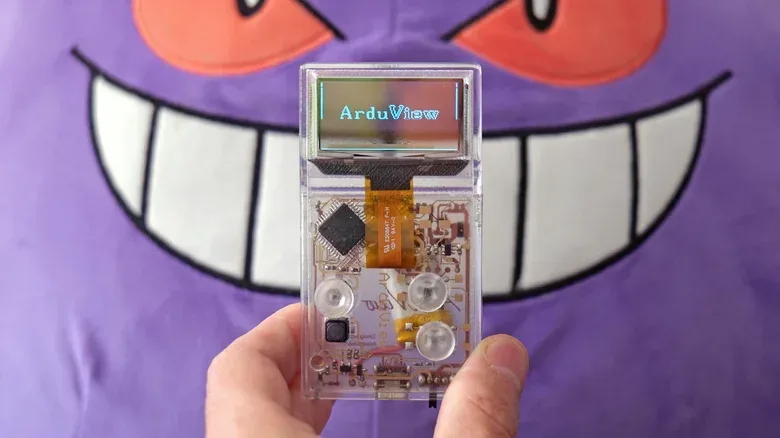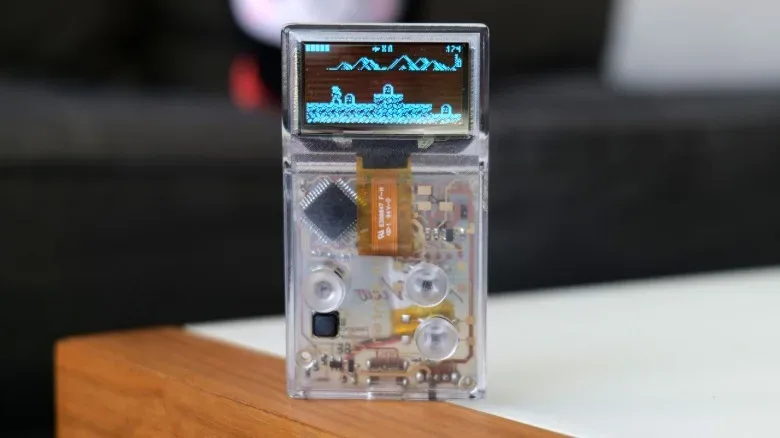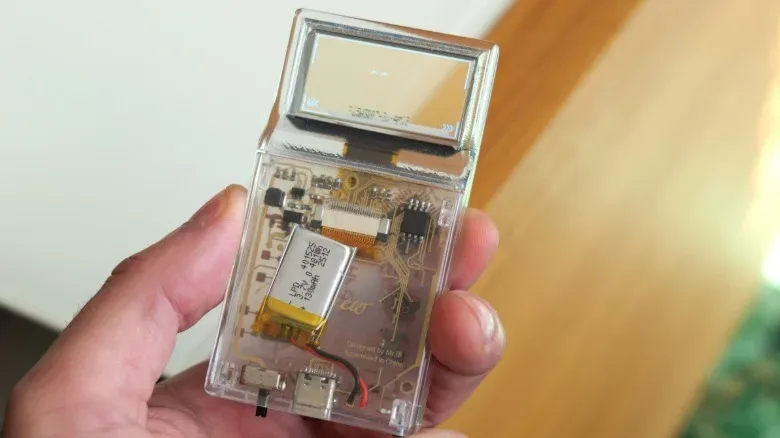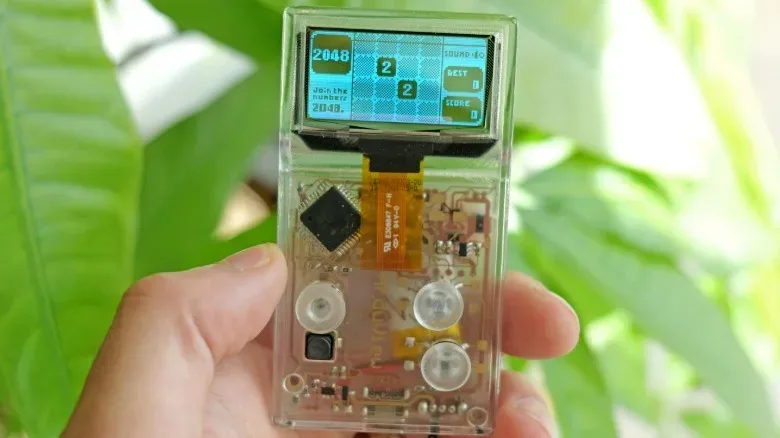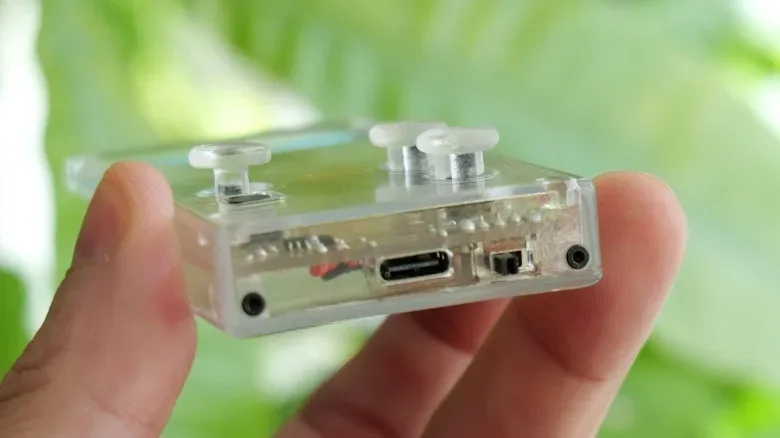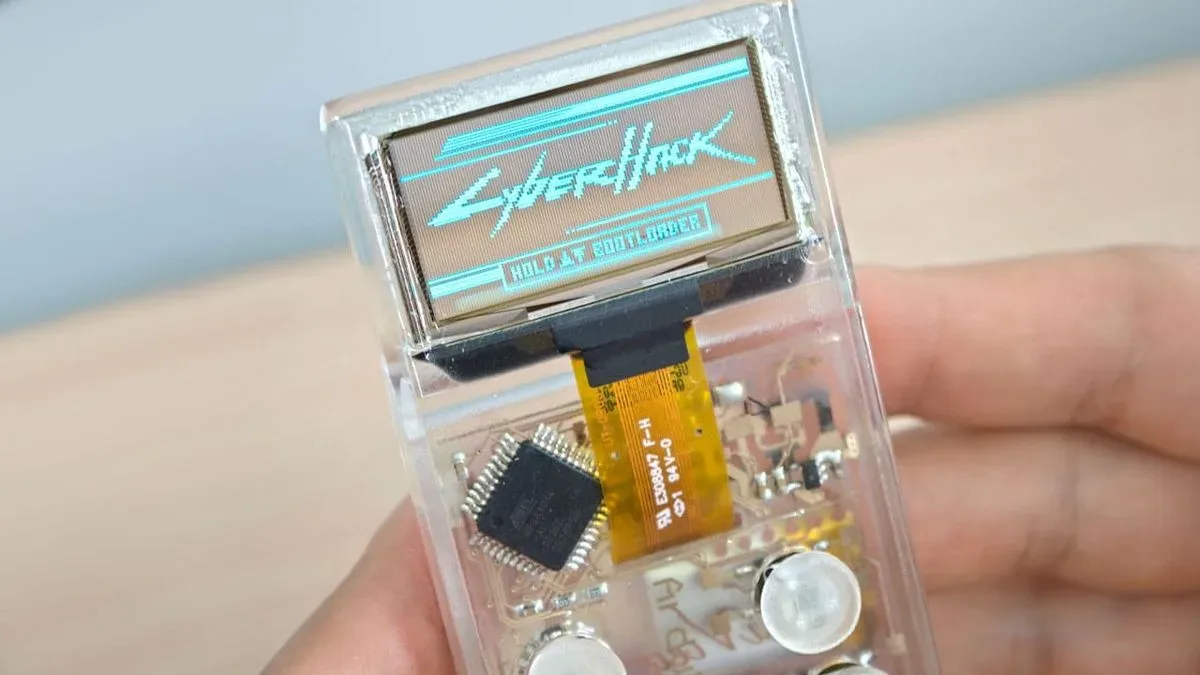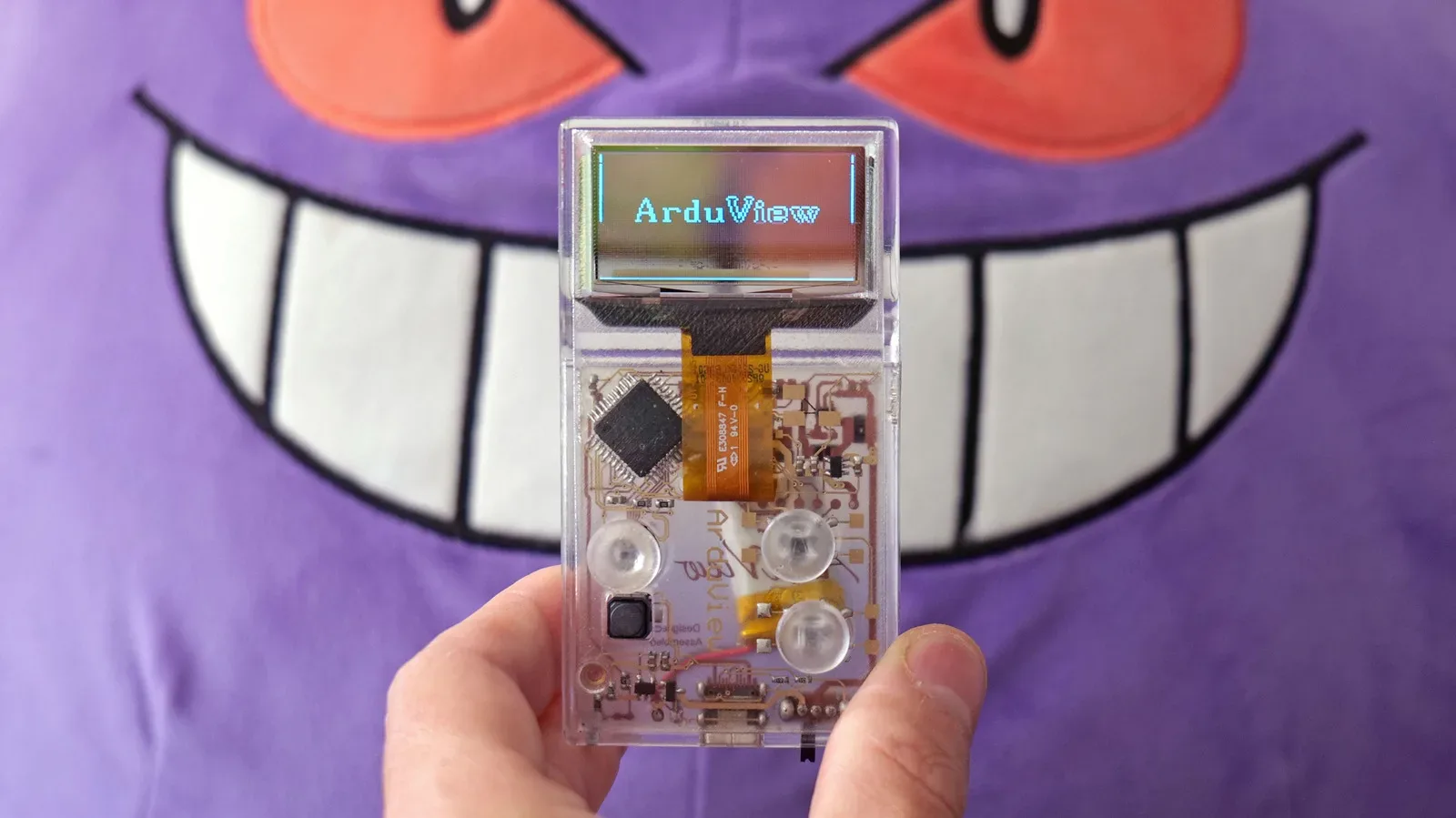
The Arduview is a tiny handheld built around an idea that is instantly legible to anyone who remembers translucent gaming hardware: show the machine rather than merely wrap it in clear plastic. Its casing is see-through, certainly, but the more unusual detail is the effort to make the buttons, joystick, circuit board and even the display visibly transparent to varying degrees.
That makes the device a design-led homage to the clear and colored translucent gadgets associated with earlier portable-console eras. The company describes it as the world’s first transparent game console, a claim that should be treated cautiously: not every part is equally transparent, and “first” claims often depend heavily on definitions. Still, the distinction that matters here is not the slogan. It is that the visual experiment reaches substantially further than a conventional clear shell.
Underneath that highly visible construction is a deliberately modest 8-bit handheld based on the open-source Arduboy project. It is not trying to be a current-generation portable, emulate a broad catalogue of high-end systems, or replace a player’s main gaming device. The stated appeal is a pocketable collection of short, simple games—and an object whose hardware is part of the attraction.
A screen designed to be looked through
The standout component is a 1.51-inch transparent display with a resolution of 128 by 64 pixels. Those figures describe a very small screen with a limited pixel grid, not a display intended for dense artwork or modern interface complexity. In practical terms, that resolution suits clean 8-bit-style visuals, simple menus and games built around immediately readable objects and rules.
Transparency is the feature that makes this panel notable, but it also raises an obvious usability question. A screen that lets light and background detail through can potentially make game graphics harder to read. The available report on a pre-production unit says the display was bright enough to remain visible in a sunny room. That is encouraging, but it should not be treated as a full production-unit verdict. Final hardware, calibration and manufacturing consistency still matter.
The screen also makes sense in the context of the device’s broader constraints. The Arduview has 16MB of storage and uses an 8-bit ATmega32U4 chip. An 8-bit chip is a microcontroller designed for comparatively lightweight computing tasks; it is a natural fit for compact games with limited visual complexity. The ATmega32U4 is therefore part of the product’s premise rather than a compromise hidden behind the design. The machine’s visual language and technical limits point in the same direction.
That coherence is important. Plenty of nostalgia-oriented products use old aesthetics while asking their internals to do something entirely different. The Arduview instead appears to embrace a small-resolution, small-storage, quick-session identity. Its transparent display is not simply there to recreate a familiar color of plastic; it makes the act of looking at the hardware central to the experience.
Arduboy roots mean a large library of small games
The Arduview uses the same game selection available on a standard Arduboy, with more than 300 games pre-loaded. Quantity alone does not tell a player what kind of library this is, so expectations matter. These are generally compact games designed around the limits of the platform, rather than expansive releases with the depth, scale or audiovisual range expected from a mainstream handheld.
Examples include Castleboy, described as a homebrew take on ideas associated with Castlevania, and Circuit Dude, which reworks the puzzle-driven approach of Chip’s Challenge. That framing gives prospective backers a better sense of the catalogue: familiar gameplay concepts translated into a very lean technical format.
“Homebrew” is a useful term here. It generally refers to software made independently for a platform rather than commercial games issued by the original hardware manufacturer. On a device such as this, homebrew is not an incidental extra. It is the foundation of the content offering. That can be a strength for players who enjoy experimentation, miniature game concepts and a deep list of quick distractions. It also means buyers should not approach the machine expecting officially licensed versions of the franchises those games may evoke.
The more than 300 included games give the handheld an advantage over a single-purpose novelty device. It is not dependent on one demo or one retro-style pack to justify being carried around. At the same time, the machine’s hardware makes its intended role clear: it is best understood as a companion for brief 8-bit play, not a substitute for a larger portable system. For a broader look at how game platforms are wrestling with the scale and quality of uploaded material, see this report on Itch.io’s changing upload volume.
Small enough to disappear into a pocket
The Arduview weighs 50 grams and is smaller than a credit card. Those physical specifications are central to its appeal. A tiny dedicated game device has a different relationship with convenience than a phone or a full-size handheld: it can be carried with little planning, picked up for a few minutes and put away again without requiring space in a bag.
Power comes from a 120mAh battery, while USB-C handles charging. USB-C is the reversible connector used across a wide range of newer electronics, and its inclusion is a meaningful practical choice even on a deliberately retro-styled device. It reduces the need to keep an older proprietary cable around solely for this handheld.
There is a small built-in speaker, but no audio jack. The lack of a headphone connection is worth noting for players who expect to use a portable quietly in shared spaces. It is especially relevant because sound was not working on the cited pre-production device. That issue may be limited to unfinished hardware, so it should not be read as confirmation of a retail defect. But it is a reminder that pre-production impressions can reveal both the promise and incompleteness of a crowdfunded product before final units exist.
The controls also deserve the same measured treatment. The joystick and buttons on that pre-production sample were described as stiff and notably loud. Control feel is not a cosmetic concern on a device devoted to simple games, since these games may rely on repeated directional inputs and quick restarts. Loud buttons could matter just as much as stiffness for someone planning to play near another person watching television, working or resting. Neither observation establishes how finished retail controls will feel, but both are sensible factors to watch as the project moves toward fulfillment.
A keychain clip appears in promotional material, though it is an optional extra rather than standard equipment. That detail reinforces the intended lifestyle pitch: the Arduview is meant to be a small object that can travel everywhere. Buyers should simply distinguish between the handheld’s listed base hardware and accessories shown in marketing.
Why the design is more than a clear case
Translucent plastic has long carried a particular kind of technology nostalgia because it exposes just enough of an object’s structure to make the product feel playful and mechanical at once. The Arduview pushes that idea beyond the usual treatment. Instead of revealing only the outline of a board behind a clear outer shell, it makes several of the individual input and display components part of the visual presentation.
That is a more difficult balance than it may initially appear. A handheld must still be readable, hold together securely and give the player usable controls. The transparent display is particularly telling: it is a bold aesthetic choice, but only works if brightness and contrast keep games legible. The report that it remained usable in a bright room suggests the project understands that tension, even if retail hardware remains the more meaningful test.
There is also a pleasing match between the exterior and what runs inside it. A transparent enclosure around a powerful all-purpose device could be visually interesting, but might have little to do with how that device is used. Here, the small screen, limited storage, 8-bit processor, lightweight body and simple game library all produce a focused identity. The Arduview is positioned as an intentionally constrained game toy whose limitations help define its charm.
Crowdfunding is still the biggest buying consideration
The Arduview is launching through Kickstarter, with early packages starting at about $75. The campaign has already reached its goal, and a small number of pre-production units have been sent out. Those are positive signs that the project has progressed beyond an illustration or concept render.
They do not, however, turn a pledge into an ordinary retail transaction. Crowdfunding involves uncertainty: backing a campaign does not guarantee a device will be delivered, and final products can differ from early samples. This is particularly important with hardware, where component sourcing, assembly, quality control and final tuning can all affect the finished result.
For prospective backers, the sensible approach is to evaluate the Arduview on its specific merits rather than assume the word “retro” guarantees a frictionless purchase. The strongest case is clear: an exceptionally small, unusually transparent Arduboy-based handheld with a large pre-loaded catalogue of quick 8-bit games. The limitations are equally clear: modest technical specifications, no headphone jack, an accessory keychain clip, and control and audio questions that arose in unfinished hardware.
That combination will not suit everyone, nor is it supposed to. The Arduview’s value proposition is not broad compatibility or cutting-edge performance. It is an affectionate, technically literal take on the transparent-gadget look, paired with an established open-source handheld-game ecosystem. For players who want a tiny side device that makes its electronics part of the show, that is a much more distinctive proposition than another opaque retro handheld.