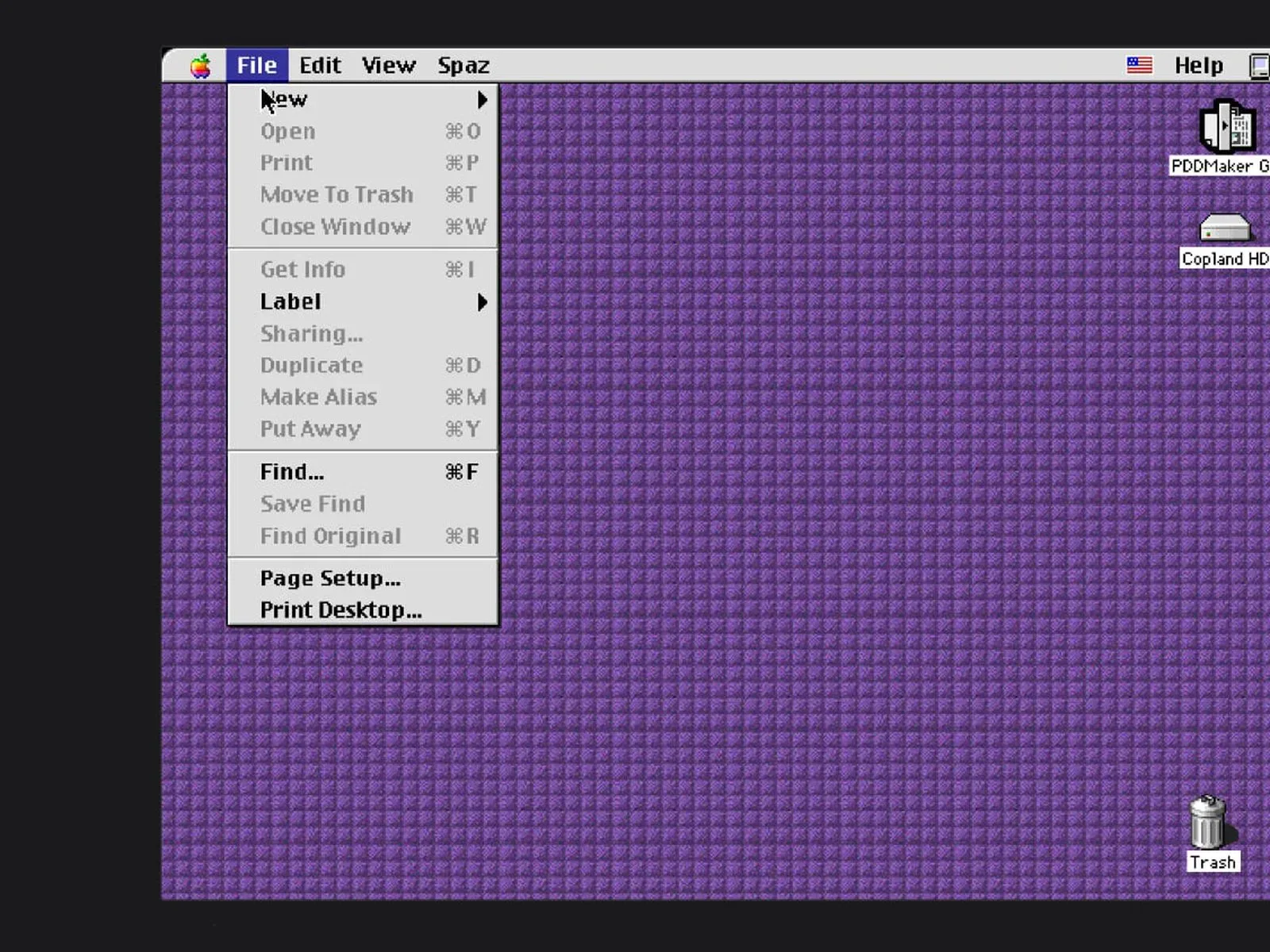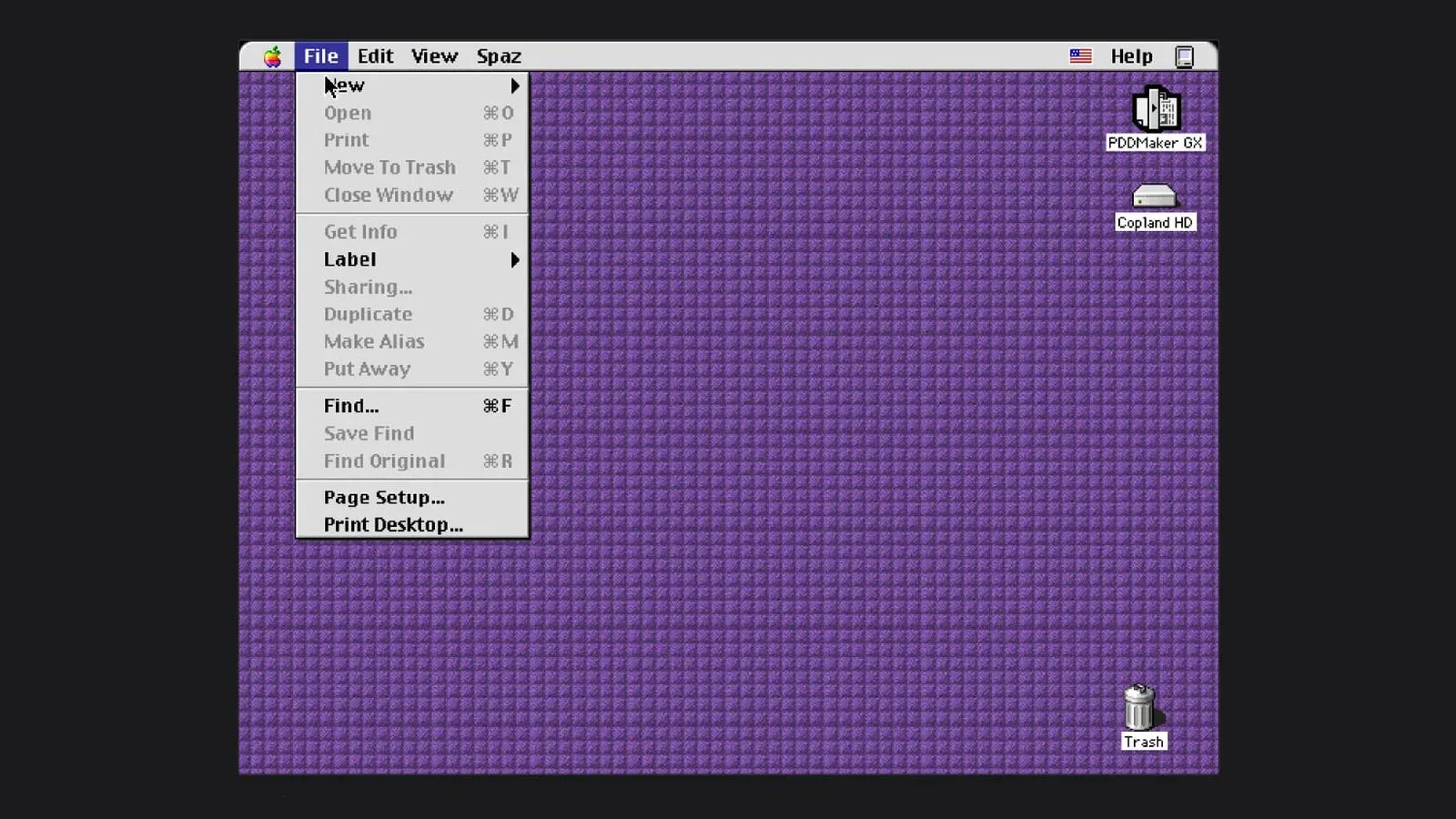
One of Apple’s most famous unfinished software projects is now accessible in an unexpectedly modern setting: a web browser. Copland, the operating system Apple announced in the mid-1990s but ultimately canceled, has been made to boot in emulation through work on the open-source Power Mac emulator DingusPPC.
The achievement is more than a novelty for vintage-computing enthusiasts. Copland has long carried an unusual status in Apple history: it was a public-facing future platform that never became a finished commercial product, while pieces of its development later surfaced in Mac OS 7.6 and Mac OS 8. Getting a beta version running in an emulator creates a more approachable way to inspect that abandoned branch of the Mac’s evolution without relying on increasingly difficult-to-maintain original hardware.
The working build is Copland D11E4, the final of three betas released during the operating system’s development. Michael Steil, whose work includes reverse engineering vintage hardware and software, modified DingusPPC to make it run. He has said the effort required 11 patches, and has made both a browser-based version and the necessary boot patches available.
What Copland was meant to be
Copland was Apple’s mid-1990s operating-system project, announced at a time when the company was trying to move its Macintosh platform forward. It never reached commercial release. The project was canceled before completion after management problems and feature creep made it untenable as a complete operating system.
Feature creep is the steady expansion of a project’s scope beyond its original plan. A feature can sound useful in isolation, but accumulating additions can make software harder to finish, test, integrate, and ship. In the Copland story, that expanding scope was part of a wider development failure rather than a simple case of a product missing a target date.
Its cancellation does not mean every part of the project disappeared. Elements associated with Copland’s work made their way into Mac OS 7.6 and Mac OS 8. That distinction matters when looking at unfinished software: a canceled platform can still leave behind code, concepts, and practical engineering work that influences released products. Copland itself, however, remained an incomplete whole.
For people interested in old PC and console software, the parallel is familiar. A prototype, beta, or unreleased build is not a substitute for a retail release; it is evidence of a process that stopped midway. It can reveal ambitions, technical constraints, and the state of development at a particular moment, but it should not be treated as a polished version of a product Apple chose not to ship.
Why emulating it is notable
An emulator is software that reproduces enough behavior of another hardware environment for software made for that environment to operate. Here, DingusPPC is a Power Mac emulator: it aims to provide an emulated Power Macintosh setting in which software such as Copland can boot.
That is different from merely preserving a disk image or archival file. A file can survive while remaining impractical to use. Booting an operating system requires the emulated hardware, the operating system’s assumptions about that hardware, and the emulator’s implementation to line up closely enough for startup to proceed. Problems in any of those areas can prevent the process from reaching a usable state.
Copland has been described as notoriously difficult to run on real hardware, and it had not previously been available in emulation. That context makes the 11 patches especially important. The number alone does not explain every compatibility problem, but it shows that a stock emulator was not enough. Targeted changes were needed before the final beta could be brought up successfully.
A browser version lowers the barrier further. Instead of requiring visitors to obtain compatible vintage equipment or assemble their own emulator setup, it offers a direct route to viewing the environment. That does not turn Copland into a dependable everyday operating system, nor does it erase the limitations of a beta from a canceled project. It does make a historically elusive build more visible to researchers, hobbyists, and curious users.
D11E4 is a beta, not a recovered final release
The designation D11E4 identifies the Copland build that has been made operational in emulation. It was the last of Apple’s three development betas. Its place in that sequence is significant, but it should not be misread as a near-final retail edition.
A beta is software distributed for testing before a final release. It may contain unfinished work, faults, incomplete integration, or behavior that later changes. In Copland’s case, there was no commercial final version to compare against because the project ended before one existed. D11E4 is therefore valuable as a late surviving development artifact, not as a completed representation of what customers would necessarily have received.
That framing helps keep the browser experience in perspective. Users can explore an OS that was once publicly announced and then abandoned, but the exercise is best understood as software preservation and technical reconstruction. Expectations of modern reliability, security, compatibility, or workflow convenience would be misplaced. The compelling part is precisely that the software preserves a path that the Macintosh did not ultimately take.
From Copland’s cancellation to NeXTSTEP
Apple canceled Copland in August 1996. The company then looked outside its own walls for a new operating-system foundation. That search led to the purchase of NeXT in 1997 and the return of Steve Jobs.
NeXTSTEP, NeXT’s operating system, became the precursor to Mac OS X. This makes Copland’s revival especially interesting as a historical contrast. The emulated beta documents the direction Apple had been pursuing before the company changed course. The subsequent NeXT acquisition supplied the lineage that led toward Mac OS X instead.
It is tempting to reduce this history to a simple winner-and-loser story, but the more useful takeaway is about contingency. Software platforms are shaped by technical decisions, project organization, deadlines, unfinished ambitions, and occasionally a wholesale shift in strategy. Copland’s problems helped create the conditions for Apple to seek another route. Its cancellation was not the end of the company’s operating-system story; it was a major turn in that story.
For gaming readers, this sort of preservation also resonates beyond Macs. Older games and applications often depend on a particular hardware and software context, which is why emulation is so valuable when that context becomes hard to access. The same interest in maintaining access to older computing environments sits alongside ongoing discussion about what technology platforms preserve or leave behind, whether it concerns vintage software or modern hardware ecosystems such as the uncertainty around a future Quest platform.
What the project preserves—and what it does not
Steil’s work preserves an opportunity to run Copland, rather than resolving the reasons Copland was canceled. The browser-accessible emulator does not transform the beta into a supported Apple product, and it does not supply the missing final version that never existed. Its value is more specific: it gives people a practical way to encounter the D11E4 build and offers technical patches that document how the emulator was adapted to boot it.
That documentation is an important part of the accomplishment. Preservation is strongest when it includes not just an endpoint but some record of the work required to reach it. The patches show that compatibility was achieved through deliberate technical intervention, not accidental luck. For future emulator work, that can help distinguish a reproducible process from a one-off demonstration.
Copland remains a cautionary artifact of ambitious software development overwhelmed by project-management trouble and expanding scope. Yet its browser revival also gives the story a more productive afterlife. A platform that never reached store shelves can now be examined as software, not merely remembered as a footnote. For anyone interested in the rough drafts of computing history, that is a meaningful upgrade from legend to something that can actually boot.