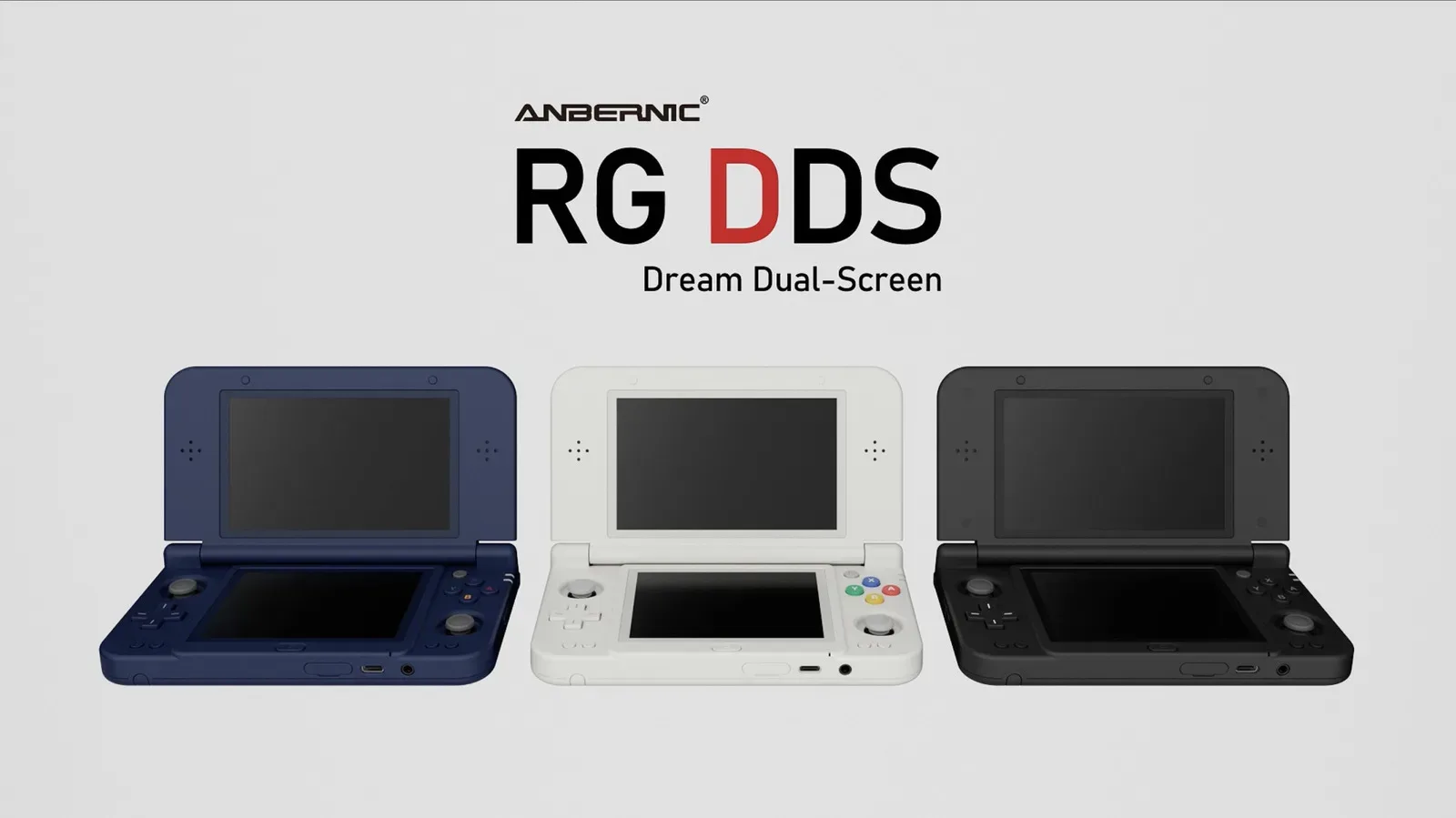
ANBERNIC’s RG DS Plus has returned to the spotlight with a new promotional video that offers a clearer look at the company’s dual-screen handheld in action. The footage runs for more than six minutes and presents a Linux-based machine built around the kind of layout that makes Nintendo DS software particularly interesting on modern retro hardware: two displays, a touchscreen-and-stylus-friendly format, and less need to squash a second game screen into a tiny corner.
There is still an important asterisk the size of a handheld console here. ANBERNIC has not confirmed the RG DS Plus’ full specification sheet, retail price, or release date. Claims that it could reuse the original RG DS chipset, include 1GB of RAM, and arrive below $100 remain rumors rather than finalized product details. Promotional footage can show a device at its best, too, so performance, battery endurance, controls and software reliability will need to wait for independent hands-on coverage and retail hardware.
Even with those caveats, the video provides useful clues about what ANBERNIC wants the RG DS Plus to be: an affordable Linux handheld with Nintendo DS emulation at the center of its identity, but one that also reaches toward other retro systems, local-network-style multiplayer functionality, and PC game streaming.
A dual-screen handheld with DS games at the center
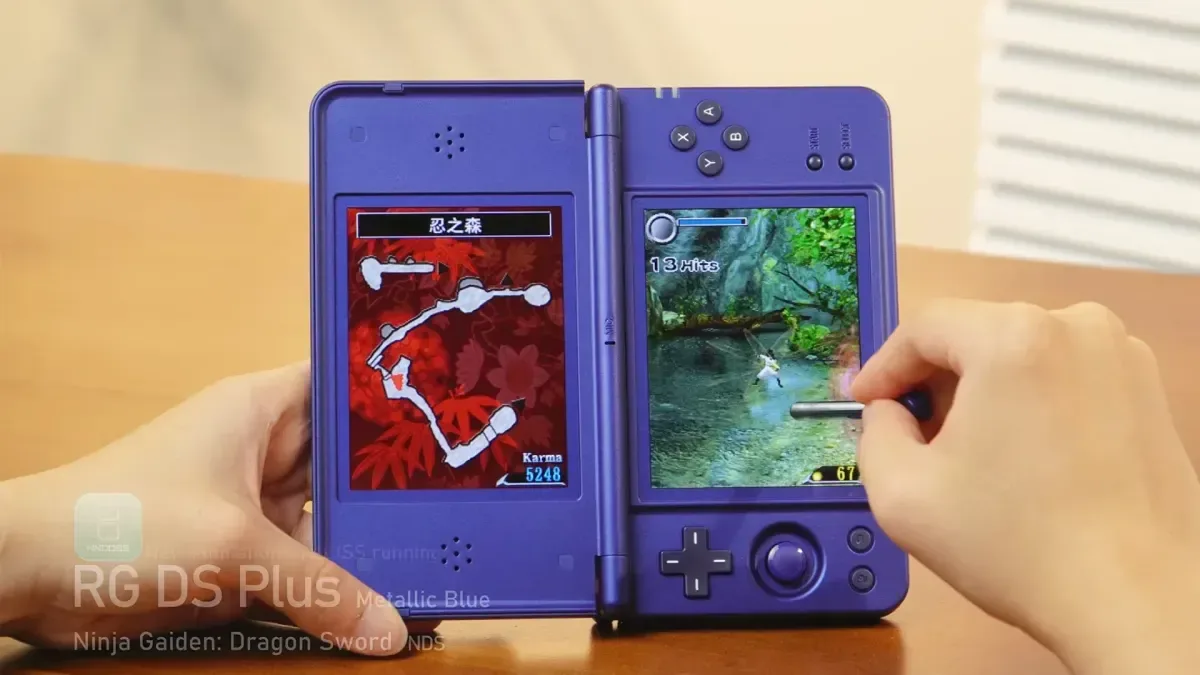
The standout feature is obvious. Unlike a conventional single-panel retro handheld, the RG DS Plus uses two screens, allowing DS games to retain the fundamental visual structure that made them difficult to translate elegantly to one display. For games that constantly rely on separate map, menu, touch or action screens, native-style stacking is more than a novelty. It can make the experience easier to read and closer to the original hardware’s intended flow.
The footage includes Nintendo DS gameplay and stylus interaction, putting the lower display’s touch-focused role on show. That matters because DS emulation has often involved compromises. A single-screen system may display both panels side by side, stack them at a reduced size, or require frequent switching between views. Those approaches can work, but they are not equally comfortable for every game. A purpose-built two-screen layout potentially avoids much of that friction.
The specific software shown is called NNDDSS, a Linux emulator presented as a new self-emulator solution. ANBERNIC’s framing suggests it is designed to make DS emulation run smoothly on Linux hardware with just 1GB of RAM. If that target holds up outside controlled footage, it could be a significant part of the device’s value proposition: modest hardware aiming to handle the system its physical design most naturally serves.
That does not make the footage a final performance verdict. Compatibility can vary game by game, and the practical experience depends on factors beyond raw frame rate. Touch accuracy, stylus feel, screen responsiveness, sleep behavior, save handling, scaling options and the consistency of the emulator’s settings all matter on a DS-focused device. The video is an encouraging preview rather than proof that every corner of the DS library will behave perfectly.
NNDDSS appears functional before it appears flashy
The NNDDSS interface shown in the video looks utilitarian. It is not being positioned as a lavish front end full of elaborate animation and shelf-display presentation. Instead, the apparent priority is straightforward organization of ROMs and access to games. For a budget Linux device, that may be a sensible trade: users generally need a menu that is readable, predictable and quick to navigate more than they need one that resembles a boutique launcher.
Related coverage includes ANBERNIC RG DS Plus Video Shows Dual-Screen Emulation, Stylus Use and NetPlay.
One intriguing detail is how the system appears to treat games designed for a single display. The footage indicates that the user can select which panel shows the game, while the unused screen can display an image representing the relevant console. It is a modest solution, but it acknowledges that a dual-screen device will not spend every minute running DS software.
That flexibility could be useful across a mixed retro library. A player may prefer a particular screen based on viewing angle, hand position or which panel feels most comfortable for a given game. At the same time, leaving the second display as a visual identifier preserves some purpose for the hardware rather than presenting an unexplained blank panel.
Linux also sets expectations for what this machine is likely to be. The RG DS Plus does not appear to be an Android multitasking handheld where the spare screen becomes a general-purpose browser, chat window or app companion. Its attraction is more focused: dedicated emulation, game organization and handheld play. For people who want a device that behaves like an appliance rather than a miniature tablet, that narrower remit could be a feature rather than a limitation.
More than Nintendo DS: PSP, Mega Drive and streaming are shown
Although DS software is clearly the headline act, the new footage also shows emulation from other platforms, including PSP and Sega Mega Drive. That broadens the RG DS Plus beyond a one-system curiosity. The real question is how well the hardware performs across those systems, what emulator choices are available, and whether the two-screen design remains comfortable for games that were never built around it.
The presence of PSP footage should be read carefully. PSP emulation can demand more from a handheld than older 2D console libraries, and a short video does not establish a device-wide standard for speed or compatibility. Still, its inclusion signals that ANBERNIC is pitching the RG DS Plus as a general retro device, not merely a DS-shaped specialist.
The video also features Steam game streaming. Streaming is different from running a game locally: the quality of the experience depends heavily on the host PC, home network, router setup and the handheld’s wireless performance. Still, this could give the device a secondary role as a compact remote-play screen for a PC library. The dual displays may not transform every streamed game, but the option itself offers more flexibility than a retro-only box.
Anyone planning to use wireless accessories or streaming regularly should also consider the security and convenience implications of connected hardware. Our practical guide to leaving Bluetooth on for controllers and headsets covers the tradeoffs that can come with keeping connections active.
NetPlay could be one of the more compelling extras
Multiplayer is another feature demonstrated in the promotional material, through NetPlay. For a retro handheld, that is an appealing inclusion because it can make a portable device feel less solitary. Classics designed around competitive or cooperative local sessions can gain a second life when players are able to connect without needing original hardware and cables.
As with streaming, NetPlay’s eventual usefulness will depend on implementation. Easy setup, connection stability, game compatibility, latency, save-state behavior and clear menus will determine whether it becomes a regular feature or an occasional experiment. The fact that ANBERNIC chose to show it is meaningful, though. It suggests the company is trying to give the RG DS Plus a more social set of capabilities than its low-cost, Linux-oriented positioning might initially imply.
The second screen can be disabled to conserve power
ANBERNIC has also indicated that users can turn off the second screen through the settings to save battery life. It is a practical option. Two active displays are central to the handheld’s appeal for DS games, but they are not required for every title or every use case. A single-screen retro session, especially with Mega Drive-era software or another non-DS platform, may not need both panels illuminated.
The setting also highlights one of the balancing acts behind the RG DS Plus. Dual screens create a distinctive form factor and a potentially better DS setup, but they can increase power demands. Until battery capacity, screen specifications and real-world endurance are confirmed, it is impossible to say how large the benefit will be. Providing the choice is nevertheless sensible, especially for a portable system intended to cover multiple generations of games.
What remains unknown before the RG DS Plus can be judged
For now, the RG DS Plus looks promising chiefly because its design and software pitch align. A dual-screen Linux handheld needs a credible answer to the question of why both screens exist; NNDDSS, stylus-oriented DS play, configurable screen behavior and the ability to disable a panel for battery savings are all parts of that answer.
But the unanswered details remain the deciding ones. ANBERNIC has not officially locked in the rumored chipset, 1GB RAM configuration or a sub-$100 price. Nor has it provided a release date. The final device will need to be assessed on build quality, display quality, hinge durability, controls, firmware maturity, emulator compatibility and battery performance, not solely on a polished video.
For retro players who have wanted a more natural way to revisit Nintendo DS games without abandoning access to systems such as PSP and Sega Mega Drive, the RG DS Plus is shaping up as a device worth watching. The latest footage gives the idea more substance. The next step is confirmation: final specifications, final pricing, and hardware in the hands of people who can test whether this small two-screen promise survives the big real-world questions.