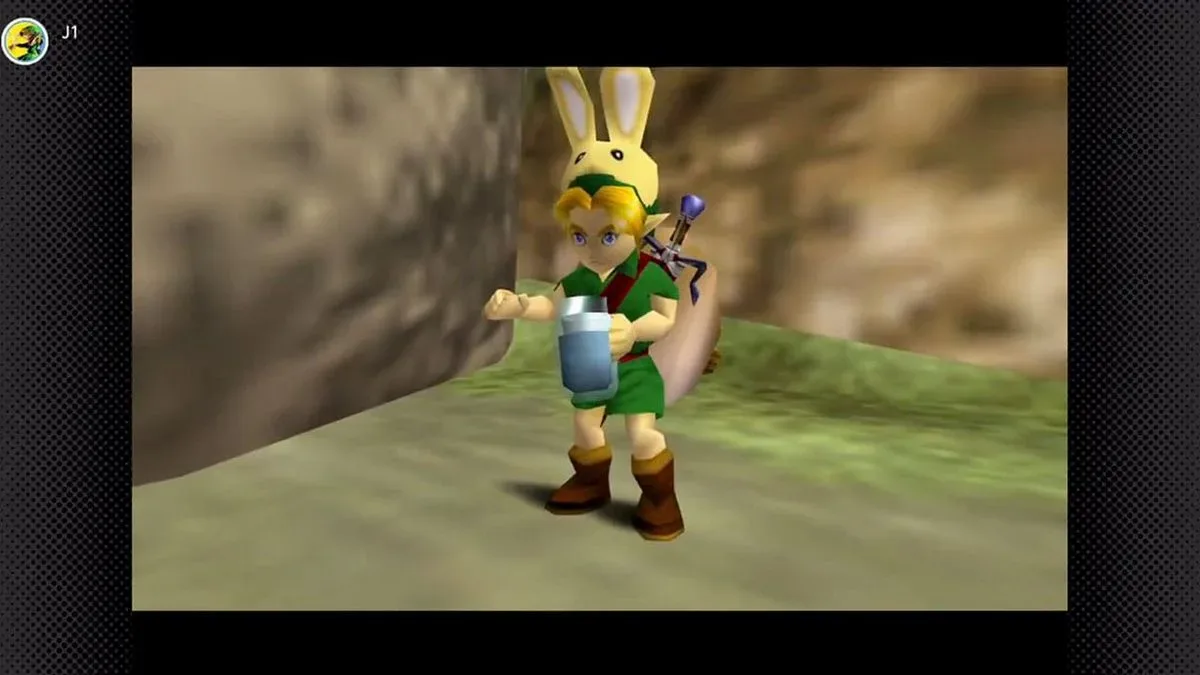
A newly circulated The Legend of Zelda: Majora’s Mask clip appears to show one of the least intuitive uses for water in a Zelda game: blowing up a boulder. Rather than using an obvious explosive, the sequence reportedly has Link perform a Spin Dash and immediately pour water near the rock. The boulder then breaks as if it had been struck by a powder keg.
The footage, attributed to Sera68, is a striking example of why decades-old games can still produce surprises. It also deserves a little caution. The apparent result has been described as a glitch, not an intended puzzle solution, and there is no confirmed technical explanation for why the input sequence would cause a destructible object to register an explosion-like effect.
What the clip appears to show
The reported setup is unusually specific: Link performs a Spin Dash, then pours spring water onto the ground close to a boulder. The rock breaks immediately afterward. A builder in the scene is said to react with visible surprise, underscoring how unconventional the result looks.
On its face, the interaction conflicts with normal gameplay logic. Water and explosive damage are fundamentally different kinds of game actions. Water would usually be expected to fill, grow, extinguish, trigger, or otherwise interact with environmental systems designed around it; a boulder that normally needs an explosive should not treat a poured-water action as demolition equipment.
That mismatch is exactly why the clip reads as a bug rather than a newly uncovered intended mechanic. A glitch is an unintended behavior produced when a game’s systems, states, timing, or data handling interact in an unforeseen way. It can be repeatable without being deliberate. A reproducible glitch may become useful to players, speedrunners, or curious experimenters, but repeatability alone does not turn it into official design.
Why the timing likely matters
The reported order of actions matters more than the water by itself. Spin Dash first, pour water immediately afterward, then watch the boulder break. That suggests a possible state interaction: the game may briefly retain information from the Spin Dash while processing the next action, or it may attach an incorrect interaction value to the object or area near Link.
That is analysis, not a confirmed diagnosis. The available evidence establishes an apparent sequence and result, but not the programming cause. Without a detailed frame-by-frame inspection, controlled tests across locations and versions, or direct examination of the game’s underlying behavior, it would be premature to say the glitch is caused by a specific animation cancel, collision error, damage flag, or item-state overflow.
Still, the immediate timing is a meaningful clue. In older games especially, actions can be processed across short windows rather than as perfectly isolated events. When one animation transitions into another, the game may need to update player movement, item use, collision detection, nearby objects, and environmental effects in rapid succession. An unusual sequence can sometimes expose a case the developers never expected players to create.
Related coverage includes A Newly Shared Majora's Mask Glitch Turns Water Into Boulder-Blasting Ammunition.
Technical terms without the guesswork
- Collision detection: the system that determines whether characters, items, attacks, and objects touch or overlap.
- Damage flag: a simplified way to describe data telling an object that it has been hit by a particular kind of attack or effect.
- State: the set of conditions the game currently tracks, such as whether Link is spinning, using an item, moving, or interacting with an object.
- Input timing: how closely one command follows another. Tiny timing differences can determine whether a glitch works at all.
- Reproduction: repeating a reported method under comparable conditions to see whether the same outcome occurs.
None of those terms proves what is happening here. They simply outline the types of systems a glitch researcher would examine before declaring that water itself has acquired the properties of a bomb.
A claim worth testing carefully
Reports indicate that other players have tried the technique with positive results. That is encouraging for anyone interested in preservation-minded experimentation, but it is not yet the same as a complete set of instructions. Small details may be decisive: the exact boulder, Link’s position, whether the Spin Dash fully begins, how quickly the water is poured, or the precise water source could all matter.
Players attempting to reproduce it should therefore treat the clip as an observation rather than a guaranteed universal shortcut. A careful test would keep most variables fixed and change only one at a time. Start with the same sort of boulder shown in the video, use the stated order of actions, and repeat the attempt several times. Then adjust position or timing in small increments. If the effect only occurs occasionally, that would support the idea that a narrow timing window is involved. If it happens in one place but not another, the location or specific object may be part of the trigger.
It is also sensible to preserve a save before experimenting. Glitches are often harmless, but unexpected behavior is, by definition, behavior outside the game’s intended rules. Players looking for conventional, clearly documented completion help rather than emergent oddities may prefer a structured resource such as this completion roadmap, where the purpose is to map planned progression instead of probing a game’s edge cases.
Why a late discovery is still notable
The appeal of the reported trick is not just its absurd image—water apparently demolishing stone—but the fact that it surfaced long after Majora’s Mask became one of the most examined games in the Zelda series. Players have had years to test movement, items, combat interactions, and object behavior. Yet large games contain a vast number of possible action combinations, especially when precise timing is involved. A behavior can sit unnoticed simply because few people think to try that exact sequence in that exact context.
The game’s development circumstances add useful context without proving any link to this particular bug. The game was made in a year using assets from Ocarina of Time, a demanding constraint that required a great deal from the development team. Complex projects made under tight schedules can produce strange edge cases, although it would be speculation to attribute this water-and-boulder effect to any one production decision.
What can be said is that old software does not become fully understood merely because it is old. Games are rule systems, and players continue to find new ways to press against their boundaries. Sometimes that uncovers a hidden route or an overlooked input. Sometimes, as this clip apparently demonstrates, it produces an outcome that looks like fantasy magic but is more plausibly a momentary disagreement between several pieces of code.
Not a replacement for the game’s intended tools
If the behavior is genuine and consistent, it may offer a novelty route past at least one obstacle. It should not be read as evidence that all boulders can be destroyed with water, that every water source produces the effect, or that it is a dependable alternative to intended explosive tools. Those are separate claims that require separate testing.
The distinction matters because viral clips often compress the process into a few seconds. The visible result is compelling; the invisible conditions are where the real mystery lies. Does the move need to be completed or merely initiated? Is the water placed at a precise spot? Does the boulder need a particular status? Is the effect tied to one version or scenario? At present, the reported footage supports the existence of an unusual-looking interaction, while leaving those broader questions unresolved.
For now, the safest description is also the most entertaining one: a newly shared Majora’s Mask glitch appears to let a tightly timed Spin Dash followed by poured spring water break a boulder. Until the behavior is more thoroughly documented, it remains a curious community discovery—not a formally understood mechanic, and certainly not a reason to leave conventional explosives behind.