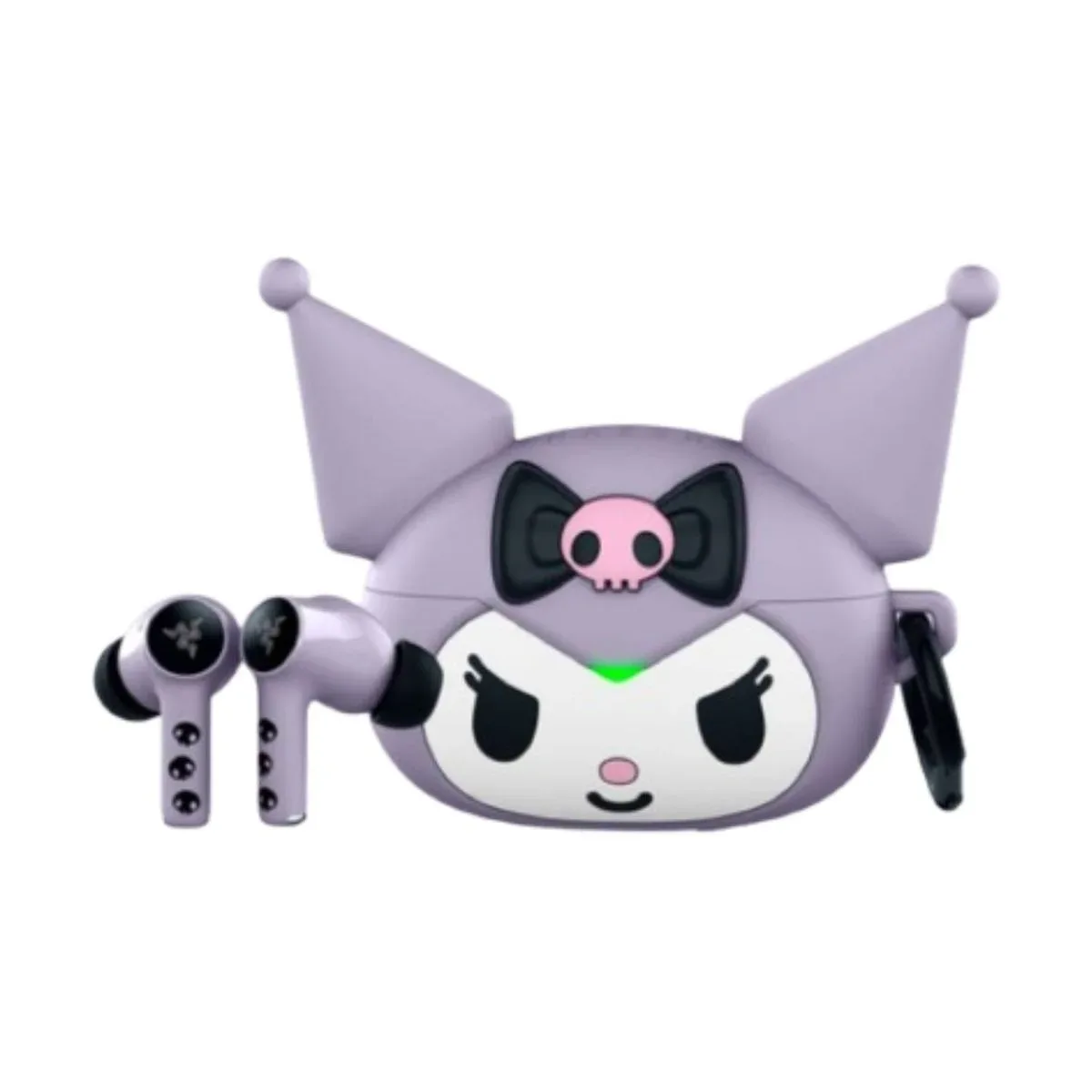
Licensed gaming gear often settles for the safest possible collaboration formula: take an established product, apply a character image, change the color, and add a surcharge. Razer’s Kuromi Edition Hammerhead V3 X HyperSpeed earbuds take a much less timid route. Their charging case is remade as a three-dimensional version of Kuromi’s head, with her hooded ears and skull-bow motif incorporated into the object rather than treated as a flat print.
That makes the case—not merely the earbuds—the centerpiece. It is an unusually literal interpretation of character-branded audio hardware, and that is largely the point. The pastel-purple finish, character silhouette, and sculpted details turn a normally discreet pocket accessory into an unmistakable piece of Sanrio merchandise that also happens to charge wireless earbuds.
The Kuromi Edition is priced at $119.99, a $20 increase over the standard version. It retains the underlying Hammerhead V3 X HyperSpeed hardware, including 2.4GHz wireless, Bluetooth 5.2, touch controls, and 7.1.4 surround sound support. In other words, this is a design-led edition rather than a newly specified audio model.
A case designed as the collaboration, not its packaging
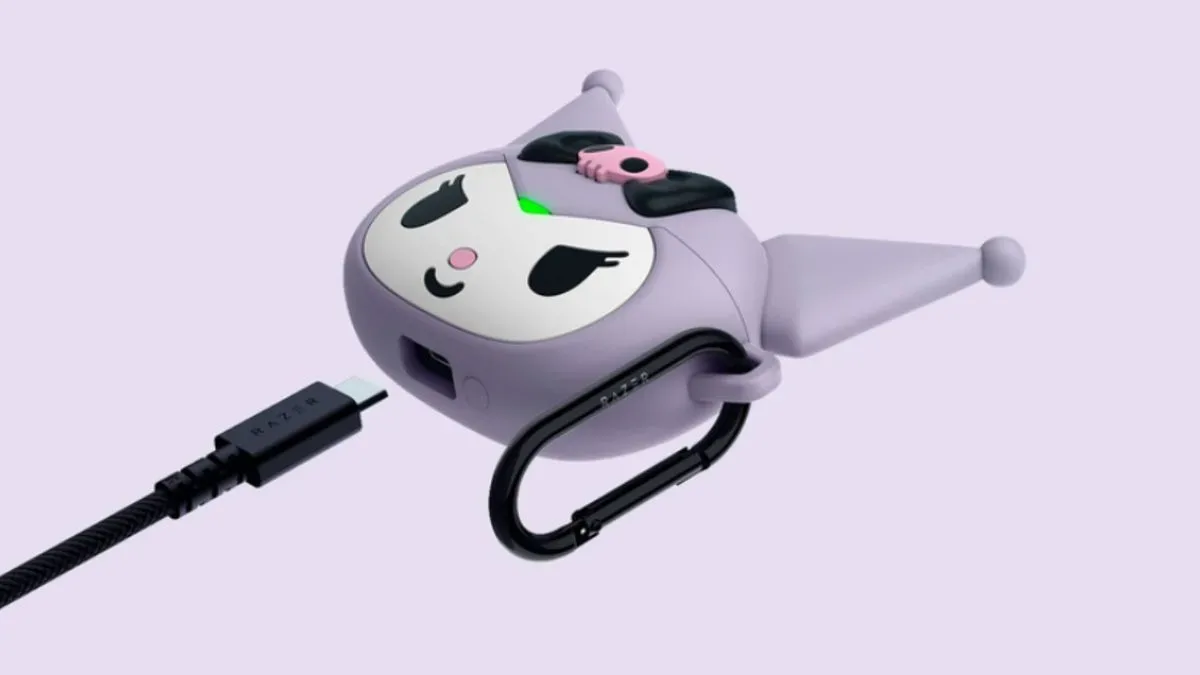
The biggest departure from conventional special-edition tech is the charging case’s form. Instead of the usual compact enclosure recolored in purple, it has been replaced by Kuromi’s head. The sculpt includes the character’s ears and a raised skull bow. Razer has also integrated necessary hardware details into the theme: the LED indicator sits at the hood’s widow’s peak, while USB-C charging is accessed at the base of the character head.
That integration matters because themed peripherals can easily become impractical-looking when functional components are added after the artwork. Here, the indicator and charging port are described as part of the character sculpt’s layout. The design still has to perform the ordinary task of holding and recharging the earbuds, but it treats that requirement as part of the visual concept.
The earbuds themselves continue the purple treatment. Each bud includes a skull pattern along its side, though Razer’s familiar snake logo remains present. The result is more coordinated than a character case paired with otherwise standard-looking earbuds, even if the branding does not fully surrender to Kuromi’s skull-heavy aesthetic.
What stays the same inside
For buyers weighing the collaboration premium, the important distinction is simple: the Kuromi Edition uses the existing Hammerhead V3 X HyperSpeed feature set. The supplied specifications position the earbuds for both gaming and everyday listening, with two wireless connection approaches.
- 2.4GHz wireless: A wireless connection type commonly used by gaming accessories, listed here as part of the earbuds’ multi-platform support.
- Bluetooth 5.2: The Bluetooth standard cited for the earbuds, offering another way to connect them to compatible devices.
- Touch controls: Controls built into the earbuds that allow functions to be operated without reaching for the paired device.
- 7.1.4 surround sound: A surround configuration reference included in the product’s audio feature list.
- USB-C charging: The case charges through a USB-C connection at the bottom of the Kuromi head sculpt.
“Multi-platform” is a broad compatibility description rather than a promise that every device will behave identically. Prospective buyers should still check their preferred platform and connection method before treating these as a replacement for a dedicated headset. Earbuds and over-ear gaming headsets solve different comfort, microphone, isolation, and battery-life needs, even when both are marketed for gaming.
Related coverage includes Razer's Kuromi Hammerhead Earbuds Turn a Sanrio Icon Into a Full 3D Charging Case.
Still, 2.4GHz wireless alongside Bluetooth 5.2 gives the product a clear dual-purpose identity. A buyer who wants one pair for game audio and ordinary listening has more flexibility than they would with earbuds limited to a single connection standard. The Kuromi model’s appeal is therefore not solely decorative: it attaches an overt fandom design to a feature set already intended to move between gaming and non-gaming use.
The collaboration premium is visible
At $119.99, the Kuromi Edition costs $20 more than the plain Hammerhead V3 X HyperSpeed earbuds. That price difference is the central trade-off. There is no indication of exclusive internal audio hardware or extra wireless features; the added value is the licensed theme and the unusually elaborate charging-case construction.
Whether that is worthwhile depends on what a special edition is expected to deliver. If a buyer only wants the lowest-cost route to the underlying earbuds, the standard model is the straightforward answer. But licensed hardware has a different audience as well: people who want the object to communicate a favorite character or visual style even when it is sitting on a desk, clipped into a bag, or opened in public.
By that standard, the Kuromi model makes a stronger case for its premium than a simple recolor would. The physical design is distinctive enough that it cannot be mistaken for the plain product with a printed decal. Its absurdity is also its advantage. A charging case shaped like a character’s head is not trying to disappear, and Kuromi’s hood, ears, skull bow, and purple palette all support that loud approach.
There is a practical corollary: a more sculptural case is likely to matter most to people who carry and display it. Buyers seeking an especially understated setup may find the character-head format too conspicuous regardless of its technical feature list. This is a product where personal taste is not a small footnote; it is the primary reason to choose this edition.
For fans who want less—or more—character branding
Razer’s broader licensed lineup illustrates two different design philosophies. Its Pikachu and Eevee Collection takes a comparatively restrained approach, using dusty pink coloring and character artwork without the three-dimensional ears or character-head construction seen on the Kuromi case. That makes the Kuromi earbuds the maximalist option: they center the character’s shape as much as her artwork.
For some fans, restrained branding is the better fit. It can preserve a cleaner desk or travel setup while still signalling an affiliation with a character or series. For others, the reason to buy a licensed version at all is to get something regular hardware would never attempt. The Kuromi edition falls squarely into the latter camp, making the most ordinary element of a true-wireless setup—the charging case—its most expressive one.
The product also arrives in a moment when accessory costs are a real consideration. A collaboration surcharge can be easier to accept when the design changes the physical object substantially, rather than merely adding surface-level art. Here, the $20 increase accompanies a case that has been structurally reimagined around Kuromi, plus coordinated purple earbuds with skull detailing.
Availability may vary by region. The Kuromi Edition earbuds had not appeared in Razer’s UK online store at the time of the information provided, while other Kuromi-branded Razer accessories were listed from £62.38 through Amazon. That makes it sensible for interested buyers to confirm local listings, pricing, and platform compatibility before committing to the collaboration edition.
For readers following game-adjacent hardware with a full-dose character identity, Razer’s Kuromi case is a reminder that a branded accessory does not have to settle for a logo and a paint swap. It can become the entire visual premise of the product. For a very different kind of gaming-world release, see The Witch’s Bakery opening on PC and consoles.