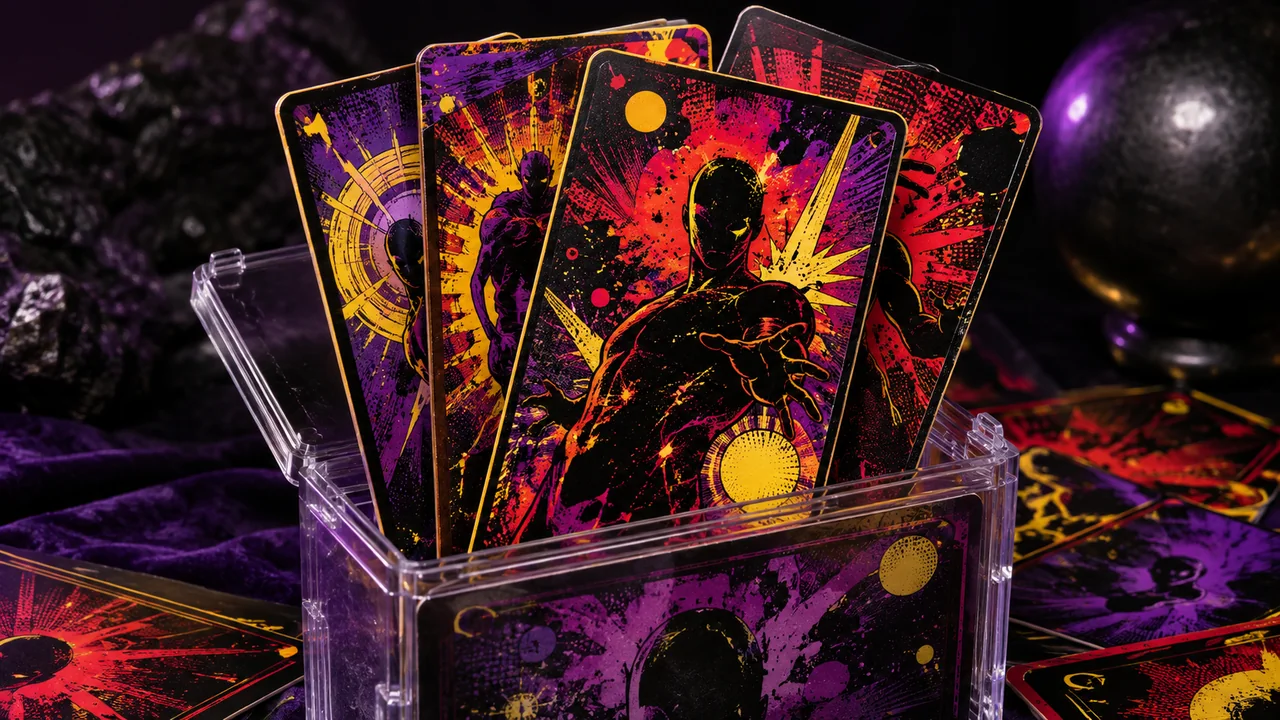
The 2026 Pokémon World Championships have wrapped in San Francisco, leaving the competitive Pokémon calendar with the kind of highlight reel that makes a clean break between seasons feel almost unfair. Champions were decided across Pokémon Video Game Championships (VGC), the Pokémon Trading Card Game (TCG), Pokémon GO and Pokémon UNITE, while Championship Sunday transformed Chase Center into a full-scale arena event.
There were high-level technical decisions that looked bizarre until the board state made them brilliant. There were players producing their biggest result on the biggest stage. There was an endurance test of a Pokémon GO final, a decisive milestone for a storied UNITE team, and TCG turns that demonstrated why Prize cards alone never tell the entire story of a match.
For collectors who follow the game as closely as the cardboard, the TCG scenes are an excellent reminder that cards are not simply names, rarities and conditions in a binder. They are tools in a constantly changing competitive language. Anyone sorting out the basics of printed card information can start with this guide to Pokémon rarity symbols, but Worlds is where the practical value of a card is revealed one difficult decision at a time.
VGC’s peculiar Protect becomes the right play
One of the most memorable VGC sequences came from Antonio Sánchez, whose Charizard used Protect in a situation where the usual success-or-failure framing did not really apply. The important point was not whether the protective move itself would resolve in a conventional, satisfying way. By choosing a non-damaging action, Sánchez made sure Charizard would not absorb a Sucker Punch from Kingambit.
That distinction mattered. Keeping Charizard healthy enabled Toxapex to continue gradually wearing down the opposing side. It is the kind of turn that can appear passive when viewed in isolation, yet it illustrates the precision demanded by doubles competition. A move selected to avoid interacting with an opponent’s condition can be more valuable than one selected to immediately remove a target.
Competitive Pokémon often rewards players who calculate not only damage, speed and type matchups, but the decision trees created by opposing moves. Protect is usually discussed as a defensive button. This sequence showed it can also be a way of denying an opponent the exact interaction they need. In a format packed with pressure, that can be an aggressive idea in disguise.
Takuma Yamazaki’s moment on the major stage
Takuma Yamazaki reached a historic breakthrough in VGC after never having won a major tournament before. His defining play against Hiroshi Onishi was a double-up: Feint and Aqua Jet combined to knock out Onishi’s Mega Charizard Y and put Yamazaki in position to secure the win.
Yamazaki acknowledged that the line was not necessarily the optimal one, but competitive history tends to make room for the plays that are both decisive and unforgettable. A major tournament is an unforgiving place to choose the merely cool option, which is exactly why a cool option that works becomes part of the event’s identity.
This was also the first World Championships to crown Pokémon VGC champions on Pokémon Champions. That context gives every pivotal turn an added sense of arrival. New competitive platforms and formats are measured by whether they produce meaningful drama; this one did not have to wait long for an answer.
The TCG’s smartest wins did not begin with a knockout
Pokémon TCG competition has a wonderfully misleading surface. New viewers understandably watch the Prize count, see one player behind, and assume the route back is a rapid series of knockouts. At Worlds, Andrew Hedrick offered a sharp counterargument in game two against Diego Cassiraga, the 2017 World Champion.
Hedrick appeared to be in trouble, but recognized that Cassiraga’s own Lucky Helmet could reshape the endgame. Rather than knock out Cassiraga’s Alakazam immediately, Hedrick deliberately left it in play. That decision forced Cassiraga down to only two cards remaining in deck. Hedrick then attacked Alakazam again, using the resulting sequence to win by decking Cassiraga out.
It is a particularly satisfying TCG moment because it treats deck size as a resource as real as Prize cards, Energy or damage counters. Winning without first taking the anticipated knockout is not a gimmick; it is a legitimate consequence of seeing the game’s win conditions more clearly than your opponent in a pressured moment.
The play also makes Lucky Helmet feel appropriately mischievous. An item intended to provide an advantage became a key part of the line that defeated its owner. Pokémon cards have long produced these reversals, where an effect that seems universally useful becomes risky in a narrower board state. That is the strategic texture that turns a familiar card into a headline.
Mateusz turns Cursed Blast into a lifeline
Another TCG highlight arrived with Mateusz fighting to remain in the tournament against Henry Chao. Mateusz used Dusknoir’s Cursed Blast Ability twice, collecting three Prize cards and forcing an exceptionally unusual tiebreaker match for game two.
There is a special intensity to tournament-life turns. Every resource has already survived the opening exchanges; every option has an opportunity cost; and there may be no later turn in which to correct an error. Using Cursed Blast twice to seize three Prizes did more than improve the score. It changed the shape of the match entirely and kept the contest alive through a rare tiebreaker scenario.
These two TCG clips tell complementary stories. Hedrick’s route was patient, indirect and rooted in the opponent’s shrinking deck. Mateusz’s was explosive, extracting a huge Prize swing from Dusknoir. One is a lesson in restraint, the other in finding a narrow path through urgency. Both are reminders that the game’s most consequential turns often ask players to look beyond the most obvious target.
For people whose Pokémon interest begins at the collector table, competitive play can add another dimension to the cards they already recognize. The printed symbols and set information matter, but so does the question of what a card enabled when a World Championships match was slipping away.
ZETA Division completes its UNITE story
Pokémon UNITE’s final World Championship ended with ZETA Division lifting the trophy. The result carried considerable emotional weight for the team: ZETA Division had finished second at Anaheim the prior year, then returned to close the gap and claim the final crown of the Pokémon UNITE Championship Series.
Runner-up finishes are often described as motivation, but that phrase can flatten how difficult a return trip really is. A team must remain cohesive, adapt to competition from around the world and arrive ready to handle a final when its previous near-miss is part of the story surrounding it. ZETA Division did exactly that on Championship Sunday.
The win stands as a fitting endpoint for the series because it supplies a familiar competitive arc without making it automatic. Second place did not guarantee first place later. It simply made the eventual success more resonant. In esports, as in traditional sports, a team’s history can become an extra opponent; ZETA Division overcame its own.
GGs489hiromaru claims a first for Japan in Pokémon GO
Pokémon GO’s Grand Finals required a response from GGs489hiromaru. After losing the first set to MEweedle, GGs489hiromaru reset, regrouped and won the deciding fifth game of the second set with Hisuian Electrode and Jellicent playing central roles.
The victory came in GGs489hiromaru’s first Pokémon GO World Championship, and it established a national milestone as well: he became the first player from Japan to win Pokémon GO’s premier global event. The combination of a debut Worlds appearance, a lost initial set and a five-game decider makes the achievement especially striking.
Finals are often remembered as a single victory or defeat, but this one was a test of adjustment across sets. Losing early did not end the run; it set the stage for the response. Hisuian Electrode and Jellicent became part of the competitive snapshot of that response, two Pokémon tied to the final game that delivered the title.
A Championship Sunday built for an arena
The tournament action closed with a packed Chase Center joining in for a live performance of “Gotta catch ’em all!” The song has been part of Pokémon’s cultural vocabulary for almost 30 years, and its use at the end of the day underlined the scale of the event. This was not merely a collection of bracket results. It was an arena celebration for players, spectators and a competitive scene that spans several distinct games.
That shared-room energy is difficult to reduce to standings, but it matters. Competitive events thrive when their highest-stakes moments have a place large enough to match them, whether the audience is following careful TCG sequencing, a VGC endgame, a mobile battle or a team fight in UNITE. For a related look at how gaming communities shape their own in-person rituals, see the unwritten rules of couch multiplayer.
With San Francisco now in the rear-view mirror, attention turns to the 2027 World Championships in Singapore. The next season will bring new matchups, new decks, new teams and new stories. But 2026 already has its lasting images: Sánchez protecting Charizard from the interaction Kingambit wanted, Yamazaki’s bold finishing combination, Hedrick weaponizing Lucky Helmet in an unexpected deck-out, Mateusz’s Dusknoir swing, ZETA Division’s redemption, and GGs489hiromaru’s historic comeback.
Those highlights also explain why Pokémon competition continues to pull together groups that might otherwise follow separate games. The formats differ enormously, yet all four reward preparation, adaptation and a willingness to recognize that one unusual turn can change everything.