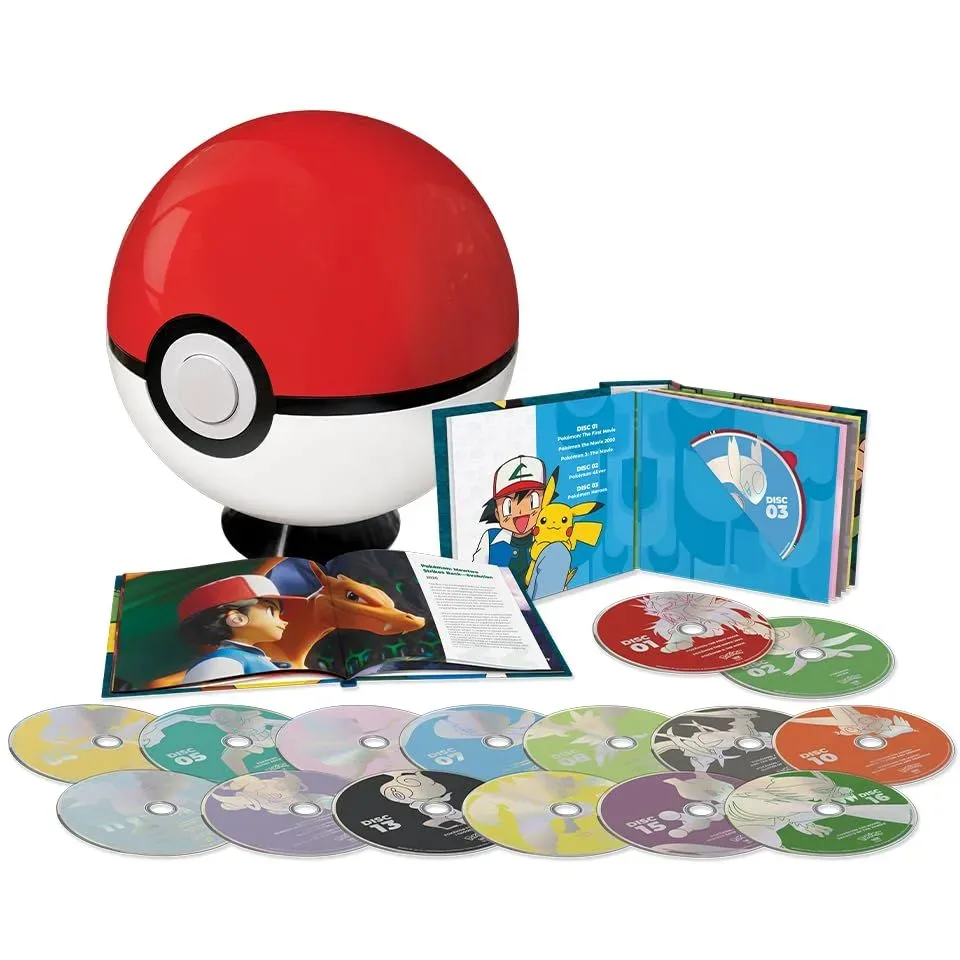
Pokémon collectors are being offered a very round proposition: Pokémon: 24-Movie Collection, a limited-edition Blu-ray package that gathers 24 animated feature films on 16 discs, housed in a Poké Ball-shaped case. It is scheduled to arrive on November 14, 2026, carries a $399.99 MSRP at Amazon, and is available to preorder in the United States as an Amazon exclusive.
That is an enormous chunk of Pokédollars for a home-video release, even one that aims to put a major portion of the franchise’s film history on a shelf in one go. The pitch is immediately understandable: the set spans the anime movies from Pokémon: The First Movie through stories reaching the Forest of Okoya, while also including the CGI remake Pokémon: Mewtwo Strikes Back—Evolution. For fans who grew up alongside Ash Ketchum and have accumulated individual discs, incomplete box sets, or streaming-watchlist fatigue, consolidation has real appeal.
But the collection’s considerable price makes the information still absent from the listing just as important as the information that is there. There is no complete film-by-film rundown, no confirmed specification sheet for language tracks, and no clear answer about the theatrical shorts that accompanied several early Pokémon movies. It is a handsome-looking premium object on paper. Whether it is a complete archival-style movie set is harder to judge until those details are clarified.
What is confirmed for the Pokémon: 24-Movie Collection
The core facts establish this as an anime-film package rather than a broad “every Pokémon movie ever made in every format” anthology. The collection contains 24 movies across 16 Blu-ray discs and is presented in a hardbound book-style format enclosed by the Poké Ball case. Its promotional description traces the run from Mewtwo’s origin through the Unova-era films and finally to the Forest of Okoya, the setting associated with Pokémon the Movie: Secrets of the Jungle.
The announced 24-film count lines up with the run of animated Pokémon theatrical features. That framing also helps explain an omission that some buyers may initially expect to see: Detective Pikachu, the live-action Pokémon film, is not mentioned in the available description. There is currently no indication that it is included. Anyone looking for one package that mixes the anime films with the live-action detective adventure should not assume this box does that job.
At $399.99, the collection works out to roughly $16.67 per movie before considering the physical case, book packaging, and disc count. That arithmetic may make the headline price feel less monstrous to a dedicated collector, but it does not settle the value question. A collector is buying more than 24 titles; they are buying the presentation, the convenience of one coordinated set, and hopefully a lasting disc library with the features they want.
A premium box set can be a celebration of a franchise, but it also needs a checklist sturdy enough to survive a trainer battle with a suspiciously well-prepared Rival.
The missing movie list is a strange gap
A 24-movie total gives buyers a strong idea of the scope, yet a full title list is still essential for a collection at this price. Pokémon movies have crossed several eras, distributors, versions, and viewing traditions. Listing every included film would remove doubt about what exactly has made the cut and make it easier for collectors to compare this release with the Blu-rays they already own.
It would also help distinguish a genuine all-in-one solution from a polished repackaging of material that many longtime fans have purchased in pieces. That is not an argument against repackaging—the entire point of a box set is often to make a library easier to own and display—but transparency matters when the buy-in is $399.99 rather than the cost of a casual single-disc pickup.
The book-style packaging could prove to be a meaningful bonus if it includes substantive production notes, artwork, credits, or other archival material. At present, however, its contents have not been detailed. The same applies to the discs’ technical presentation. There is no confirmed rundown of video encodes, audio formats, subtitles, special features, region information, or disc-by-disc allocations in the supplied information. Those may sound like specialist concerns, but they are precisely the concerns physical-media buyers tend to have after they have been burned by a “definitive” edition that turns out to be less definitive than its box suggests.
Japanese language is listed, but English dub status is unclear
The current product information identifies Japanese language audio. That is useful, but it is not enough to tell English-speaking buyers whether the familiar English-dub tracks are included across the films. The name Veronica Taylor, who voiced Ash Ketchum during the early English-dub era, appears among the listed contributors. Still, that credit alone cannot confirm an English audio option. It could relate to the book or another part of the package.
This distinction is particularly important for Pokémon. A fan’s preferred version may be tied to the original Japanese performances, the English dub they watched as a child, or both. The earliest films, especially, occupy a very specific place in millennial nostalgia, where a movie night is as much about hearing the voices and music remembered from childhood as it is about revisiting Mewtwo’s dramatic existential crisis.
Before preordering, buyers who care about dubbing should look for an explicit confirmation of included audio tracks and subtitle options. “Japanese language” is a concrete detail, but it is not evidence that every expected dub track is present. It is best to treat unlisted features as unconfirmed rather than filling the gaps with optimism. A Poké Ball is great at holding surprises; a $400 media purchase should ideally be less mysterious.
The animated shorts may decide how complete this feels
Perhaps the most collector-focused unknown concerns the pre-feature animated shorts. Several Pokémon movies originally played with short cartoons before the main event, including Pikachu’s Vacation, which preceded Pokémon: The First Movie. These shorts are not simply disposable extras for many fans. They were part of the theatrical experience, and leaving them out can make a marathon feel like starting a favorite game with the opening cutscene removed.
Older home releases have not always included those companion pieces. That precedent makes it unwise to presume the shorts will be on these 16 discs without a formal confirmation. If they are included, it would give the new collection a stronger claim as a comprehensive celebration of the animated movie era. If they are absent, the set may still be attractive as a feature-film library, but collectors should understand that they are not necessarily receiving every component associated with each original theatrical program.
There is a broader lesson here for collecting franchise media: the title on the front of a box does not always define the contents as precisely as the back. The same method applies whether someone is checking editions of a movie set, inspecting a vintage game, or decoding a card’s print details. Pokémon card collectors already know that identifying the exact set comes before interpreting its symbols; our guide to Pokémon rarity symbols follows that same sensible order. With this Blu-ray release, the exact edition and specifications come first.
A display piece, a film library, or both?
The Poké Ball-shaped outer case is likely to be a major factor in the set’s appeal. Standard Blu-ray shelves are full of rectangular spines, which is practical but not exactly the stuff of Professor Oak’s dreams. A bold display container gives this collection the presence expected of a limited edition, and the hardbound inner book adds to the impression that it is meant to be kept rather than merely consumed and forgotten.
Yet novelty packaging brings practical collector questions. How securely are the discs held? Is the case built for repeated access? Will the book be easy to browse without placing strain on its binding? None of these can be answered from the currently available details, and prospective purchasers should avoid assuming build quality from the shape alone. A package can be charming and still be awkward during the 14th time somebody wants to jump directly to an early Kanto adventure.
For collectors considering shelf management as much as display, organization matters. Physical media becomes less enjoyable when a collection is difficult to locate, inspect, and actually use. The principles in our piece on how to store retro games translate neatly to discs: keep items protected, know where they are, and arrange them so the collection remains playable rather than becoming decorative storage with lore.
What buyers should verify before committing
The November 14 release date leaves time for fuller specifications to emerge. The set may ultimately answer every major concern, but the currently available information does not yet do so. Anyone weighing a preorder should watch for concrete updates on the following points:
- A complete list of all 24 included films, with official titles and ordering.
- Audio options, especially whether English dub tracks accompany the identified Japanese-language presentation.
- Subtitle details and any accessibility features.
- Animated theatrical shorts, including whether titles such as Pikachu’s Vacation are present.
- Special features and book contents, if any beyond the feature films.
- Disc specifications and regional compatibility for buyers outside the United States.
- International distribution, since UK availability has not been confirmed.
For the right Pokémon fan, 16 Blu-ray discs and a Poké Ball case could make a memorable centerpiece: an orderly run through decades of animated movie adventures without hunting down separate editions. But a limited edition’s value rests on what it preserves as much as on how impressively it sits on a shelf. Until the film list, language options, and short-film status are spelled out, this collection remains a promising ultra-ball of mystery rather than a fully mapped catch.
Keep reading
Shop the products
Check current price, model and availability at the retailer.