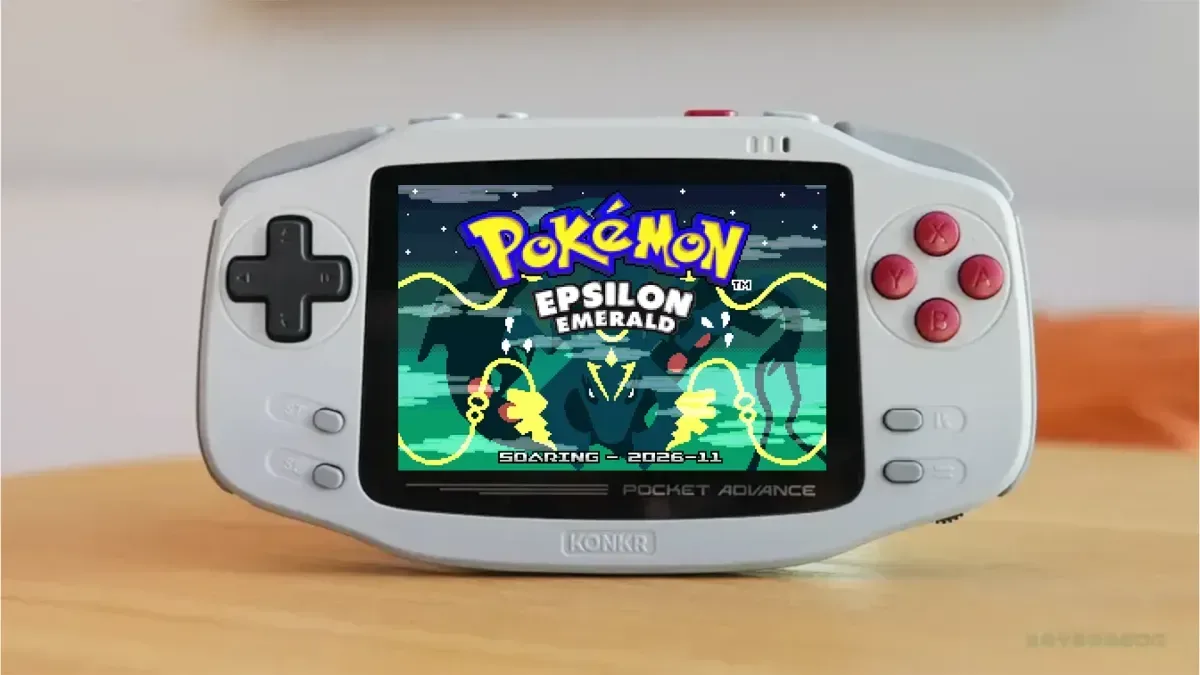
Pokémon Epsilon Emerald, a ROM hack built from Pokémon Emerald, is scheduled for release on November 14. A newly released trailer has put the spotlight on an unusually broad project: a complete demake of Pokémon Omega Ruby and Alpha Sapphire that aims to rework Hoenn through Emerald’s framework while adding modernized systems, revised encounters and a substantial amount of postgame material.
Developer pokemerrp has characterized the project as fully human-made. The release is not positioned as a small balance patch or a simple visual conversion. Its feature list covers story content associated with the later Hoenn remakes, including a playable Delta Episode; major mechanical adjustments; newly added Pokémon from multiple generations; and several convenience changes designed to make repeated play and team-building less cumbersome.
Further post-development work is planned into 2027, with the stated goal of adding features for the project’s established audience. That makes the November release an important milestone, but not necessarily the final word on what Epsilon Emerald may contain over time.
An Emerald foundation with Omega Ruby and Alpha Sapphire ambitions
The central idea is easy to state but large in scope: take the Game Boy Advance-era structure of Pokémon Emerald and create a full demake of the Hoenn material associated with Omega Ruby and Alpha Sapphire. Epsilon Emerald retains Emerald as its base while folding in new locations, character changes, story elements and mechanics inspired by the later games.
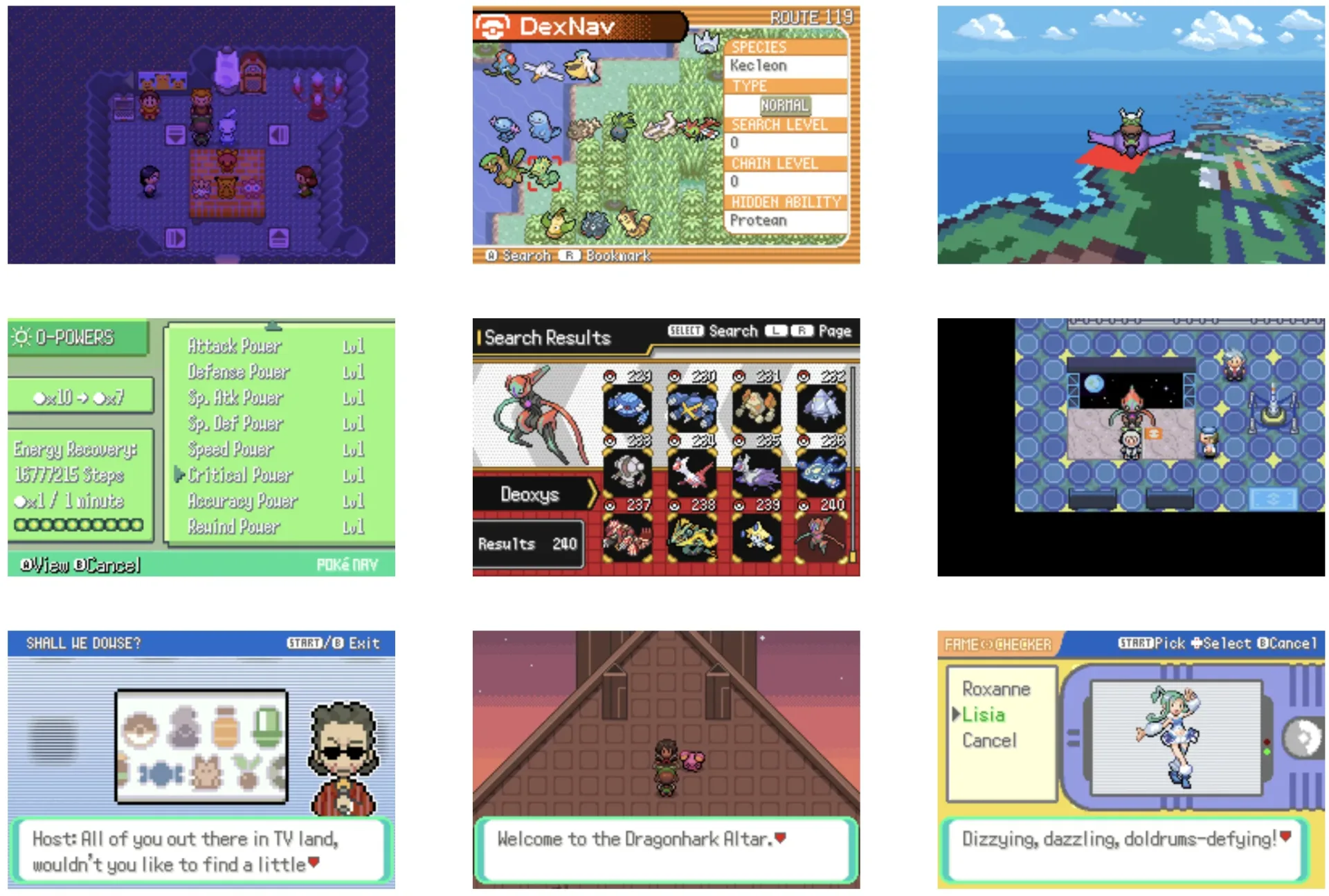
The project’s ORAS-inspired content includes a complete Delta Episode, as well as appearances and changes involving Professor Cozmo, Aarune, Lisia and Zinnia. It also lists soaring through the region via Latias or Latios, Mirage Spots, enhanced television programming and BuzzNav, plus a set of Contest-related sidequests involving Lisia, Chaz and Wallace.
Several additions are framed specifically around expanding what players can do once the main journey is complete. These include a Rustboro postgame training location for EV and level-up training, a sidequest for the gear-switching Machro Bike, and the ability to rematch Wally at the Battle Frontier’s Ranking Hall. A custom Mega Evolution for Milotic is also on the feature list.
In practical terms, the project is trying to make Hoenn feel more densely connected to the ORAS version without abandoning the presentation and underlying identity of Emerald. That distinction matters. A demake does not merely recreate a newer game at lower visual fidelity; it must translate systems and story ideas into a much older game structure. Epsilon Emerald’s long list of bespoke features suggests that translation is intended to extend beyond maps and character appearances.
Difficulty settings put battle rules in plain view
Epsilon Emerald will offer three difficulty settings: Easy, Normal and Hard. Easy adds no stated extra challenge. Normal enforces the SET battle style and restricts Bag use to two items per battle. Hard keeps those Normal-mode constraints, removes Bag item use during battles entirely, and has trainer teams scale with the player’s party level.
Related coverage includes Pokémon Epsilon Emerald Trailer Highlights Its Ambitious Omega Ruby and Alpha Sapphire Demake.
The settings are not described simply as numerical stat boosts. Instead, they change the rules around battle recovery and switching, which should make individual decisions more consequential on the higher options. Trainer teams throughout the game have also been reworked.
Normal and Hard feature soft level caps that change with badge progress. The project describes this implementation as diminishing experience returns rather than an absolute wall: Pokémon can still gain experience, but leveling becomes less efficient beyond the intended range. This is a meaningful difference from a hard cap, where advancement would be stopped outright.
There is also a built-in Nuzlocke mode, accessed through an intern in Professor Birch’s laboratory. Nuzlocke is a self-imposed challenge format in the broader Pokémon community, and integrating it into the game itself is a notable attempt to support that style of play without asking players to track every rule externally.
For those who want a more flexible campaign, Epsilon Emerald includes a toggleable Exp. Share, Hyper Training and Bottle Caps. The combination points to a project that is trying to accommodate both structured challenge runs and players who would rather spend less time on routine team maintenance.
Modern conveniences, adapted for a Game Boy Advance-style adventure
Many of the listed upgrades focus on reducing friction in a familiar Hoenn campaign. TMs are reusable, while HMs can be used without first teaching the move to a Pokémon. The game also allows players to fly to routes rather than only towns, increases text speed, reduces repeated NPC interactions and supports registering as many as four Key Items at once.
Those changes are modest individually, but they address the repeated actions that can accumulate across a long role-playing game. They also sit alongside systems that are more visibly modern: Gen 6 and 7-style icons are planned throughout the game, including on the PC, and shiny support is included. Text is decapitalized, another presentation change intended to give the script a different feel from the original all-caps style.
The Pokédex is set to include evolution methods, learnsets and fast page navigation. DexNav is included as well, as is the Fame Checker feature associated with FireRed and LeafGreen. Mystery Gift support is listed through Wonder Card and Wonder Code input for event distribution.
Day-and-night lighting, effects and encounters are also part of the overhaul. Alongside new and rearranged music tracks and artwork, those additions indicate that the goal is not only to add systems but to make the region’s moment-to-moment atmosphere feel less static.
For a useful comparison of how deliberate presentation choices can shape a Nintendo reimagining, see the discussion around Ocarina of Time Remake’s puppet-show visual direction. Epsilon Emerald is working in a different medium and format, but it similarly puts the emphasis on adapting a familiar adventure rather than simply preserving it unchanged.
Following Pokémon and a wider range of team options
One of Epsilon Emerald’s most prominent additions is originally coded following and walking Pokémon. The system is said to support every type of Poké Ball, Shiny Leaves and hundreds of conditional messages. In other words, the follower system is presented as more than a single sprite trailing behind the player: it is designed to acknowledge circumstances and cosmetic states.
The hack also includes Pokémon from multiple generations, although the supplied feature details do not specify a full roster. Updated battle mechanics accompany that broader selection. Pokémon Memories are retained through trades, another feature directed at preserving information connected to individual Pokémon as they move between players.
Cosplay Pikachu is included with revised types and abilities, while Mega Evolution and Spectacular Talents can be used in Contests. These are particularly clear examples of the project blending systems associated with ORAS into an Emerald-based build instead of treating Contest content as an untouched side activity.
Secret Bases become a bigger social and creative feature
Secret Bases receive one of the most extensive upgrades in the entire package. Epsilon Emerald’s Super-Secret Bases are compatible with vanilla bases, gain new locations around Hoenn, and can be shared with other players through an mGBA savestate. The feature also adds dozens of functional decorations, including a Berry Pot, Berry Blender and Pinball Machine.
The inclusion of functional decorations distinguishes these additions from purely visual room dressing. The project further lists in-game Secret Bases tied to the Mauville Old Guys, suggesting that bases will have more connection to the wider world rather than existing only as isolated player spaces.
This is one of the clearest areas where Epsilon Emerald appears to expand the optional side of Hoenn. Secret Bases have long been a personal-expression system within the region, and the stated additions give players more spaces, more objects and a means of sharing those spaces. The use of mGBA savestates is a technical method of exchanging save-state data; here, it is specifically identified as the route for sharing these bases.
What the feature list suggests about the project
Based on its announced systems, Pokémon Epsilon Emerald is not chasing just one kind of player. Its Easy mode and toggleable Exp. Share can serve players primarily interested in a refreshed story run. Normal and Hard instead establish tighter combat restrictions, scaling trainer parties and experience-based soft caps for those seeking more pressure. Built-in Nuzlocke support goes further by recognizing a popular challenge format within the game’s own structure.
At the same time, the developer has devoted attention to exploration, customization and repeatability: route flying, new locations near Route 111 and Dewford Town, soaring and Mirage Spots, Secret Base expansion, detailed Pokédex information, event-code input and postgame training all broaden the stated range of things to pursue.
That breadth is the project’s defining promise ahead of November 14. Epsilon Emerald is set to use Emerald as a foundation for an ORAS-flavored Hoenn adventure while revisiting elements players may value for very different reasons: story additions, difficulty rules, team building, Contests, base decoration and postgame battles. With additional work planned beyond launch, its first full release will establish the core version of an already ambitious Emerald reworking.