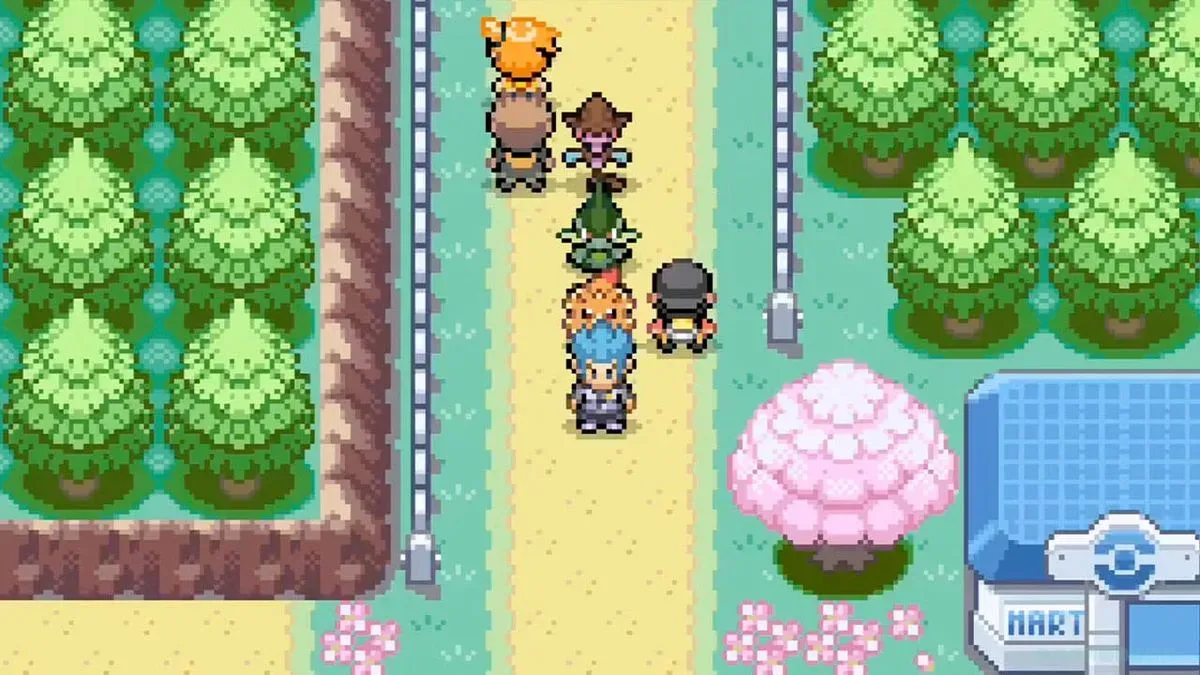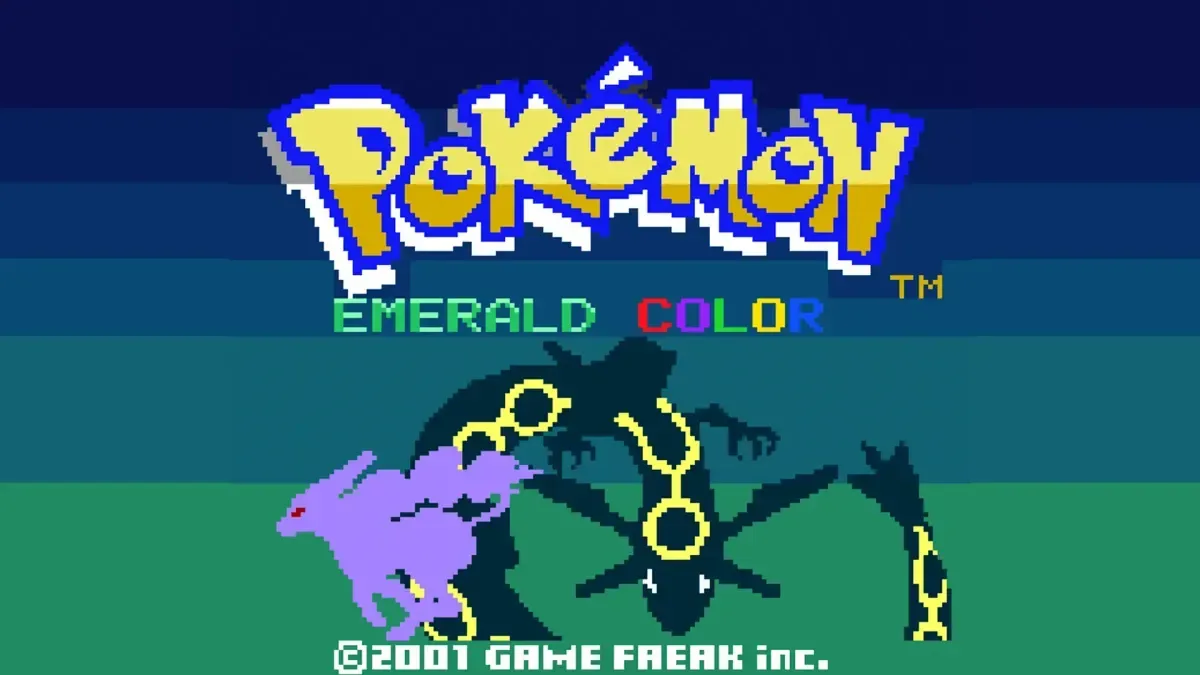
Hoenn is heading backward in time—at least in visual and technical spirit. Pokémon Emerald Color, an announced unofficial fan demake by davidpwalter, aims to recast Pokémon Emerald through the constraints and presentation associated with Game Boy Color-era Pokémon. Its stated approach is unusually ambitious: use Pokémon Crystal as the base, then adapt Emerald’s story, mechanics and overall character as closely as possible within that older framework.
That means the project is not simply a palette swap or a small graphical mod. The central idea is to make a version of Emerald that feels as though it could have belonged to the Game Boy Color generation, even though Emerald itself came from the Game Boy Advance era. The prospect is easy to understand for fans who have imagined Gen 3 Pokémon, Hoenn locations and moments such as the Rayquaza encounter at Sky Pillar rendered with Game Boy Color limitations rather than the more capable GBA presentation.
A public beta is expected later this week. The proposed setup is notable, too: players will need their own copies of both Pokémon Emerald and Pokémon Crystal, then decompile them on a computer to create the Pokémon Emerald Color ROM. That resulting ROM is intended for use on PC, through an emulator, or on Game Boy Color and Game Boy Advance hardware by way of a flash cart.
What Pokémon Emerald Color is trying to do
A demake is a reinterpretation of a newer game as if it had been made for older, less powerful hardware. It differs from a remake, which generally modernizes a game, and it differs from a straightforward port, which seeks to bring substantially the same game to another platform. The point of a demake is the translation: deciding what a game looks and feels like after its original technology is replaced by much tighter limits.
In this case, the stated target is not merely “Emerald, but lower resolution.” Pokémon Emerald Color is being positioned as an attempt to convert Emerald around Pokémon Crystal’s game foundation. That distinction matters because the project has to reconcile a different storyline, Pokémon generation, mechanics and style with an older Game Boy Color-based structure.
For players, the appeal lies in the collision of two familiar Pokémon eras. Emerald is associated with Hoenn and Gen 3, while Crystal supplies the Game Boy Color reference point. A successful conversion would offer a deliberately altered version of Emerald’s identity: not an effort to replace the original Game Boy Advance game, but a hypothetical alternate-history edition shaped by older graphical limitations.
That framing also sets sensible expectations. “As closely as possible” leaves room for compromises, and those compromises are the heart of any project like this. An older platform-style presentation cannot be expected to reproduce every aspect of the newer game unchanged. The interesting question is how the story, encounters, locations and mechanics are translated while maintaining a cohesive Game Boy Color feel.
The beta workflow: decompilation, ROMs and flash carts
The planned public beta is described as a build-it-yourself process rather than a conventional download-and-play release. Users will need copies of both named games and will decompile them locally to generate the new ROM.
Related coverage includes Pokémon Emerald Color Aims to Bring Hoenn to Game Boy Color Hardware.
Decompilation, in this context, means converting a game’s compiled program into a form that can be worked with and rebuilt. The important practical detail is that the expected beta process is local: the player supplies the required game copies and creates the Emerald Color ROM on their own computer.
A ROM is a game image used with software or compatible devices. Once created, Pokémon Emerald Color is intended to run in several ways:
- on a PC;
- through an emulator; or
- on Game Boy Color or Game Boy Advance hardware using a flash cart.
A flash cart is a cartridge-style device that can load a game image onto compatible hardware. It is the route mentioned for anyone who wants to use the project on original Game Boy Color or Game Boy Advance systems. The distinction is worth making: using a flash cart is not the same thing as an official retail cartridge release. The current description concerns an unofficial fan project and a generated ROM, not a commercially produced game cartridge.
There is obvious nostalgia in the idea of seeing a Hoenn adventure running from a cartridge-shaped device on a Game Boy Color or Game Boy Advance. But the beta’s described requirements mean interested players should be ready for a more technical process than selecting a game from a storefront. It is built around obtaining the necessary original games, working on a computer and choosing an appropriate way to run the finished ROM.
Original Game Boy Color performance is still a key question
The project is not being presented as finished. Visual polish remains on the to-do list, and certain areas reportedly experience frame-rate drops. That is especially significant because the goal includes operation on original hardware.
Frame rate describes how often a game updates its on-screen motion. When it falls, movement and animations can appear less smooth. In a project designed around Game Boy Color limitations, these slowdowns are more than a minor cosmetic issue: they are part of the difficult work of making a more expansive concept feel dependable on the intended hardware.
Emulators may be able to run beyond some physical constraints, but that does not settle the question of how the game behaves on an actual Game Boy Color. The present state should therefore be read carefully. Pokémon Emerald Color is aiming for original-hardware compatibility, yet its developer still has performance work to do, particularly in areas where the frame rate drops.
For prospective beta players, this makes platform choice meaningful. Playing on a computer or emulator may be the most convenient way to look at the conversion and follow its development. Playing on original hardware through a flash cart is the more authentic test of the project’s central premise, but it is also where the remaining performance limitations are most relevant.
AI assistance has not been confirmed
There has been speculation that Pokémon Emerald Color may be AI-assisted, potentially involving ShinyGen AI. That should remain firmly in the category of unconfirmed information: no confirmation from the developer has been provided.
The distinction matters. “AI-assisted” can cover many possible roles in a development process, and it does not, by itself, explain what was made with a tool, what was made by hand, or how the work was implemented. Until the developer clarifies the project’s methods, it would be inaccurate to state that ShinyGen AI was used or to describe a specific role for AI in the demake.
The question nevertheless sits within a wider conversation around fan projects, mods and how players judge their creation. For a separate example of how technical changes can put modding and player-made fixes at risk, see our coverage of gameplay mods and bug fixes caught up in an anti-cheat change. Pokémon Emerald Color is a different kind of project, but it similarly highlights how much the practical experience depends on the tools, platforms and workflows surrounding the game itself.
Why this particular demake idea stands out
Pokémon games make a natural fit for demake curiosity because their identities are carried by more than visual detail. Regions, Pokémon, routes, story beats, menus and battle systems all contribute to a game’s character. Putting Emerald into a Crystal-derived, Game Boy Color-style framework gives the project a defined creative test: can the Hoenn experience still read as Hoenn once it is filtered through a much earlier Pokémon presentation?
Sky Pillar and Rayquaza are a concise illustration of that appeal. The project invites players to imagine a major Emerald moment not at its original Game Boy Advance level, but with Game Boy Color-style graphics. That is not just a question of whether sprites can be drawn differently. It is about how an iconic event is staged when visual presentation has to be more economical.
There is also a useful separation between the project’s immediate promise and its eventual quality. The promise is clear: a fan-made Emerald-to-Game-Boy-Color-style conversion, created from the foundations of Crystal and intended to work across PC, emulators and compatible original hardware. The quality questions are still open until the beta arrives: how complete the adaptation is, how polished the visuals become, and how much the ongoing performance work improves play on a real Game Boy Color.
For now, Pokémon Emerald Color is best viewed as a technically demanding fan reinterpretation still in progress—not a replacement for Emerald, not an official release, and not a finished product. If the beta arrives on the stated schedule, it should give Pokémon and retro-hardware fans their first practical opportunity to see how far that Game Boy Color-era Hoenn experiment can go.