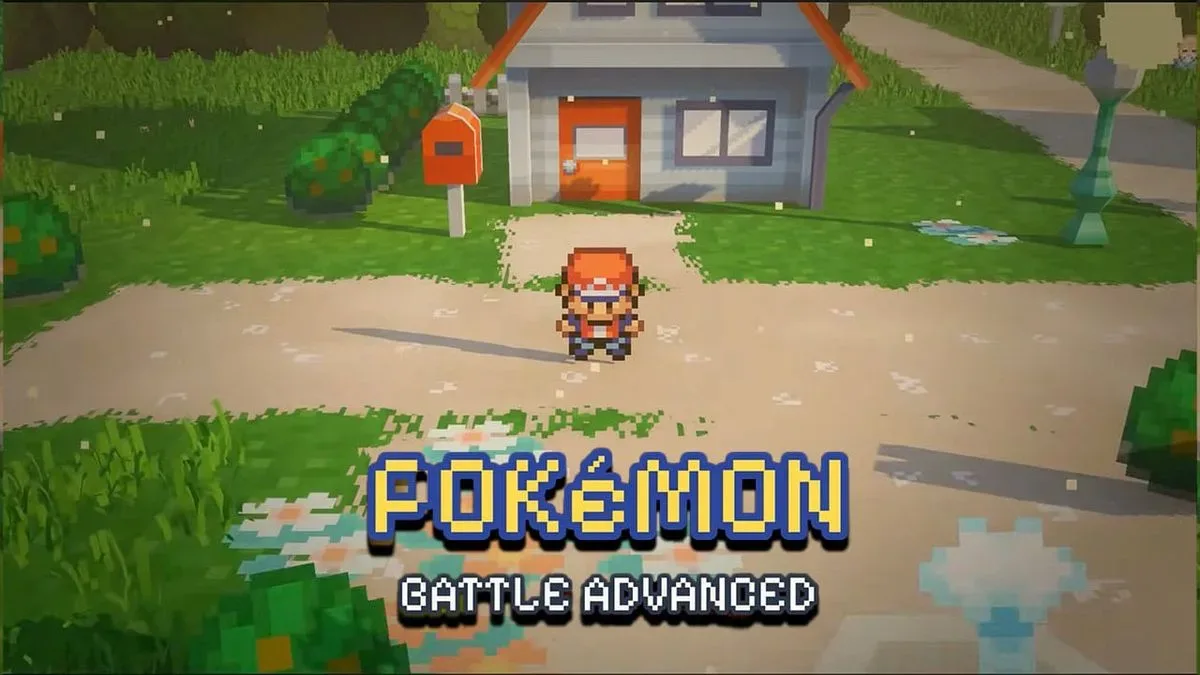
Pokémon Battle Advanced is a fan-made reinterpretation of Pokémon FireRed that takes Kanto’s earliest stretch in a notably different direction: a 3D presentation, environmental effects, and real-time trainer combat. Created by The Daigan, the available demo runs in a browser through Itch.io, with no download, mod installation, or file-upload process described for players.
That low-friction setup is a major part of the project’s appeal. Fan recreations and modifications can ask players to navigate patches, emulators, setup instructions, or technical prerequisites before they can see what makes the project special. Battle Advanced instead presents its opening as something closer to a direct browser demo. The current build covers the beginning of the adventure through Brock, the first Gym Leader.
A different way to revisit FireRed’s opening
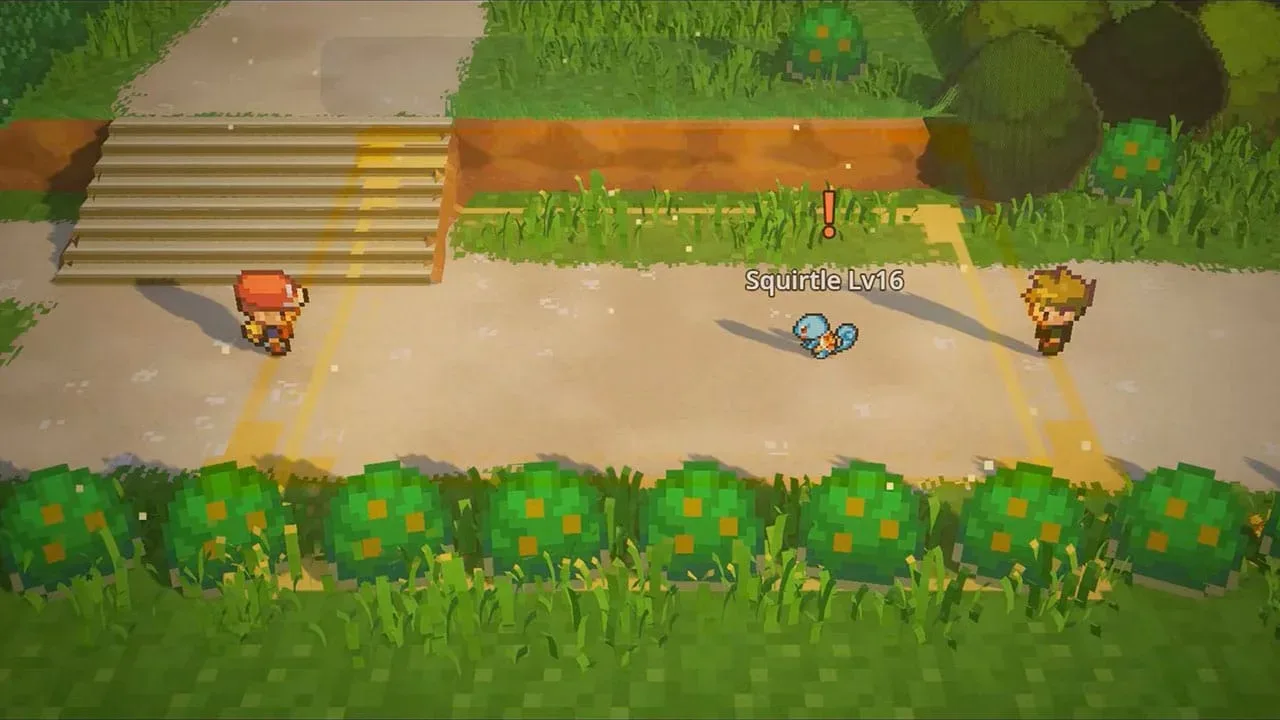
FireRed is the foundation, but Battle Advanced is not simply a higher-resolution version of the original experience. Its 3D world uses a voxel-like look, giving Kanto’s early towns and routes a block-built form while retaining Pokémon-inspired character and creature designs. The visual approach has been compared to a meeting point between the older Game Boy-era Pokémon aesthetic and the softer, more toy-like look associated with Pokémon Pokopia.
Voxel is short for “volumetric pixel.” Where a conventional pixel is a two-dimensional dot on a screen, a voxel is a small cube-like unit used to construct a three-dimensional scene. In practical terms, that can make terrain, buildings, vegetation, and characters feel intentionally chunky rather than photorealistic. It is a fitting visual language for a project revisiting a game whose original world was communicated through compact sprite art and tile maps.
The demo also adds details that are less about raw resolution and more about atmosphere. Flowers move in the wind, fireflies appear in the environment, weather changes during play, and the world has a day-and-night cycle. Lighting responds to the time of day, with lights coming on after dark. These are small systems individually, but together they change how a familiar route is framed. Rather than existing as a largely static series of tiles, the setting is presented as an environment with movement and changing conditions.
That does not mean the project should be treated as a replacement for FireRed, nor does the current demo establish that every part of the original adventure will receive the same treatment. What it does demonstrate is a specific creative question: what if the introductory portion of a classic Pokémon journey were staged more like a modern third-person action game?
Trainer battles become real-time boss encounters
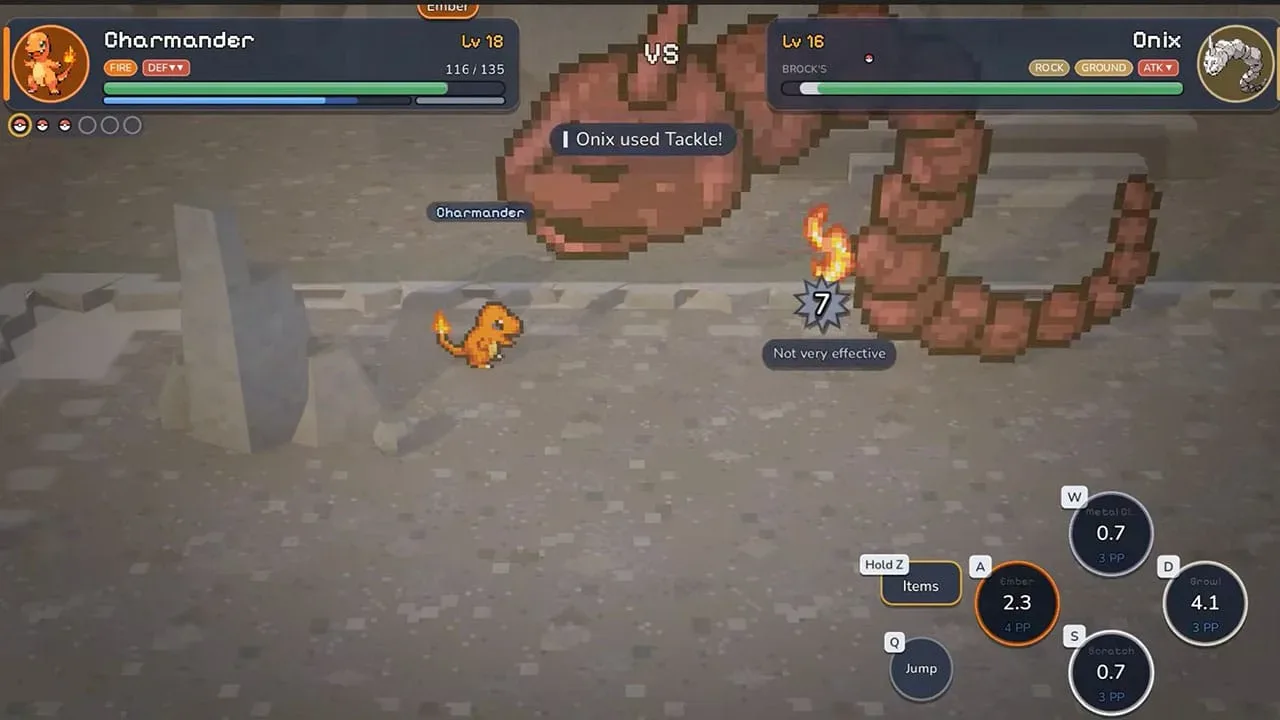
The biggest mechanical departure is combat. Mainline Pokémon battles are famously turn-based: players select a move, actions resolve in sequence, and decisions typically revolve around type matchups, move choices, party composition, and resource management. Battle Advanced replaces that familiar structure in trainer encounters with real-time battles.
In a real-time system, events continue to unfold as the fight is happening instead of pausing for each combatant’s selected turn. The demo positions trainer encounters, including Gym fights, as boss-style challenges that must be completed live to progress. A health-bar display at the top of the screen communicates the remaining health of both sides, an interface commonly used to make the state of an action-game boss fight immediately readable.
Related coverage includes Pokémon Battle Advanced Brings 3D FireRed Action to Browsers.
The player takes the field with their starter while the Pokémon handle the fighting. The available description also says wild Pokémon can be brought in to tag-team during battle. That potentially shifts the feeling of the series’ early encounters from a tactical exchange of menus into a more immediate contest of positioning, timing, and battlefield pressure, although the precise controls, move behaviors, and long-term party systems have not been detailed.
It is worth drawing a line between what is shown and what is still unknown. The demo includes the opening portion of the game and the battle with Brock; it does not confirm a finished full-game conversion, a complete roster implementation, or how later areas and fights might work. Mentions of future clashes with characters or Pokémon such as Mewtwo and Moltres are an appealing possibility, not a documented feature of the currently available demo.
Why Brock is a useful early test
Brock’s place at the end of the demo makes sense from a design perspective. He serves as the first Gym hurdle in FireRed’s opening progression, so reaching him lets the project show a compact arc: exploration, rival conflict, trainer battles, and a climactic Gym challenge. It gives viewers a clear comparison point with the original without requiring the fan project to establish all of Kanto at once.
That narrow scope is also useful for judging the core premise. A real-time Pokémon battle system has to communicate who is attacking, how damage is being exchanged, and how a player affects the outcome quickly enough to feel responsive. The health bars help solve part of that readability problem. The browser format, meanwhile, makes it easier for curious players to assess the concept without first committing to a lengthy setup process.
Browser delivery is part of the experiment
Running the demo directly in a browser matters beyond convenience. It turns the project into something that can be opened and sampled more immediately than many fan modifications. For people interested in Pokémon projects but reluctant to deal with mods, uploads, or unfamiliar installation steps, that can remove a meaningful barrier.
There are practical boundaries to keep in mind. Browser play is not a guarantee of universal device compatibility or permanent availability, and the supplied information does not specify supported browsers, control options, save behavior, or performance targets. Players should view the build as a demo of an in-progress reinterpretation rather than assume feature parity with a finished commercial game.
The browser angle also places Battle Advanced in a broader conversation about how experimental game projects are shared. Easy access makes a concept easier to demonstrate, but it does not by itself answer questions about polish, stability, or how expansive the finished idea might become. Those distinctions matter especially when an ambitious project remakes a recognizable game structure while altering its central combat language.
Technical accessibility has increasingly become part of how games are judged and preserved, although simplicity for a player does not mean simplicity behind the scenes. That broader tension is visible in a very different context in this report on a game patch that still left affected players with a character workaround: a straightforward path into a game is valuable, but it is not the same thing as solving every underlying technical issue.
AI-assisted coding disclosure and the human work behind it
The project’s Itch.io page discloses that AI was used to assist with coding. That is a disclosure worth retaining accurately, particularly because “AI-assisted” describes a contribution to the development process rather than automatically explaining the extent of that contribution. The information available also indicates human development was involved.
There is not enough detail to establish which code was AI-assisted, how much of the project used those tools, or how the work was divided between automated assistance and the developer’s own implementation. It would be misleading to fill in those gaps. What can be said is that the project identifies AI assistance as part of its coding process and that its public presentation also reflects a human-made creative direction: translating an established RPG opening into a 3D space, choosing environmental details, and recasting Gym progression as a real-time boss encounter.
For players, the more immediate question is likely whether the demo’s ideas cohere. The visual atmosphere, accessible browser delivery, and action-oriented battle framing all point toward the same goal: making the early FireRed journey feel unfamiliar enough to be surprising while remaining recognizable as a Kanto adventure.
What the current demo establishes
- It is a 3D browser-playable fan project based on Pokémon FireRed, created by The Daigan.
- The available demo reaches through Brock and the first Gym battle.
- Its world includes changing weather, a day-and-night cycle, lighting after dark, moving flowers, and fireflies.
- Trainer and Gym encounters replace conventional turn-based battles with real-time boss-style fights and on-screen health bars.
- Wild Pokémon can join the player’s side in tag-team battles.
- The project’s Itch.io listing discloses AI assistance with coding alongside human development work.
For now, Pokémon Battle Advanced is best understood as an early, playable proof of concept with a clear hook rather than a complete remaking of FireRed. Its opening demonstrates how much can change when perspective, atmosphere, and combat tempo are redesigned together. Whether the same approach can sustain an entire Kanto journey remains unanswered, but the route to Brock offers a direct look at the experiment without requiring players to turn a modding session into their evening’s main quest.