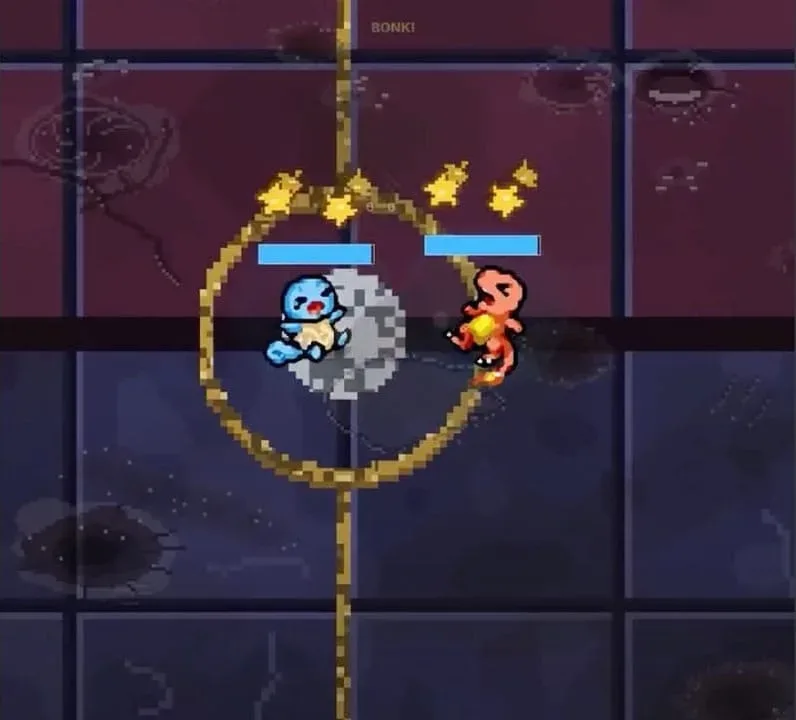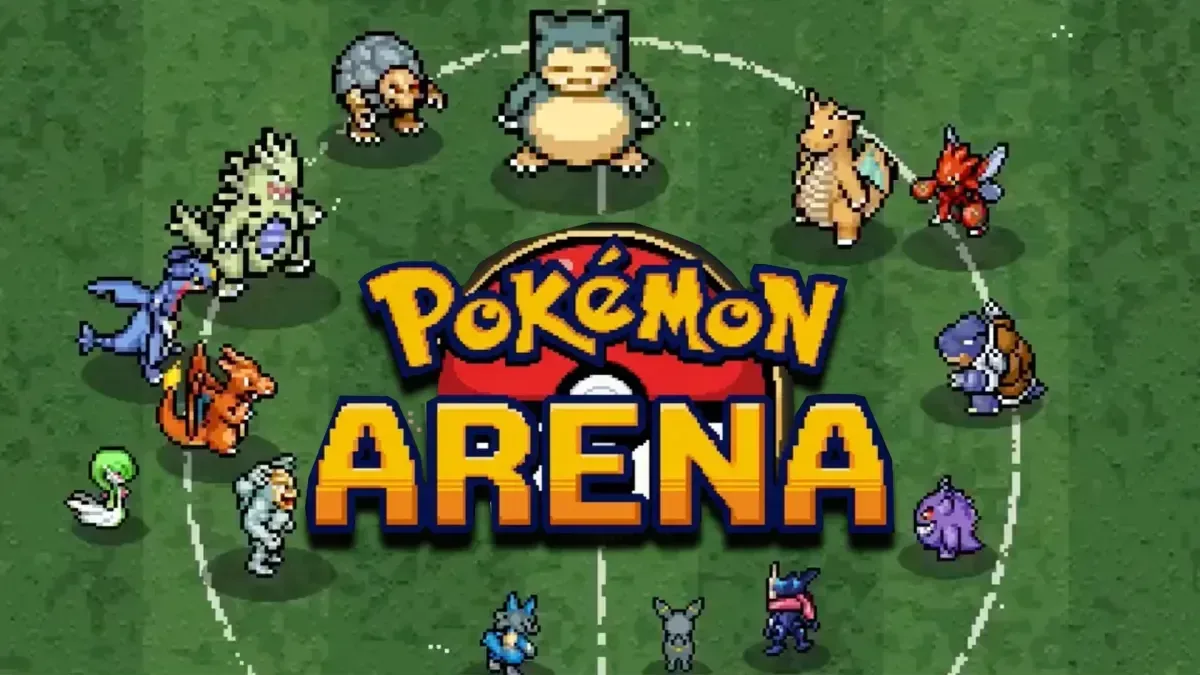
A project called Pokémon Arena is drawing attention for a simple-but-ambitious pitch: familiar-looking retro sprite battles reimagined as a fast, real-time arena fighter. Teaser footage attributed to developer Big Kid Nation shows Pokémon moving freely through enclosed 2D stages, evading attacks and changing the terrain with impacts rather than selecting a command and waiting for a turn to resolve.
There is still much that has not been detailed. Big Kid Nation has said the project is nearing a public beta, but no date, platform list, complete roster, or final ruleset has been specified in the material available so far. That makes this a project to watch rather than a finished game to evaluate. Still, the footage and stated goals point to an unusual blend of ideas: pixel-art presentation, arena-scale movement, and action-oriented Pokémon combat.
A battle game built around movement
Pokémon Arena’s clearest departure from classic Pokémon games is its approach to combat. Traditional Pokémon battles are turn-based: each side chooses an action, then the game processes those choices in an ordered sequence. Positioning is generally abstracted away. A move succeeds, misses, deals damage, or applies an effect according to the battle system’s rules, not because a player physically steered a character out of its path.
The footage for Pokémon Arena instead depicts real-time combat. In practical terms, that means player movement and reaction appear to be central to each exchange. A dodge can matter as much as an attack selection, while spacing—keeping the right distance from an opponent—becomes a major tactical decision. That is a substantially different challenge from reading turn order, managing move resources, or predicting a switch in a conventional battle format.
The easiest reference point is an arena fighter: characters share a space, attacks have visible trajectories or areas of effect, and players need to respond immediately. The project has been described as a 2D counterpart to Pokkén Tournament in its broad concept, but its use of small sprite characters and overhead-looking arenas gives it a separate visual identity.
That combination could make Pokémon Arena immediately legible to players who recognize older Pokémon sprite work while asking them to learn a new combat language. The appeal is not just nostalgia for pixel art. It is the promise of seeing that visual style do something it was not usually built around: active, multi-directional action where a battle can change from one second to the next.
Stages appear to be part of the fight
The trailers also show a range of arena surfaces, including water, concrete, grass and dirt. More importantly, the environments do not appear to be purely decorative. Digging and body-slam-style impacts are shown leaving holes or craters in the ground.
This is commonly described as a reactive or destructible stage: an environment that visibly responds to combat. Based on what has been shown, the confirmed point is visual deformation from certain actions. It has not been established whether a crater changes movement, blocks an attack, creates a hazard, or affects damage. Those are different kinds of gameplay systems, and viewers should not assume them simply because the terrain can be marked up.
Related coverage includes Pokémon Arena Teases Fast 2D Battles With Retro Sprites and Destructible Stages.
Even if the effect is visual only, it can do valuable work. Damage to the arena makes heavy attacks feel consequential and helps a chaotic skirmish remain readable: players can see where particularly forceful encounters happened. If terrain interaction is tied to strategy in the eventual build, it could add another layer beyond aim and timing—but that remains an open question until the developer provides more details or a playable beta.
Five Pokémon have also been visible battling at once. That is notable because increasing the number of active combatants can change more than spectacle. Multi-character fights require players to track threats from multiple angles, judge whether to commit to an attack, and recover when attention shifts elsewhere. The footage establishes that such larger fights are being shown; it does not yet explain their modes, teams, win conditions, or how targeting is handled.
What is known about development and multiplayer
Big Kid Nation says it has spent two years on Pokémon Arena and had considered making the game for seventeen years before reaching its current near-beta stage. The developer also says multiplayer is planned for work in the coming months.
That wording matters. Planned multiplayer is not the same thing as a confirmed, feature-complete online mode. At this point, there is no stated information on whether multiplayer will be local, online, cooperative, competitive, cross-platform, or available in the initial beta. Those implementation details matter especially for an action game, where responsive controls and synchronization between players are fundamental to the experience.
The beta itself will be an important next step because short teaser footage is well suited to showing motion, art direction and punchy stage effects, but less suited to explaining game flow. A playable test can answer questions the clips leave unresolved: whether every Pokémon has distinct mobility, how attacks are mapped and balanced, whether matches are one-on-one or team-based, and how the game communicates cooldowns, damage and objectives.
For now, the responsible read is that Pokémon Arena has an appealing prototype of an idea, not a fully documented feature set. There is no basis yet to make claims about release timing, supported hardware, the scope of its Pokémon selection, or the exact shape of multiplayer.
Retro aesthetics without turn-based rules
There is a useful design tension at the center of the project. Retro Pokémon-style sprites carry expectations: players may associate them with grid-like maps, menu commands and turn-based encounters. Pokémon Arena uses a similar visual vocabulary for something much more immediate. The sprites are presented as combatants moving through a shared battlefield rather than icons awaiting instructions.
That contrast may be the project’s strongest hook. Pixel art is often praised as a look, but the trailers use it to communicate action too. A small character sprite needs clear animations and readable effects if players are expected to identify attacks, dodge in time and understand who is threatening whom in a crowded arena. The apparent emphasis on water, dirt, grass and concrete also gives stages recognizable silhouettes and textures without abandoning the old-school visual direction.
Action systems often rely on what players call telegraphing: animations, effects, or other signals that tell an opponent an attack is coming before it lands. No detailed breakdown of Pokémon Arena’s telegraphing has been shared, so it would be premature to judge it. But it is one of the core issues the game will need to solve. Great-looking attacks are not automatically fair or readable attacks, particularly when five characters may be active at once.
The same is true of movement. A real-time arena game lives or dies on the feeling of control: acceleration, turning, collision, dodges and recovery after attacks all determine whether the player feels deliberate or helpless. The teasers can demonstrate the concept, but those details need hands-on play to assess.
AI questions need a clear distinction
Discussion around the project has also focused on Big Kid Nation’s public-facing use of AI-generated imagery. The developer has said that the visuals shown in the Pokémon Arena trailers are not AI-generated, that the footage is actual gameplay, and that the project was built from the ground up in Python.
Those are claims from the developer, and they should be kept separate from assumptions about the project’s wider promotional material. AI-generated profile and marketing images are not the same thing as AI-generated in-game art, just as an AI-assisted coding workflow would not automatically establish that a game was wholly generated by AI. The available information does not provide a full accounting of tools used for code or production, so definitive claims beyond the developer’s statements would go further than the evidence supports.
Python is a programming language. Saying a project is built in Python identifies a technical foundation, but does not by itself explain the engine, the tools, the workflow, or how each asset and system was made. Players looking for more clarity will likely need to wait for further development updates, beta materials, or more specific technical explanation from Big Kid Nation.
For a useful broader look at why responsive input technology can matter to motion-driven games, see our explainer on why Nintendo added Wii MotionPlus to the Wii Remote.
Why the project has people watching
Pokémon Arena is not attracting interest because it promises another familiar version of Pokémon battling. Its premise is compelling precisely because it moves away from the established command-based rhythm. It asks what retro-styled Pokémon encounters might look like if they emphasized manual movement, evasive play and visually responsive venues.
That premise is still ahead of the available detail. Big Kid Nation has shown enough to establish the broad direction—real-time sprite combat in varied arenas, visible terrain damage, fights involving up to five Pokémon, and multiplayer work on the roadmap—but not enough to settle the bigger questions of controls, balance, modes or release plans.
The prospective public beta is therefore the key milestone. Until then, Pokémon Arena remains an intriguing fan-made project with an eye-catching combat concept and plenty left to prove.