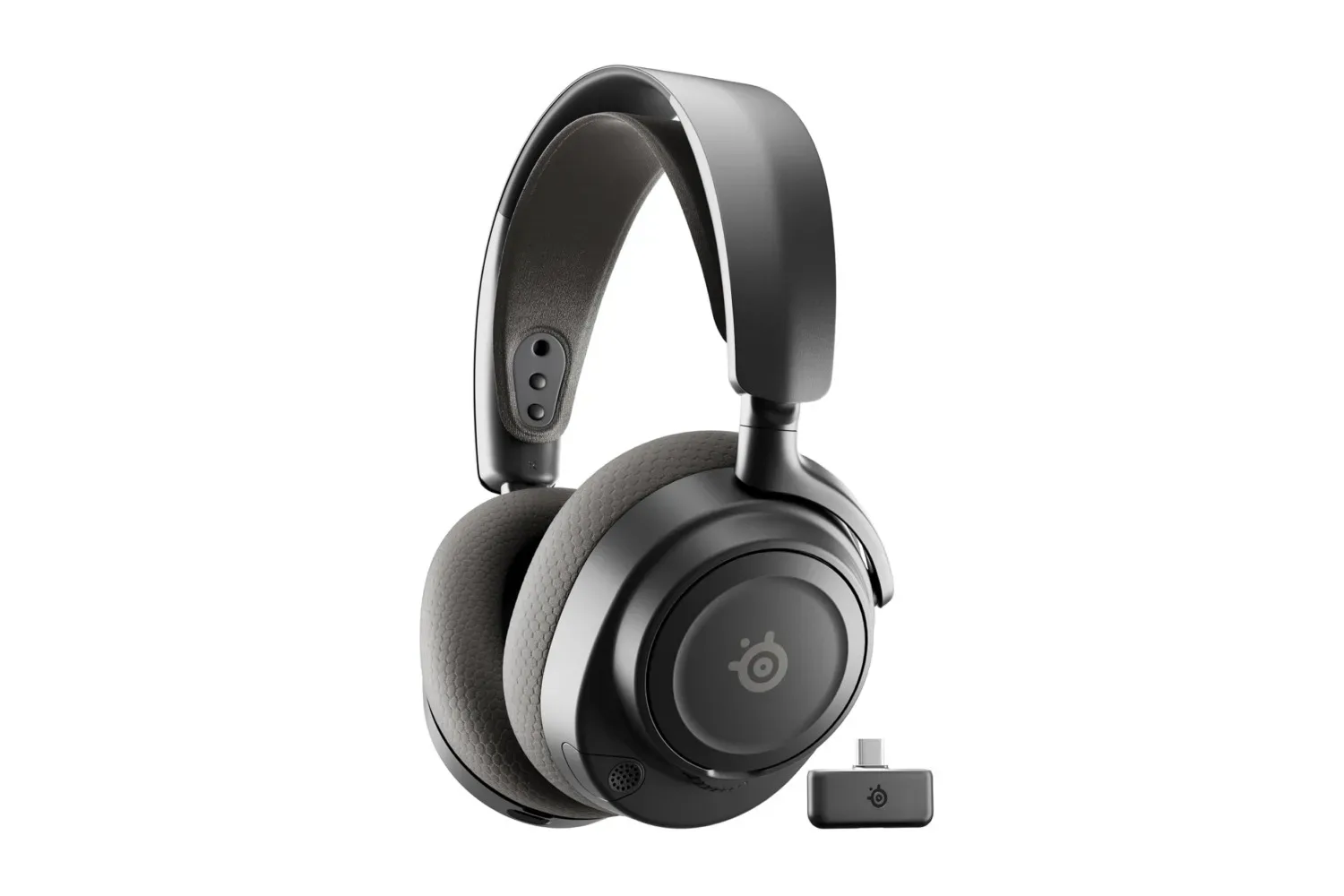
The SteelSeries Arctis Nova 7P Gen 2 has been reported at $160 during Cyber Monday, a 20% reduction from its stated $200 price. The reported offer covers Black, Magenta, and White versions of the wireless headset and applies to the PlayStation- and PC-compatible model.
A $40 reduction is useful, but the more important question is whether this particular headset fits the way someone plays. The Nova 7P Gen 2 is presented as a multi-device gaming headset rather than a simple console accessory: it supports PlayStation, PC, Switch, handheld devices, Bluetooth phone pairing, and a USB-C wireless dongle. Its headline specifications also include more than 50 hours of battery life per charge, a retractable noise-rejecting microphone, Spatial Audio support, and access to more than 200 EQ presets through its companion app.
That combination makes this deal potentially more relevant to players who alternate between a console, a PC, and a portable system than to somebody who only needs a wired headset for one controller. It also means shoppers should think beyond the sale percentage. Compatibility, connection method, chat needs, comfort, and control options will matter much more than a countdown badge. That same caution applies to controller deals, as covered in our look at the checks PS5 players should make before treating a discounted DualSense Edge as an automatic win.
What the reported $160 deal includes
The reported price is $160, down from $200. The discount is said to apply across all three listed colors, so the choice between Black, Magenta, and White should not require accepting a higher price. Cyber Monday promotions can be time-limited or change without warning, however, so a shopper should confirm the exact model, color, current price, and seller on the retail page before purchasing.
The key model detail is “7P Gen 2.” A headset family name can be easy to mistake for a different revision or platform-focused version, especially during a major sale period. Checking that full product name at checkout is a practical way to avoid assuming that every similarly named Arctis Nova headset has the same wireless, platform, microphone, and software capabilities described here.
Why the dual-wireless setup matters
One of the more practical features described for the Nova 7P Gen 2 is its ability to remain connected through the USB-C dongle while also pairing with a phone over Bluetooth. This permits audio from both devices at once. In plain terms, game sound can come through the dongle connection while a phone supplies another audio stream.
That is not merely a novelty feature. A player could keep game audio active while taking a call or listening to audio from a phone, without unplugging the headset or abandoning the primary wireless link. Whether that is desirable depends on the situation: simultaneous audio is flexible, but it can also become distracting if notifications, music, and a multiplayer match are all competing for attention.
The dongle is also described as making pairing and switching between devices easier. A wireless dongle is a small receiver that plugs into a compatible device and provides the headset’s wireless connection. Here, its USB-C format is especially relevant for the listed mix of PlayStation, PC, Switch, and handheld use. Players should still verify their own devices and intended connection setup, rather than treating broad compatibility language as a guarantee that every feature behaves identically on every platform.
Related coverage includes SteelSeries Arctis Nova 7P Gen 2 Cyber Monday Deal Drops PS and PC Headset to $160.
PC players get the deepest sound controls
The headset’s companion app offers more than 200 professional EQ presets and allows users to make their own. EQ, short for equalization, is a way to adjust the prominence of different portions of the sound range. A preset can change how a game’s soundtrack, dialogue, environmental details, or effects are emphasized. A custom setting gives the listener more direct control over that balance.
The supplied information specifically points to games where catching quieter environmental details may matter, such as a player moving through wooded terrain. Adjusting an EQ may help make a chosen set of details more noticeable, but it is best understood as personalization, not as a universal competitive shortcut. An aggressive adjustment can also make a mix less natural or push some sounds ahead of others in a way a player dislikes.
PC is where the reported controls become particularly granular. Users can adjust separate channels for game, chat, music, and memes, as well as manage sound for individual applications. Channel control means different categories of audio can be balanced against one another. If teammates are too loud relative to the game, for example, a user may prefer to reduce chat rather than turn down all system audio. Per-application controls take that idea further by allowing distinct treatment for separate programs.
This is likely to be valuable for PC players who run a game, voice chat, music, browser audio, and other apps at the same time. For players who only use a console and want a single fixed audio profile, the long list of options may simply be more flexibility than necessary. The point is not that customization is automatically better; it is that the headset appears built for listeners who want to spend time shaping their audio mix.
Spatial Audio and drivers: what those terms mean
The Nova 7P Gen 2 is described as supporting Spatial Audio and using custom-designed high-fidelity drivers. Headphone drivers are the components that turn an audio signal into the sound heard through the earcups. “High-fidelity” is a general quality-oriented description rather than a complete technical measurement, but the stated aim is clear, crisp sound.
Spatial Audio refers to processing intended to create a sense that sound occupies positions around the listener. In games, that can help make the presentation feel more directional and enveloping than a flat left-right stereo image. The experience depends on the game, platform, settings, and listener, so it should be treated as a feature to configure and assess personally rather than a promise of identical results in every title.
The practical benefit is immersion and positional context: environmental effects, voices, and action can feel more connected to the space depicted on screen. The practical trade-off is that users who prefer a straightforward sound profile may want to experiment with settings before settling on one. Having presets and custom EQ available gives the owner a route to do that.
Battery claims favor longer sessions
SteelSeries’ stated battery figure is more than 50 hours on a single charge. The supplied details also claim that a 15-minute recharge can add around six hours of playtime. Those numbers make battery management one of the headset’s central selling points, particularly for people who do not want to recharge after every few sessions.
Battery-life results can vary with use, so the figures are best treated as manufacturer-stated benchmarks rather than a personalized guarantee. Still, the quick-charge claim has a clear convenience angle. If the headset is low shortly before a session, a short top-up may be enough to get through a substantial stretch of play, rather than requiring a full recharge before it can be used wirelessly again.
For a player moving regularly between platforms, a long battery claim can remove one point of friction from the routine. It does not eliminate the value of checking whether the dongle, Bluetooth use, and controls match their devices, but it is a meaningful feature in a wireless product designed for extended sessions.
Comfort and voice chat are part of the value
The headset uses a steel frame, elastic headband, and memory-foam ear cushions. Those are design details aimed at durability, fit, and longer-wear comfort. Comfort remains personal—head shape, glasses, preferred clamping pressure, and session length all affect it—but the stated materials and adjustable-style headband approach indicate that all-day use is a consideration rather than an afterthought.
For multiplayer, the included microphone is described as noise-rejecting, with the goal of reducing keyboard clicks and background chatter. That does not mean all unwanted sound disappears, but it is intended to make speech clearer for teammates. The microphone can also be slid back into the headset when it is not needed, which is useful for solo play or for anyone who prefers a cleaner profile away from voice chat.
At the reported $160 price, the Arctis Nova 7P Gen 2 is most compelling on the strength of its combined feature set: multi-platform wireless use, two simultaneous audio sources, lengthy stated battery life, PC-level audio controls, and a retractable chat mic. Buyers who need only a basic headset should decide whether those extras will actually be used. Buyers who rotate among PlayStation, PC, Switch, handhelds, and a phone have more reason to examine the listing closely while the reported promotion remains available.
Shop the products
Check current price, model and availability at the retailer.