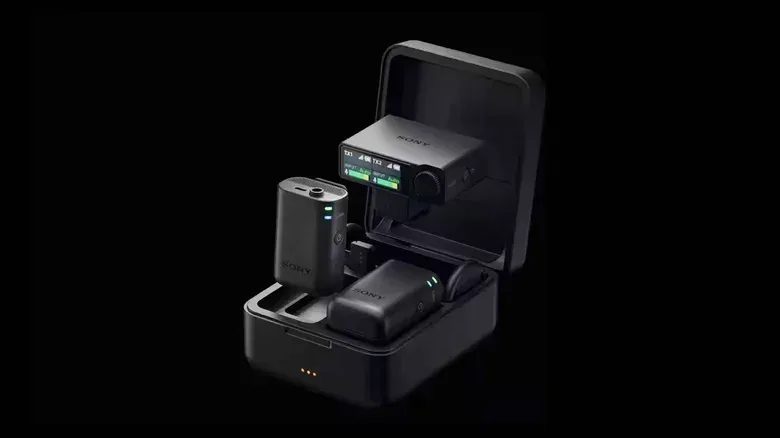
Sony has introduced the ECM-W5, a wireless microphone kit aimed squarely at creators who want a streamlined audio setup alongside a Sony Alpha camera. The $400 package includes two microphone transmitters and one receiver, with the headline feature being 32-bit float recording. Sony says the system can capture 96kHz audio at distances of up to 500 meters in line-of-sight conditions.
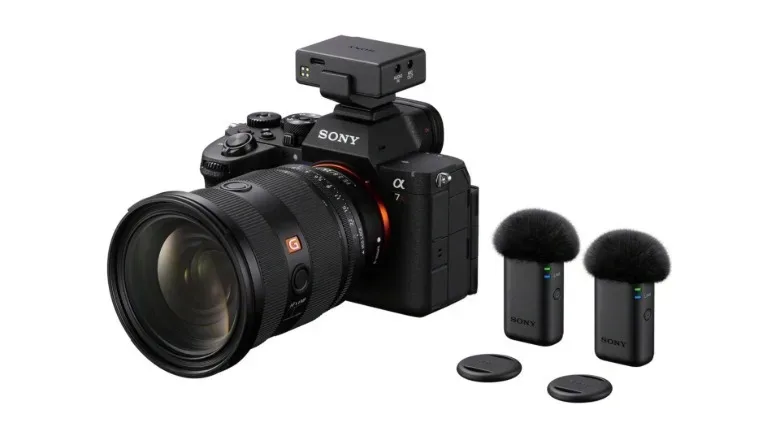
It is a notably camera-focused package rather than merely a wireless mic set that happens to work with cameras. The receiver can connect directly to compatible Sony Alpha bodies through the company’s Multi Interface Shoe, allowing it to receive power and transfer audio data through that connection. The receiver can also connect via USB-C to a smartphone or PC, making the ECM-W5 usable outside Sony’s own camera ecosystem.
Pre-orders are open at $400, with shipping planned for November. Sony will also sell the ECM-W5R receiver on its own for $190 and an individual ECM-W5T transmitter for $120.
What comes in Sony’s ECM-W5 kit
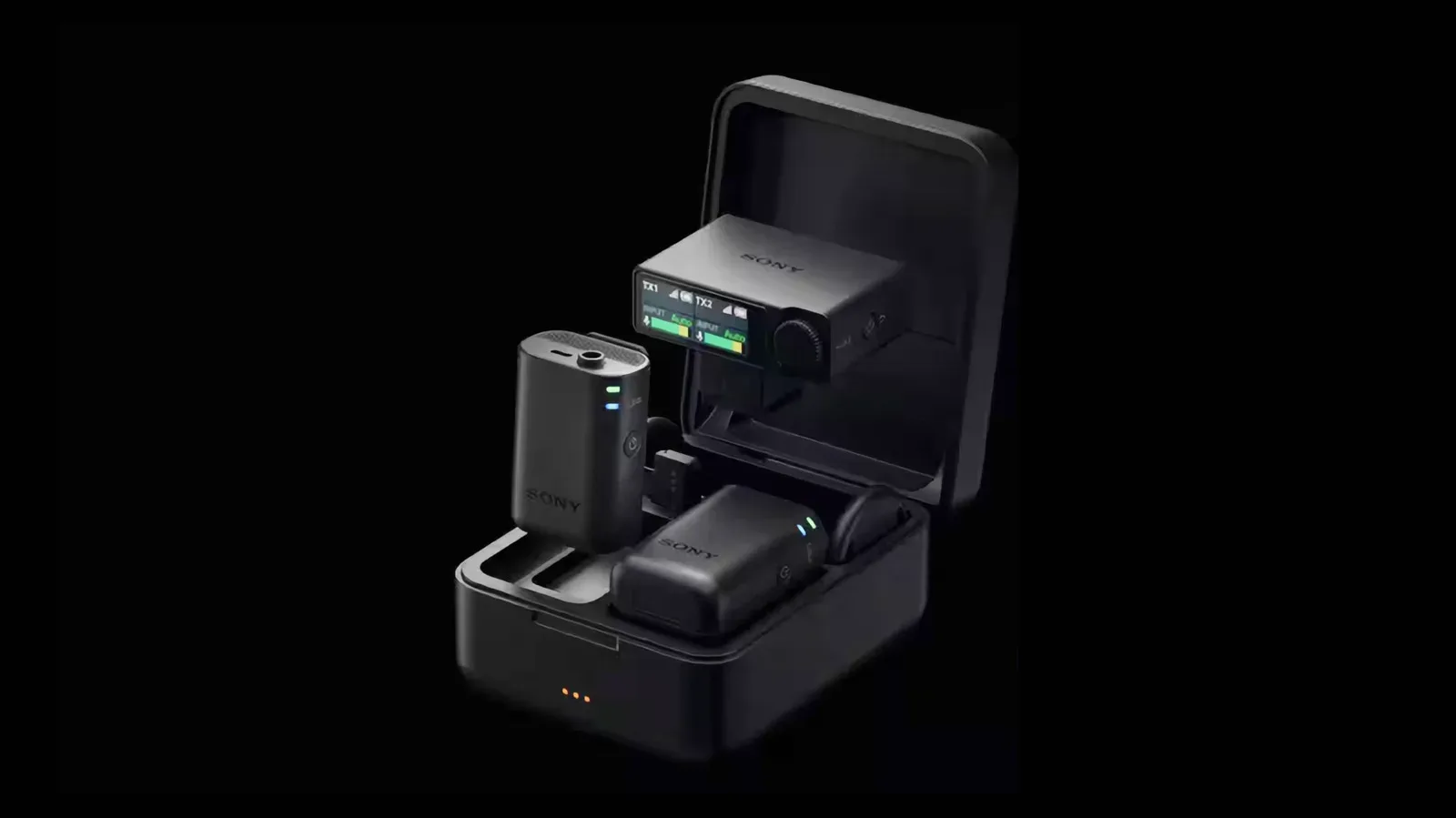
The standard ECM-W5 kit contains three core pieces: a rectangular receiver and two transmitters. That baseline configuration gives a creator two wireless microphone sources, useful for situations such as recording a host and guest, capturing two presenters, or keeping separate voices on their own tracks.
For more context, explore Megan Thee Stallion Appears in Baywatch Reboot Trailer Ahead of Early 2027 Return.
Each transmitter has 64GB of internal memory. That onboard storage serves as a backup option, a practical safeguard when wireless recording is part of a shoot. The transmitters are rated for 11 hours of battery life and include magnetic backplates for attaching them to clothing.
The system can grow beyond the two-transmitter bundle. Sony says users can record up to four tracks at once when additional $120 ECM-W5T transmitters are purchased. The separate $190 ECM-W5R receiver is also available for people planning a larger or more specialized setup.
- Included in the kit: one receiver and two transmitters
- Expandable recording: up to four simultaneous tracks with additional transmitters
- Transmitter storage: 64GB internal memory per unit
- Claimed transmitter battery life: 11 hours
- Maximum stated line-of-sight range: up to 500 meters
- Audio capability: 96kHz capture and 32-bit float recording
Why 32-bit float recording is the key feature
32-bit float is an audio-recording format intended to provide considerable flexibility when dealing with changes in volume. Put simply, it is designed to capture very quiet and very loud sounds without requiring the operator to make gain adjustments during recording.
Gain is the level applied to an incoming microphone signal before it is recorded. In a conventional workflow, setting it too low can leave speech weak and bring up unwanted noise when the recording is increased later. Setting it too high can create distortion when someone suddenly speaks loudly. That risk is especially familiar in unscripted interviews, event coverage, fast-moving video productions and any recording where performers or speakers do not maintain a consistent distance from the mic.
The ECM-W5’s 32-bit float capability is therefore less about adding a flashy specification than reducing one point of failure in audio capture. Rather than needing to constantly anticipate whether a subject will whisper, laugh, cheer or raise their voice, the creator has more room to adjust the recording in post-production.
That does not mean microphone placement, surroundings and basic recording discipline stop mattering. It does mean level management can be less restrictive. For creators who routinely work alone or operate a camera while simultaneously monitoring a conversation, that simplification could be one of the system’s strongest practical arguments.
Designed to fit Sony’s Alpha workflow
The most distinctive ECM-W5 advantage is its intended relationship with Sony Alpha cameras. Through the Multi Interface Shoe, Sony’s current hotshoe-style connection, the receiver can draw power from the camera and send data directly through the same mount. In practical terms, that can mean less cabling and fewer separate power-management tasks than a setup relying entirely on external connections.
For an Alpha user, a receiver that mounts to the camera and integrates through the shoe is an especially tidy proposition. There is no need to treat the wireless receiver as a separately powered accessory connected by a conventional audio cable in order to get the basic camera workflow underway. That convenience is likely a major part of what the $400 package is selling.
There is also value in the fact that the system is not locked to that use case. Sony includes a USB-C adapter with the receiver, enabling connection to phones and PCs. A creator could use the same kit for camera video, smartphone recording or computer-based work rather than buying a different wireless system for each device category.
Receiver settings are handled through a touchscreen. The system also supports Bluetooth LE wireless playback with Sony headphones. Bluetooth LE, or Bluetooth Low Energy, is a version of Bluetooth built to use relatively little power. Here, its role is to let a user listen wirelessly while adjusting the receiver, rather than turning the feature into a claim about long-range microphone transmission.
Price is the difficult part of the equation
The ECM-W5 arrives at a premium price. At $400, the kit costs more than the $259 DJI Mic 3 and far more than the $99 DJI Mic Mini. That gap makes the decision less about whether Sony has packed useful features into the system—the combination of onboard memory, two transmitters, expandable tracks and 32-bit float is substantial—and more about which workflow benefits most from Sony-specific integration.
For someone who does not use a Sony camera, the ECM-W5’s USB-C support keeps it viable, but it also weakens the case for paying extra solely for the Sony name. The direct Alpha connection via the Multi Interface Shoe is the differentiator that the less expensive alternatives do not inherently offer in this form.
For Sony Alpha owners, the calculation is more nuanced. The higher initial cost may be easier to justify if a cleaner camera-mounted configuration, direct shoe connection and 32-bit float recording remove enough friction from regular production work. It is also relevant that the kit starts with two transmitters, not one, and that Sony has laid out a path to four-track recording through separate ECM-W5T purchases.
Expansion is not inexpensive, however. Adding transmitters at $120 each can raise the total quickly, and the standalone receiver costs $190. Buyers considering a larger setup should look at the complete cost of the number of tracks they need, not only the $400 entry price.
Who the ECM-W5 makes the most sense for
The clearest audience is creators already committed to Sony Alpha cameras who want a purpose-built wireless audio option. The Multi Interface Shoe connection is the feature that turns the ECM-W5 from a broadly compatible wireless mic into a particularly convenient companion for Sony’s camera system.
It may also appeal to people who prioritize recovery room in post-production. The supplied information specifically highlights 32-bit float recording as a way to capture quiet and loud audio without gain adjustments. If fluctuating speaking levels are a recurring issue, that could carry more weight than a lower upfront price.
Conversely, creators looking primarily for the lowest-cost route to basic wireless audio have obvious cheaper options in the stated comparisons. The ECM-W5’s value rests on its total workflow: two transmitters in the box, internal recording memory, multi-track expansion, a long stated line-of-sight range, USB-C flexibility and, most importantly, direct integration with Sony Alpha cameras.
In a market where wireless microphones can look similar on a spec sheet, that integration is Sony’s real pitch. The ECM-W5 is not positioned as the budget choice. It is a premium accessory designed to make a Sony-centered shooting setup feel more unified while giving users greater latitude when managing audio after recording. For further details on the Alpha-focused setup, see this overview of the ECM-W5’s camera integration.