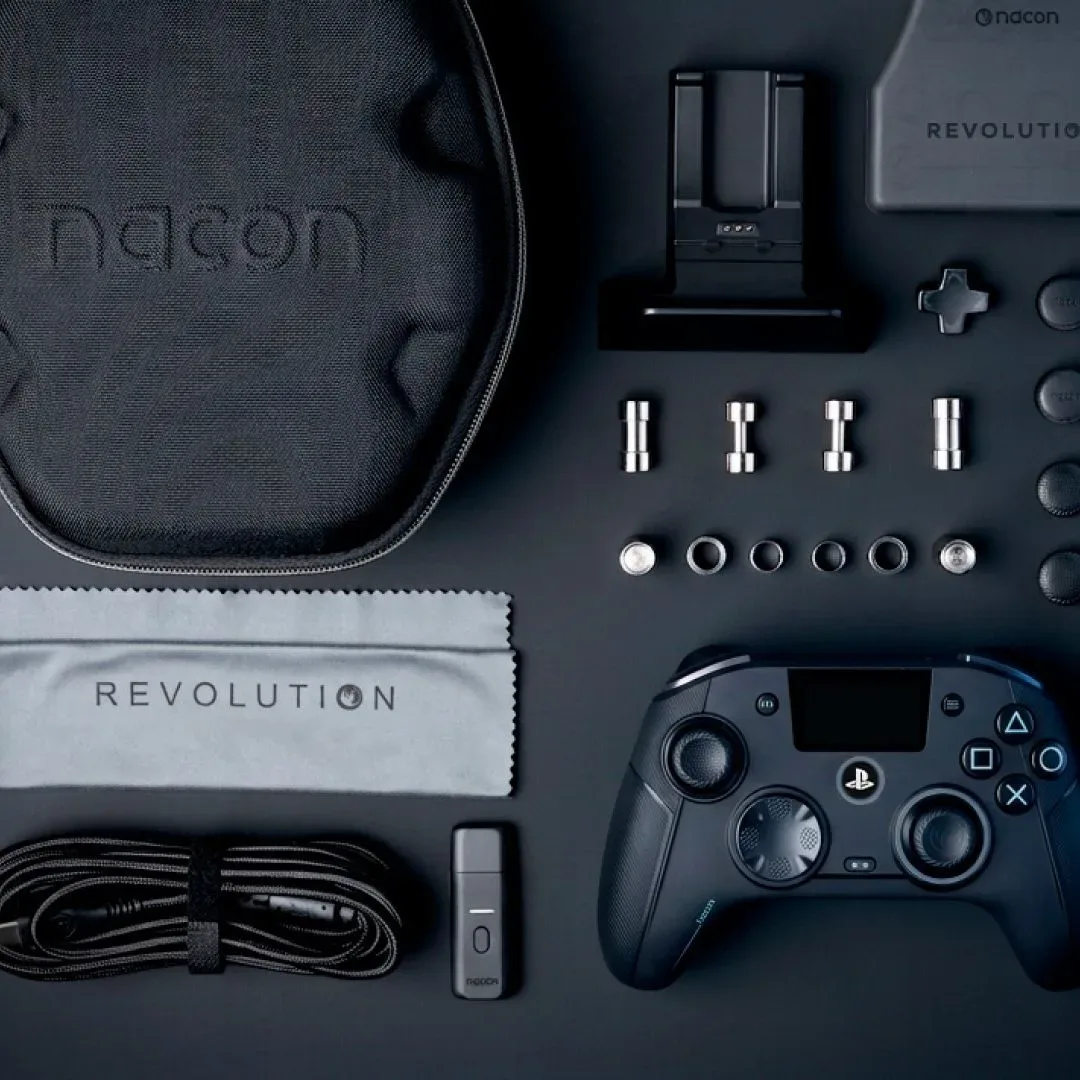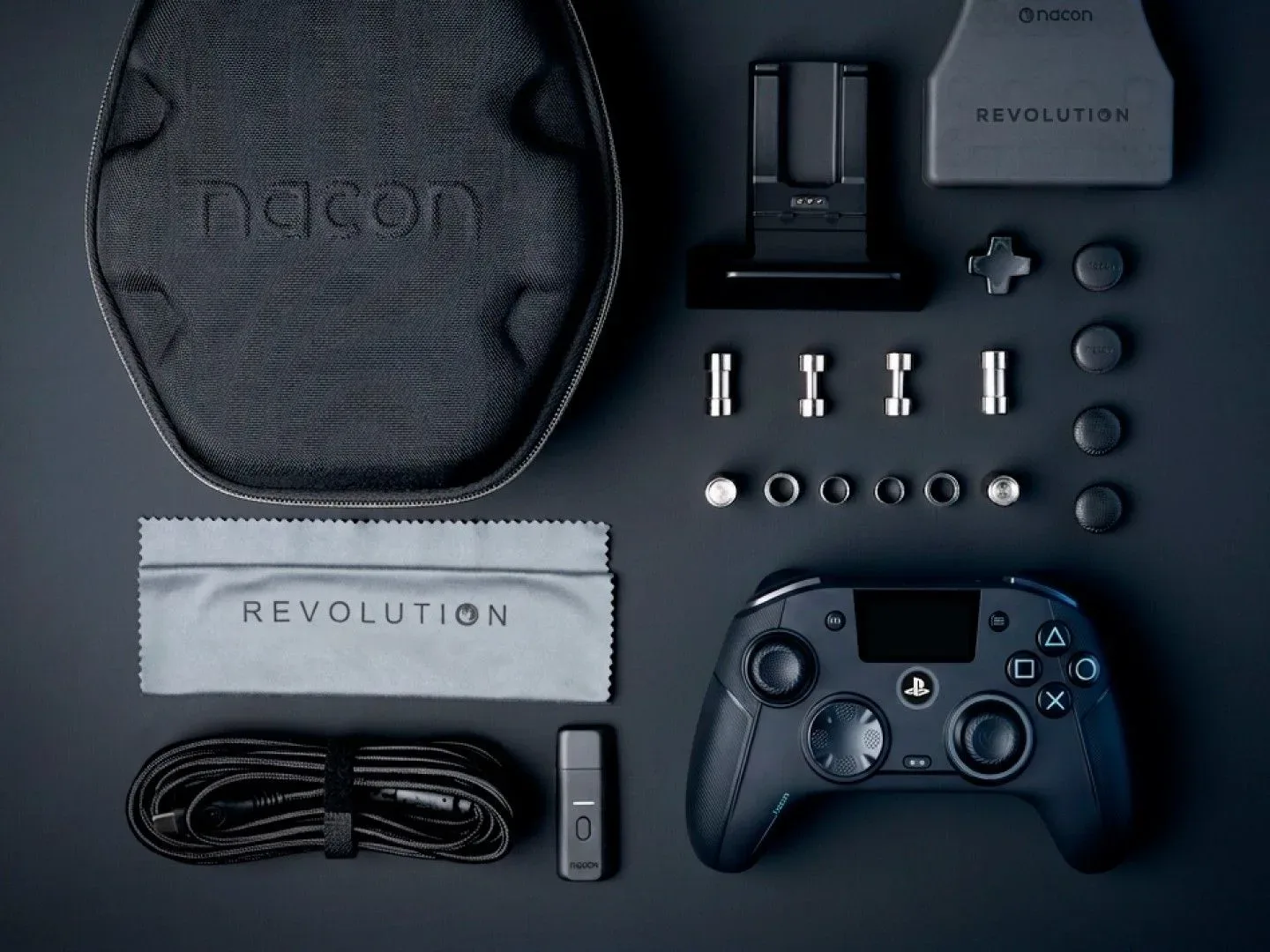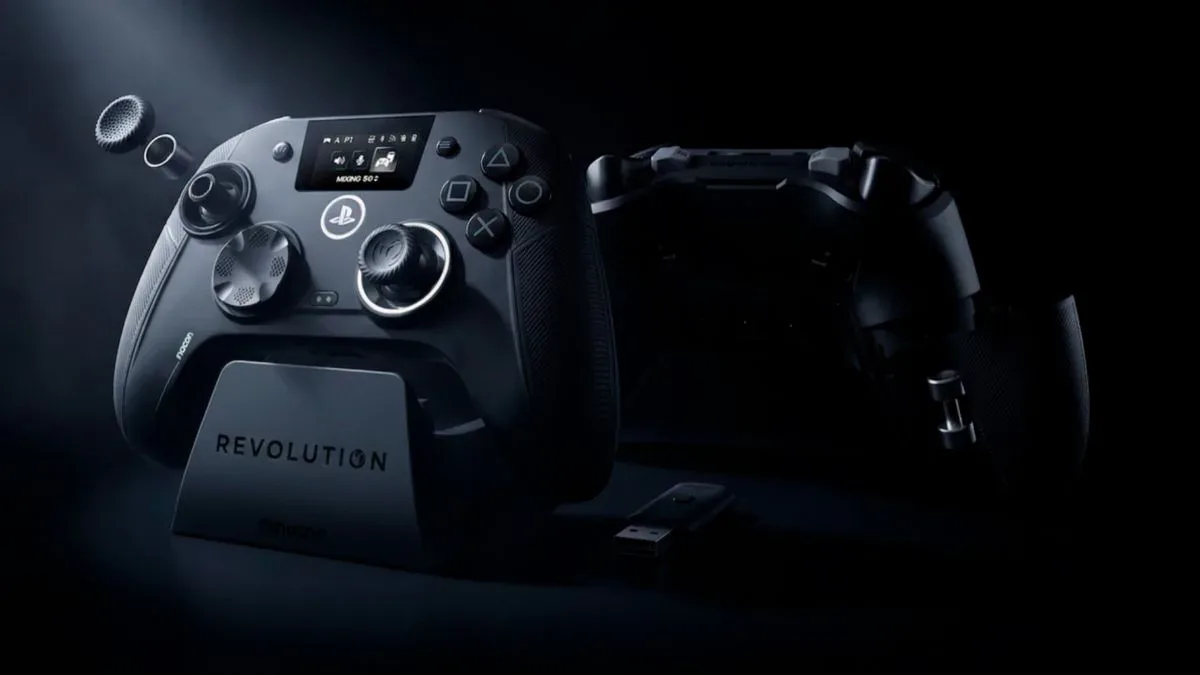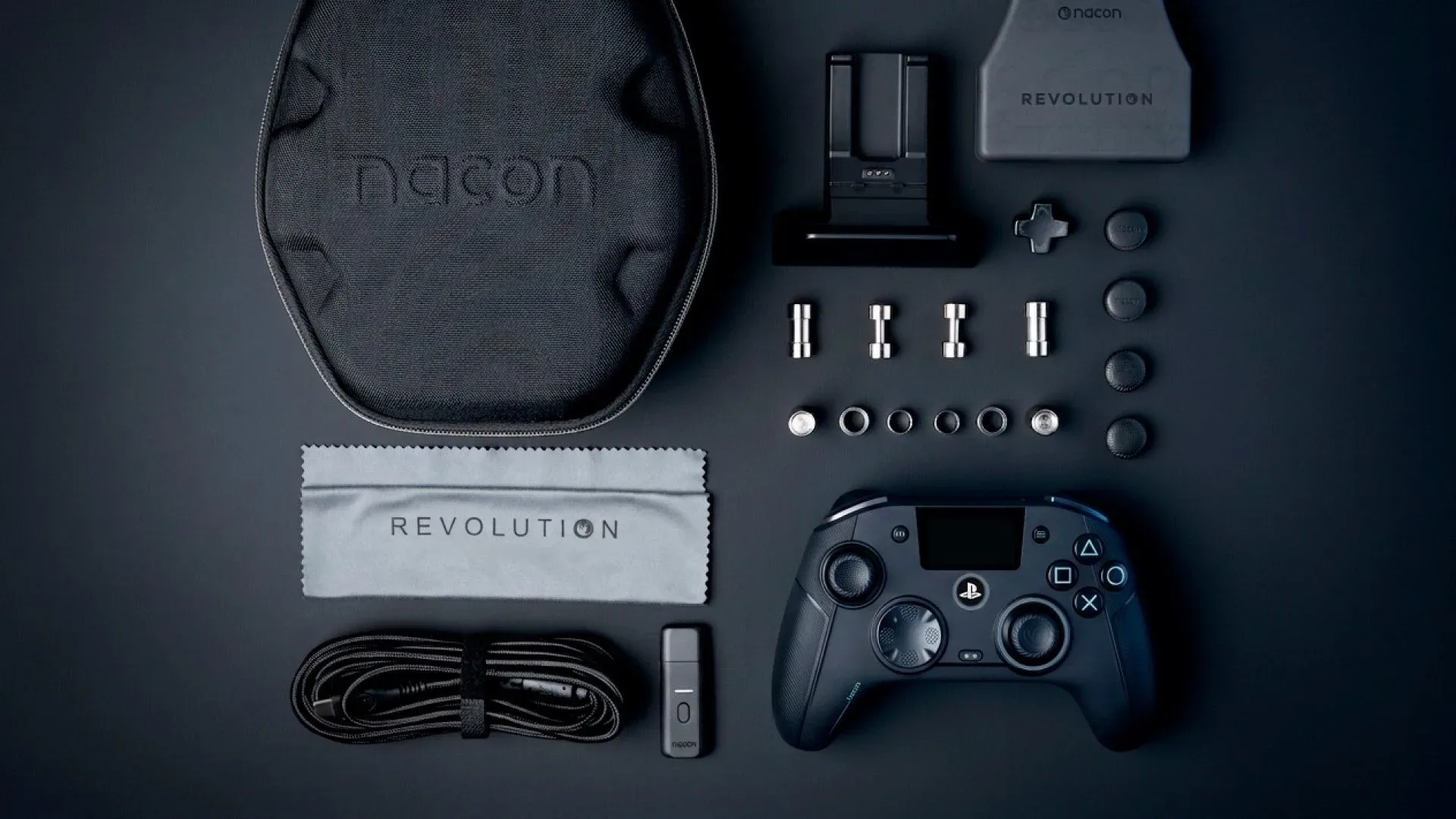
Nacon is preparing the Revolution 5 Unlimited, an officially licensed PS5 controller that aims to put more configuration controls directly in players’ hands—quite literally. Its standout feature is a built-in display with its own menu system, a first for a PS5 controller in the supplied product details. The screen is intended to handle settings that often require a companion application or a trip through a console menu, including connection management, button mapping, saved profiles, lighting and thumbstick sensitivity.
That does not mean every player needs a controller screen. It does, however, signal a specific pitch: the Revolution 5 Unlimited is built for people who regularly alter how their pad behaves between games, genres, users, or platforms. Nacon is also bundling the controller with a charging dock and carrying case, alongside swappable physical components and a wireless dongle. At $229.99 in the US and £179.99 in the UK, it is unmistakably a premium proposition—and one whose value will depend heavily on whether a buyer uses those customization options rather than simply admiring them from across the living room.
A controller menu without the detour
The small integrated display is more than a decorative status panel. Nacon says it provides access to an onboard menu for practical controller functions: managing connections, remapping buttons, switching profiles, changing lighting, and adjusting stick sensitivity. In simple terms, a profile is a saved collection of settings. A player could, for example, want one layout or sensitivity setup for a shooter and another for a fighting game, then change between them without rebuilding each setting from scratch.
On-controller controls can matter because customization is most useful when it is accessible. A controller that technically offers remapping but makes users find an application, connect hardware, and navigate several screens can still be powerful; it can also encourage people to leave it on its default setup. An onboard menu potentially removes part of that friction. The important unanswered question is how clear and quick that interface will be in daily use. The provided details establish which settings can be changed, but do not establish how many profiles can be stored, how settings are displayed, or how much adjustment range the controller offers.
There is another customization route, too. Unlike Nacon’s previous approach, the Revolution 5 Unlimited is to use a dedicated mobile app rather than a PC application for separate customization. A future PC app has not been confirmed. That distinction is worth making before prospective owners assume computer-based configuration will be available at launch.
Six additional inputs change the controller’s purpose
The Revolution 5 Unlimited has six extra buttons: four on the back and two additional bumpers. Extra inputs are among the defining traits of a pro-style gamepad because they can let players move actions away from the face buttons. The practical appeal is straightforward: in a game where thumb movement is important, putting certain commands on rear buttons may reduce occasions where a player lifts a thumb from a stick to press a face button.
That is a capability, not an automatic competitive advantage. Extra buttons take time to learn, and their benefit depends on button placement, actuation feel, remapping flexibility and whether a player can reliably avoid accidental presses. They may be especially useful to players who already prefer rear-button layouts or want separate profiles for different kinds of games. For someone satisfied with the standard PlayStation button arrangement, six more switches can be more complexity than necessity.
Nacon is also emphasizing the face buttons, which use microswitches. A microswitch is a compact switch mechanism designed to register an input with a distinct actuation. The available details characterize these buttons as having light actuation and a tactile feel, but those are ultimately subjective qualities. Their real importance is that face-button feel is one of the points of contact players notice constantly. A premium controller can offer a daunting feature list and still disappoint if its most frequently used buttons do not feel right.
Related coverage includes Nacon Revolution 5 Unlimited Brings a Screen, Charging Dock and TMR Sticks to PS5.
TMR sticks are the technical headline beneath the screen
The other major hardware claim is a set of TMR thumbsticks, which Nacon presents as an improvement over the Hall effect sticks in its Xbox-oriented Revolution X Unlimited. TMR stands for tunnel magnetoresistance. In controller discussions, TMR and Hall effect are magnetic sensing approaches often raised as alternatives to conventional potentiometer-based stick assemblies.
The broad practical reason buyers pay attention to such technology is durability. Conventional stick mechanisms can experience wear in parts that physically contact one another. Magnetic designs measure position differently, which is why they are often associated with a potential reduction in drift-related concerns. Still, buyers should treat a stick technology label as an engineering choice rather than a lifetime guarantee. The supplied information does not make a specific longevity promise for the Revolution 5 Unlimited, nor does it provide test results for accuracy, dead zones, drift resistance, or long-term reliability.
Sensitivity controls available through the display menu could be relevant here as well. Stick sensitivity generally refers to how controller movement is translated into on-screen movement. Different players prefer different response levels; an option that feels controlled in a slower game may feel restrictive in a fast one. The useful part of having settings on the pad is the potential to tune that behavior without leaving the play space. The limits and exact tuning options have not been detailed.
What PS5 players give up—and what PC mode adds
As an officially licensed PS5 controller, the Revolution 5 Unlimited will not include the DualSense’s haptic feedback or adaptive trigger resistance. Haptic feedback refers to more nuanced vibration effects intended to communicate sensations through the controller. Adaptive triggers can vary the physical resistance of the triggers. Both are recognizable parts of the standard DualSense experience, so their absence is a meaningful trade-off rather than a footnote.
Nacon’s workaround is limited to the controller’s dedicated PC mode, where it will use built-in vibration feedback. That does not replace PS5 haptics or adaptive triggers on PS5. It does mean the controller is not presented as an entirely feedback-free device when used with a PC. Players considering it mainly for Sony’s console should assess it first as a PS5 pad without those signature DualSense features; PC vibration is an additional capability for a different mode, not a PS5 substitute.
This is the central purchasing tension. The Revolution 5 Unlimited is designed around input flexibility, hardware options and direct configuration. The DualSense design, meanwhile, places particular emphasis on PlayStation-specific feedback features. Neither priority is inherently wrong, but they serve different preferences. A player who regards trigger resistance and haptics as essential to the PS5 experience may not find extra buttons and a display sufficient compensation. A player who wants rear inputs, configurable profiles and a different stick design may make the opposite calculation.
A dock, case and physical options are part of the package
Nacon says the supplied accessories include a carrying case and charging dock, the latter described as a first for a third-party PS5 controller. The case also contains additional grip weights, alternate thumbstick tops, a wireless dongle, a cleaning cloth and a cable.
The additional weights are a particularly personal feature. They allow owners to alter the feel of the grips rather than accepting a fixed mass. Weight does not make a controller objectively better: some players want a lighter pad for long sessions, while others prefer a more substantial feel. What matters is choice, especially on a device at this price level. Alternate stick tops similarly offer a physical way to alter grip and control preference, though the specific shapes and materials have not been described.
The charging dock is easy to underestimate because it is not a performance feature, but it can solve a mundane problem: where the controller lives when it is not being used. A dock creates a regular charging spot and reduces reliance on remembering a cable. Its inclusion also helps distinguish this package from premium controllers that treat charging hardware as a separate purchase. The provided information does not specify charging times, battery capacity or dock connection details, so those remain areas for a full product evaluation.
The price looks very different in the US and UK
Nacon lists the Revolution 5 Unlimited at $229.99 / £179.99. Those figures place it firmly in the upper tier of PS5 controller pricing, but the regional comparison is unusual. At the quoted UK price, it sits below the stated price of the Victrix Pro BFG Reloaded; in the US, $229.99 makes it one of the more expensive PS5-focused options described here.
That difference makes broad statements such as “expensive” incomplete. US shoppers may reasonably require a substantial feature advantage before paying $229.99, particularly with DualSense haptics and adaptive triggers absent. UK shoppers evaluating £179.99 may reach a different conclusion if a screen, dock, case, extra buttons and TMR sticks meet their priorities. Price-to-feature value is regional, and this controller is a clear example of why buyers should compare local pricing rather than relying on a single international verdict.
Who the Revolution 5 Unlimited is for
On the information available, the Revolution 5 Unlimited is not a universal replacement for the standard DualSense. It is targeted at players who place a high value on custom controls and physical adjustability: people who want rear-button inputs, profiles, swappable stick tops, grip weights, a bundled dock and a means to make adjustments from the controller itself.
It is also a notable sign of how feature-dense the premium controller market has become. While a screen is familiar territory for certain PC, Xbox and Switch 2 pads, its arrival in an officially licensed PS5 controller expands the kind of interface Sony players can expect from third-party hardware. For a wider look at the industry pressures and changes shaping how games reach audiences, see our coverage of entertainment advertising’s expanding search for attention.
For now, the most important details are clear: Nacon’s new controller pairs a built-in menu display with six extra buttons, TMR sticks, mobile-based customization, a case and a charging dock. The details that will determine its final standing—everyday ergonomics, menu usability, wireless performance, battery behavior and long-term stick performance—cannot be settled by a specification list alone. But the Revolution 5 Unlimited is making an unusually comprehensive case for the player who wants their PS5 controller to be as configurable as the games it controls.