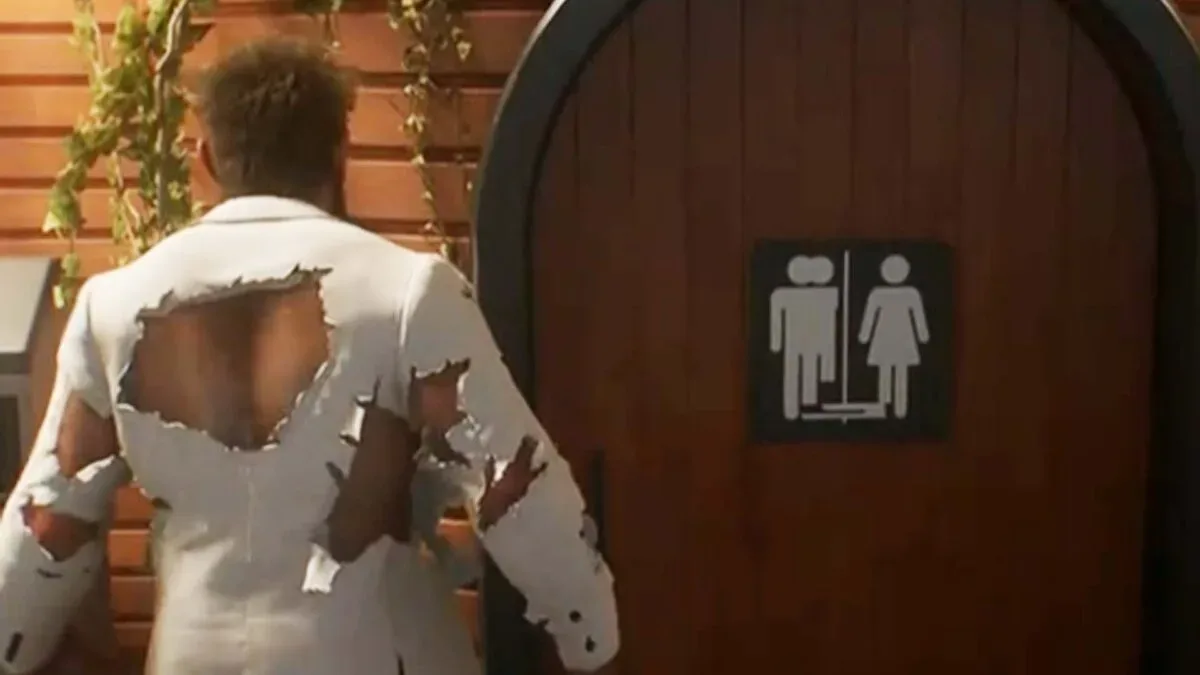
A strange restroom sign in Marvel’s Wolverine has become the latest tiny environmental detail to receive enormous online scrutiny. Screenshots and clips showed what appeared to be several male stick-figure icons tangled together on the sign, prompting speculation that the asset had been generated with AI.
Insomniac has directly rejected that claim. James Stevenson, the studio’s community and marketing director, said the problem is a UV map bug, that a fix is coming, and that Marvel’s Wolverine contains no AI-generated assets.
“This is a UV map bug, and we have a fix coming. There are no AI-generated assets in Marvel’s Wolverine.”
That clarification matters because the image spread quickly in a climate where malformed text, odd anatomy, and incoherent symbols are often treated as immediate evidence of generative AI. A single sign is a very small part of a much larger game, but it has become a useful example of why a bizarre image on screen is not, by itself, a reliable diagnosis of how an asset was made.
What players saw on the Wolverine sign
The disputed image is not a major character model, a cinematic, or a piece of promotional art. It is a restroom sign that appears visually garbled, with male pictograms overlapping or clipping into one another. A viral TikTok featuring the issue accumulated more than 700,000 views, while a social-media post questioning whether AI had been used in the game drew more than 315,000 views.
That scale of attention reflects the present-day sensitivity around AI-produced material in games. It also reflects the unusually intense attention around Marvel’s Wolverine after its PlayStation 5 launch. The game’s story, cutscenes, and quick-time events have all been pulled apart in clips and posts, with even a minor environmental flaw able to become a major talking point. At the same time, the game has quickly become one of PlayStation’s best-selling PS5 titles.
There is no need to pretend the sign looks polished. It does not. But “looks wrong” and “was made by AI” are separate propositions. Insomniac’s statement addresses the latter clearly: the studio says the error is a technical mapping issue, not a generative-art asset.
UV mapping, explained
A UV map is part of the process that tells a game engine how to place a two-dimensional image, called a texture, onto the surface of a three-dimensional object. The letters U and V refer to the two coordinates commonly used for that flat texture space, much as X, Y, and Z describe positions in three-dimensional space.
Related coverage includes Insomniac Says Marvel's Wolverine Bathroom Sign Is a UV Bug, Not an AI Asset.
For a simple sign, the intended result is intuitive: the symbol artwork should sit flat, centered, and proportioned correctly on the sign’s physical surface. If the mapping information is wrong, the image can stretch, slide, repeat, overlap, or appear to be pulled across the wrong portion of the model. A texture can also react differently as the player’s view changes, depending on the precise nature of the problem.
That last point is particularly useful when assessing the Wolverine screenshots. The sign’s appearance reportedly shifts across images taken from different angles, giving the impression that visual layers or texture regions are colliding. That behavior is consistent with the sort of mapping issue Insomniac described. It is not proof a viewer can independently use to identify a specific bug, but it helps explain why the studio’s account is technically plausible.
Why a bug can resemble AI to viewers
Generative-image systems have become associated with visual mistakes such as misspelled text, malformed hands, inconsistent repeated objects, and symbols that are almost recognizable but not quite correct. A damaged texture can create a superficially similar result: familiar visual language transformed into something messy and unsettling.
The resemblance is understandable, especially in a fast-moving clip shared without technical context. Yet the underlying causes are very different. An AI-generated image is produced by a generative system; a UV issue is a problem in the connection between a prepared image and a 3D surface. One speaks to asset creation. The other concerns asset implementation.
That distinction is not merely semantic. It changes the appropriate response. A mapped texture error is a defect to patch. A confirmed use of generated material would be a question about a studio’s production practices, disclosure, creative labor, and the expectations players bring to a major release.
Why the distinction matters beyond one sign
Players have good reason to care about generative AI in game development and to ask direct questions when something appears suspicious. The issue can affect trust in a studio as well as the work of artists, writers, and other developers. But a healthy standard of scrutiny still requires evidence that matches the claim.
Calling every malformed graphic “AI” risks producing the opposite of careful accountability. It may direct anger at artists or teams who did not use generative tools, while making genuine examples harder to discuss with precision. It also gives ordinary production bugs a larger and more misleading afterlife than they deserve.
In this case, there is an on-record response from the developer identifying the fault and promising a correction. Until there is evidence to the contrary, that is the most concrete explanation available: the restroom pictograms are an erroneous UV mapping result, not proof that AI-generated artwork appears in Marvel’s Wolverine.
The episode is also a reminder that modern game production includes many handoffs between artwork, models, materials, engines, and final shipped builds. A clean source image can still be displayed incorrectly in-game. Conversely, a peculiar image does not reveal its production history just by being peculiar.
What this means for players
For people playing now, the practical takeaway is modest. Insomniac says a fix is in development, so the affected sign should be corrected in a future update. No broader gameplay change, content removal, or platform change has been indicated in connection with the bug.
For anyone encountering similar claims online, the better checklist is simple:
- Separate what is visibly wrong from assumptions about why it is wrong.
- Look for a developer statement or other direct evidence before presenting an AI claim as fact.
- Check whether the problem changes across angles or scenes, which can suggest a rendering or mapping issue rather than a static image source.
- Keep the scale of the finding in perspective: one flawed prop does not establish how an entire game was made.
That does not mean players should ignore shoddy details. Environmental art helps sell a world, and a warped public sign can be distracting precisely because it is supposed to be instantly legible. The sign is still a legitimate bug worth flagging. The correction is simply to describe it accurately.
Questions about how games are made will continue to be part of the larger industry conversation, particularly as creators and players seek clarity around new tools. Related conversations about creator-focused work are also unfolding elsewhere in entertainment and games, as seen in this look at creator storytelling. For the Wolverine restroom sign, however, Insomniac’s position is unambiguous: this is a visual bug awaiting a fix, not an AI-generated asset.