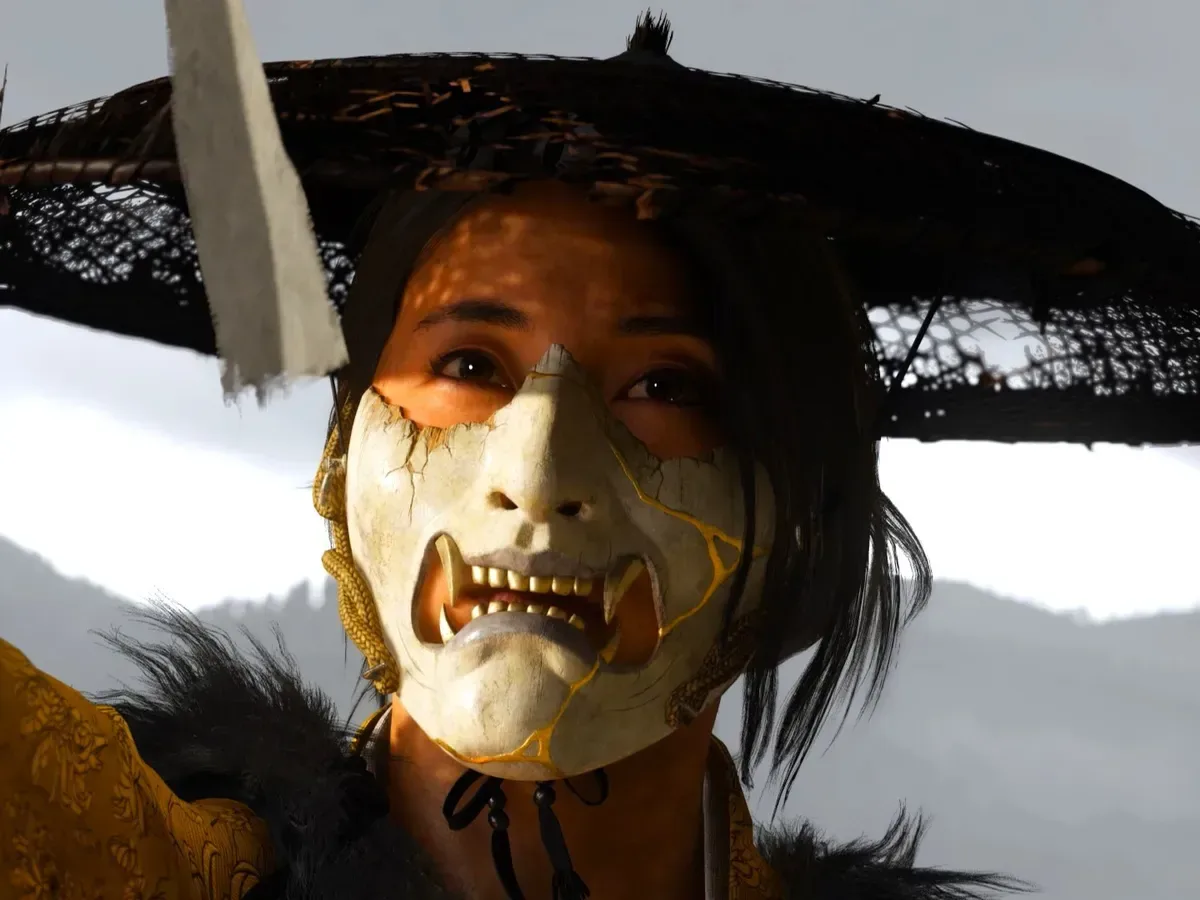
Ghost of Yōtei is estimated to have sold around 5.4 million copies on PlayStation 5, generating approximately $407 million in revenue so far. Those figures are not official sales disclosures, but they present a more useful picture than the increasingly common impulse to reduce a game’s performance to a simple win-or-flop verdict.
The sequel, released in October 2025 as a PS5 exclusive, appears to be selling more slowly than Ghost of Tsushima did at the equivalent stage of its life. Yet the reported revenue gap is remarkably small: the original is estimated to have generated about $418 million by the same point. In practical terms, Yōtei’s estimated $407 million places it close to its predecessor’s revenue despite a meaningful difference in unit sales.
That contrast is the central story. A raw copy count says Tsushima was ahead; the revenue estimate says Yōtei remains a substantial commercial release in its own right. Both observations can be true at once, and neither should be stretched beyond what an unconfirmed third-party model can establish.
The estimates: 5.4 million copies and $407 million in revenue
The available analysis puts Ghost of Yōtei at about 5.4 million units sold, with roughly 500,000 of those copies attributed to Q3 2026. Its estimated revenue total is $407 million. Because Sony has not publicly verified these figures, they should be treated as informed estimates rather than final accounting results.
That distinction matters. Sales estimates commonly combine observable store-ranking signals, platform data and modelling assumptions to arrive at a likely range or headline figure. They can be valuable for identifying broad momentum, but they are not a substitute for a publisher’s audited or formally reported numbers. An estimate of 5.4 million is therefore best read as an indication of scale, not as a precise number of copies sitting in Sony’s internal ledger.
Still, the scale is difficult to dismiss. Millions of copies sold on one platform is a major result, particularly for a full-priced, PS5-only release. Sony had already said in February that the sequel exceeded Tsushima’s sales and significantly contributed to that quarter’s financial results. That statement covered an earlier point in the game’s life than the current estimate, so it does not settle the present comparison, but it is important context: the available evidence does not support framing Yōtei as a commercial failure.
Why Ghost of Tsushima is ahead in copies
The comparison offered for Ghost of Tsushima is close to 7 million copies sold at the same lifecycle point, versus Yōtei’s estimated 5.4 million. That is a substantial unit gap. A unit is simply one game copy sold, regardless of whether it is a disc or a digital purchase, and it is often the easiest sales measure for audiences to understand.
However, unit sales are only one measure of a game’s business performance. They do not directly account for differences in launch price, discounting patterns, edition mix, platform availability or the size of the potential audience. The original launched in July 2020 at a $60 base price, while Yōtei launched with a $70 base price. A higher base price means fewer sales can generate a similar amount of revenue, all else being equal.
Related coverage includes Ghost of Yotei Estimated at 5.4 Million Sales as It Trails Tsushima's Pace.
Discounts complicate that arithmetic further. The analysis notes that PlayStation Store discounts for Yōtei have been relatively limited. Less discounting can preserve more revenue per copy, even when a title is behind another game’s pace in copies sold. It also means that simply multiplying launch price by total units would not produce a reliable revenue result for either game, since different customers may have purchased at different prices or through different editions.
In short, the apparent split between unit sales and revenue is not contradictory. Yōtei can be behind Tsushima in copies while remaining close in total dollars because its pricing and discount profile differ.
The addressable audience was different, too
Platform reach is another major qualification. At the comparable point in Tsushima’s lifecycle, there were reportedly about 117 million PS4 consoles and 10 million PS5 consoles in the market. Yōtei, meanwhile, is available only for PS5, with the PS5 installed base described as nearing 100 million systems.
An installed base is the number of consoles already owned by customers. It does not tell us how many owners want a particular game, but it establishes the maximum pool a platform-exclusive release can reach. Tsushima benefited from availability across the enormous PS4 audience, alongside PS5 availability. Yōtei is targeting a large PS5 audience, but it does not have access to the older PS4 audience that helped expand its predecessor’s potential market.
That does not automatically excuse every difference in sales pace; the PS5 base is itself very large. But it makes a straight comparison less tidy than it first looks. The two games launched in different hardware circumstances, at different prices, and with different platform footprints. The original also arrived during a period shaped by pandemic lockdowns, another condition that should not be ignored when comparing demand across years.
Physical sales remain a notable part of the mix
The estimate assigns 36.8% of Yōtei sales to physical copies. That means discs account for more than one-third of the game’s reported purchases, while digital sales make up the larger share. It is a reminder that physical software remains commercially meaningful for major console releases even as digital storefronts dominate the overall split.
For players, the split has practical implications beyond a preference for a box on a shelf. Physical and digital purchases operate differently in terms of resale, lending and reliance on a storefront account. The continuing relevance of discs is especially notable amid wider debates about what buyers retain when games are acquired digitally; digital game ownership remains a more complicated issue than a storefront listing suggests.
None of that changes Yōtei’s reported sales total, but it helps explain why a physical share approaching 37% is worth noting. It is not a niche sliver. For this release, it represents a significant portion of the estimated audience choosing a disc rather than a digital licence.
Complete Edition uptake and Echoes of Sekigahara engagement
Yōtei’s post-launch performance is not solely about base-game purchases. The digital Complete Edition replaced the digital base game and includes new content, including the recently released Echoes of Sekigahara expansion. An estimated 50,000 players picked up that edition during its first two weeks of availability.
The same analysis estimates that about 6% of the existing player base returned to play the new content. This is an engagement figure, not a new-sales total, and it should be interpreted carefully. A returning-player percentage measures how many prior owners came back for an update or expansion; it does not tell us how many completed it, how long they played, or whether all returning players bought additional content.
Even so, it is relevant evidence that the game still has an active audience after launch. Expansions can extend a game’s commercial tail by drawing in both existing owners and players who waited for a more complete package. The Complete Edition’s early estimated uptake suggests some demand for that all-in-one route, though two weeks is far too narrow a window to declare a long-term pattern.
The sequel has also received a new armor set tied to The Last of Us. That addition is separate from the sales estimates, but it is another example of PlayStation continuing to support the game after its initial release rather than treating launch week as the sole measure of its life.
What to watch next
One caution in the current assessment is that Yōtei’s revenue is said to be flattening more than Tsushima’s did. In sales analysis, a flattening curve generally means the rate of revenue growth is slowing over time. That is normal for many releases after the launch rush, but the degree and timing matter when comparing one game with another.
Whether that slowdown persists is unknown. The estimates suggest several moving pieces: limited store discounts so far, the new Complete Edition, the Echoes of Sekigahara content, and a PS5 audience that could continue to grow. There is also speculation that a future influx of PS5 buyers connected to the next Grand Theft Auto could broaden the available audience, but that remains a possibility rather than a demonstrated outcome for Yōtei.
The key takeaway is more measured than the most dramatic online reading. Ghost of Tsushima appears to have moved copies faster at the comparable stage, with an estimated lead of roughly 1.6 million units. Ghost of Yōtei, however, is estimated to be within about $11 million of the original’s revenue at that stage, has added about half a million copies in Q3 2026, retains a material physical-sales share, and is receiving post-launch content.
Those facts do not prove that Yōtei will eventually match or surpass its predecessor in unit sales. They also do not turn an estimate into official confirmation. They do show why calling the PS5 exclusive a flop would be an inaccurate reading of the information available.