The standard PlayStation 5 is getting an AI-upscaling upgrade of its own. Sony has introduced Quick Spectral Super Resolution, or QSSR, for base PS5 consoles, with Marvel’s Wolverine and Ghost of Yōtei the first games to receive it. The feature is available to developers across the platform, making these two games the opening act rather than a stated limit on where the technology can appear.
That is the headline version: a regular PS5 may be able to produce cleaner-looking images in supported games without suddenly becoming a PS5 Pro in a clever fake moustache. The more useful version is that QSSR is a new, performance-conscious form of AI upscaling designed specifically around the standard console’s hardware. It aims to improve two closely related things: fine visual detail and image stability.
For a closer look at the initial rollout, see our coverage of QSSR arriving in Marvel’s Wolverine and Ghost of Yōtei.
What QSSR is, and what it is not
QSSR stands for Quick Spectral Super Resolution. It is distinct from PlayStation Spectral Super Resolution, or PSSR, the upscaling technology that first appeared on PS5 Pro. Both names concern the same broad challenge in modern rendering: creating a sharp, coherent image while leaving enough graphics performance for a game to run as intended.
Upscaling means taking an image rendered at one resolution and presenting it at a higher output resolution. In the simplest form, that can mean enlarging pixels. Modern reconstruction systems attempt something much more sophisticated. They use information from the current frame, often alongside motion and prior-frame data, to estimate detail that would otherwise be expensive to render directly at the final resolution.
AI upscaling adds a trained neural-network component to that process. A neural network, in this context, is software trained to recognize and reconstruct visual patterns. It does not mean a game secretly hires a tiny artist to redraw every brick while the console fan negotiates overtime. It means the reconstruction method can make more informed guesses about how an image should look than a basic enlargement technique.
Sony describes QSSR as a new performance tier of AI upscaling developed through Project Amethyst, its collaboration with AMD. The wording matters. QSSR is not presented as PSSR simply being switched on for every PS5. It is a separate implementation built for the base machine, using a streamlined neural-network architecture and hand-tuned optimization intended to maximize performance on PS5.
Why “image stability” deserves equal billing
Sharper detail is easy to understand from a still image. A distant building, a fence, vegetation or signage may look less soft when a player stops and zooms in. But image stability can be just as important in actual play because games are almost never experienced as a sequence of paused screenshots.
Related coverage includes PS5 Gets QSSR AI Upscaling in Marvel's Wolverine and Ghost of Yotei.
When the camera moves, fine objects can shimmer, flicker, crawl or break apart visually. Thin geometry, dense foliage, distant architecture and other high-frequency detail are particularly difficult for any reconstruction method. A result can technically look detailed in one frame yet appear noisy or inconsistent in motion. Stability is the effort to make those details remain believable from frame to frame rather than turning into a small rebellion of dancing pixels.
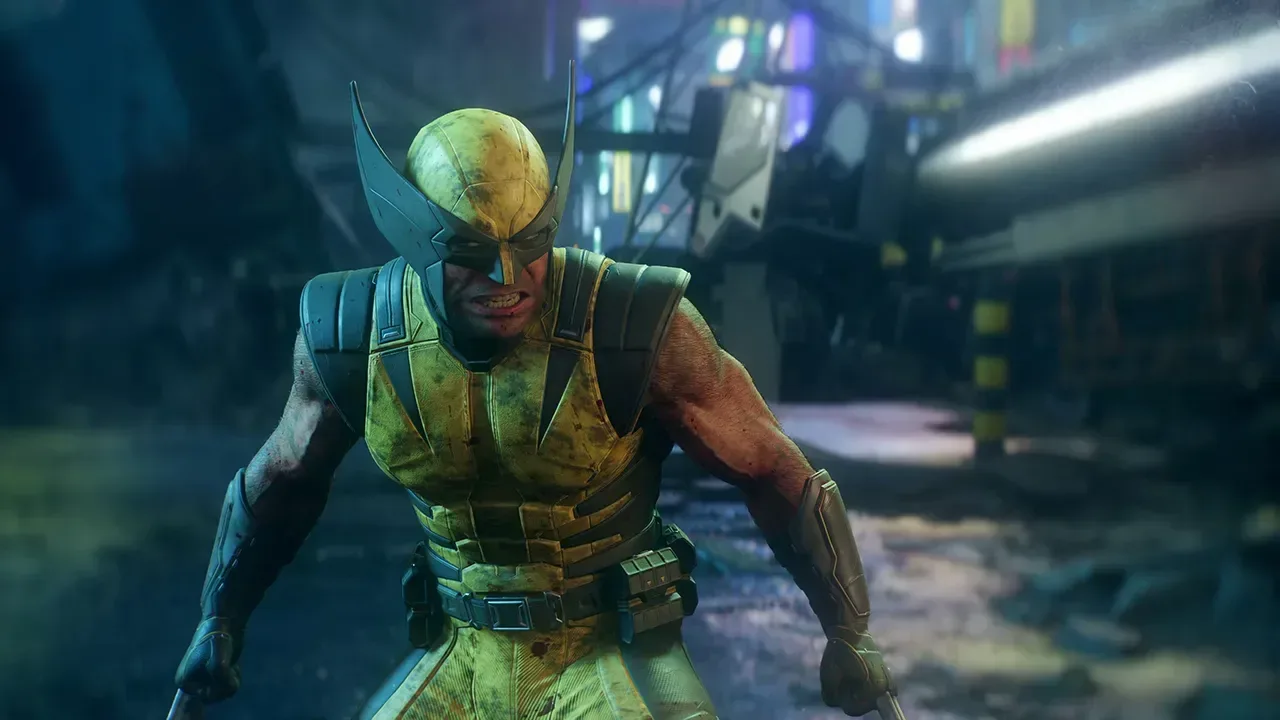
That is why the early QSSR demonstrations focus on scenes with plenty of potential visual trouble. One comparison from Marvel’s Wolverine zooms in on distant environmental detail. Background buildings appear crisper and less blurred with QSSR enabled. Insomniac Games head of technology Mike Fitzgerald said the technique brings greater pixel-level clarity and stability to environments, including the crowded streets of Madripoor and the alleyways of Shinjuku.
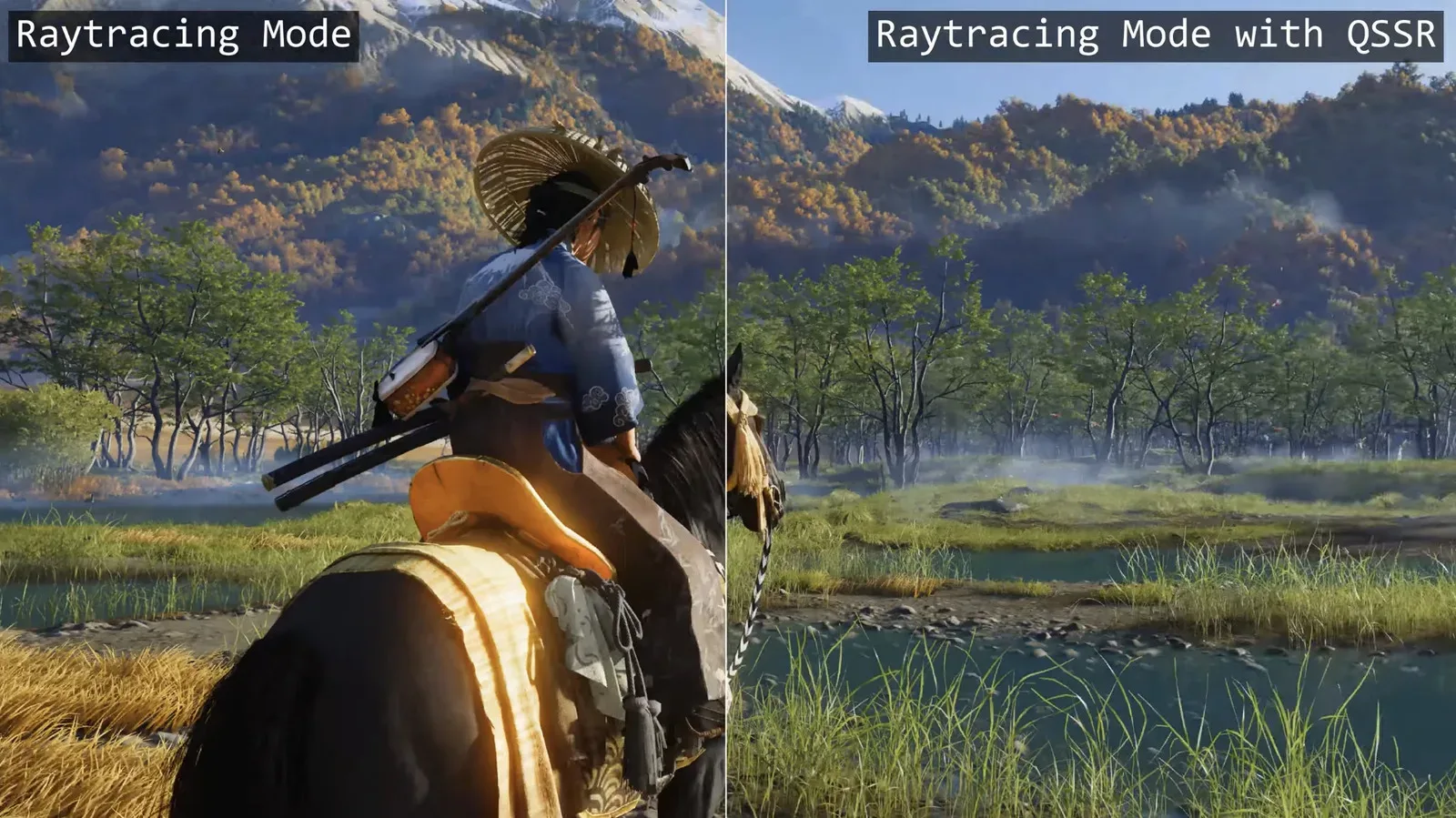
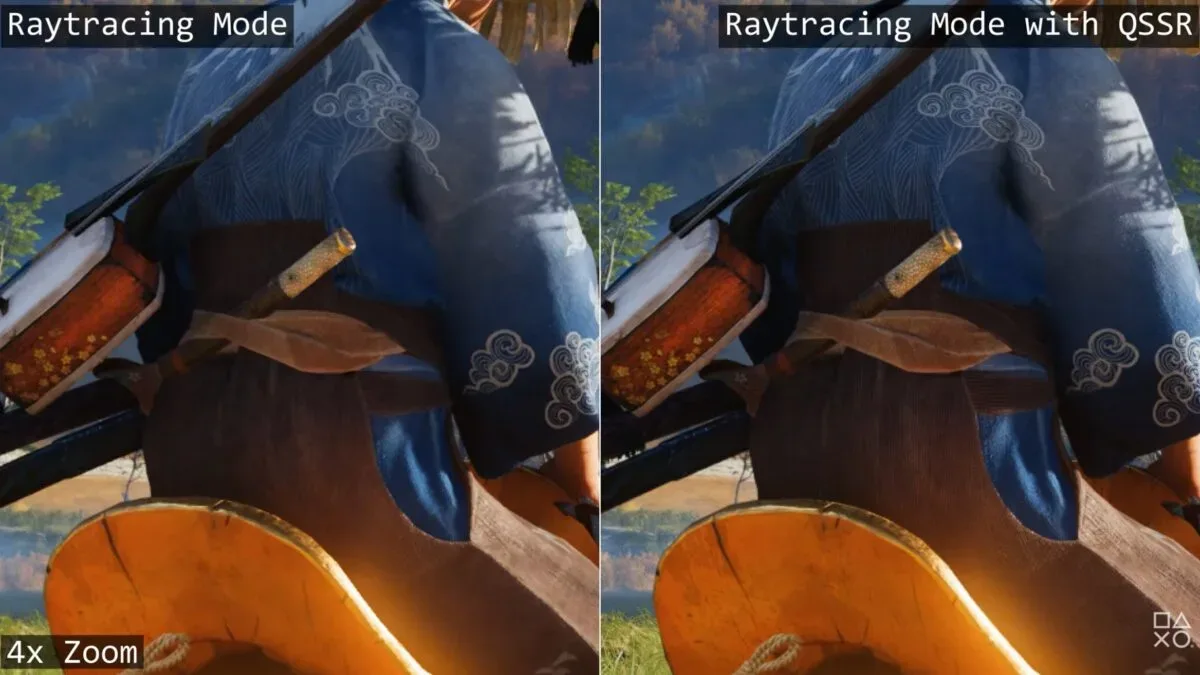
The Ghost of Yōtei comparison takes a closer subject: reeds emerging from a nearby pond. The QSSR image appears to retain more detail in the vegetation. Sucker Punch Productions lead rendering engineer Jasmin Patry described the technology as a positive move toward letting more PS5 players access the kind of image quality associated with PSSR on PS5 Pro.
What players may notice—and what remains uncertain
The most likely benefits will depend on the game, the scene, the display and the distance between the player and that display. Fine scenery detail is a natural candidate. Distant buildings and dense plant life are prominent in the comparisons because they are the kinds of elements that can look muddy, unstable or overly softened when rendering resources are constrained.
Still, close-up comparison clips are deliberately favorable conditions for spotting subtle differences. A stationary magnified image gives the eye time to inspect every edge. During ordinary play, attention is usually on movement, combat, navigation, objectives and the eternal mystery of whether that glowing pickup is important or merely decorative. The supplied footage shows an improvement, but it remains unclear how noticeable every improvement will be during moment-to-moment gameplay.
It would also be premature to translate QSSR into promises that have not been made. Sony’s stated goals are better detail and stability. There is no basis here to assume every supported game will gain a particular frame-rate mode, output resolution, graphics preset or identical visual result. Upscaling is one element of a game’s rendering pipeline, and developers make their own technical decisions about how to use available performance.
A developer option, not an automatic makeover
The practical significance of the announcement is not solely that two games support QSSR on day one. Sony is offering the technology to all PS5 developers. That expands the potential audience for AI-assisted reconstruction beyond PS5 Pro owners, but it does not automatically update an entire catalog.
Each studio will need to decide whether QSSR suits its game and then implement it. That process can involve evaluating the technique across different kinds of scenes, checking how it behaves during camera movement, and balancing image quality against the game’s other rendering needs. A title packed with foliage, dense city geometry or long-distance vistas may expose different strengths and weaknesses than a game built around simpler spaces or a fixed camera.
“Hand-tuned implementation” is important jargon here. It means QSSR has been adjusted to work efficiently on the base PS5 rather than treated as a generic technology dropped in without platform-specific refinement. The announcement does not provide a universal recipe for developers, nor a list of future adopters. What it does establish is that the option exists and that Sony wants it considered as part of the PS5 toolset.
Project Amethyst’s role
QSSR is part of Project Amethyst, Sony’s collaboration with AMD. The announcement frames the new technique as an outcome of that work and positions it as a fresh AI-upscaling performance tier. For players, the immediate takeaway is straightforward: the standard PS5 is no longer entirely outside Sony’s AI-upscaling conversation.
That does not erase the distinction between the two console models or between QSSR and PSSR. PSSR debuted on PS5 Pro, while QSSR has been tailored for base PS5 performance. The naming is similar enough to invite confusion, so the clean shorthand is this: PSSR is the existing Pro-associated technology; QSSR is the newly introduced base-PS5-focused alternative.
For now, Marvel’s Wolverine and Ghost of Yōtei are the concrete examples. Their demonstrations make a modest but worthwhile case for the technology: sharper faraway structures in one, more defined reeds in the other, with stability identified as part of the goal in both. Whether QSSR becomes a common PS5 feature will depend on adoption by developers and on how well it holds up not just under a zoom lens, but in the untidy, fast-moving business of actually playing games.