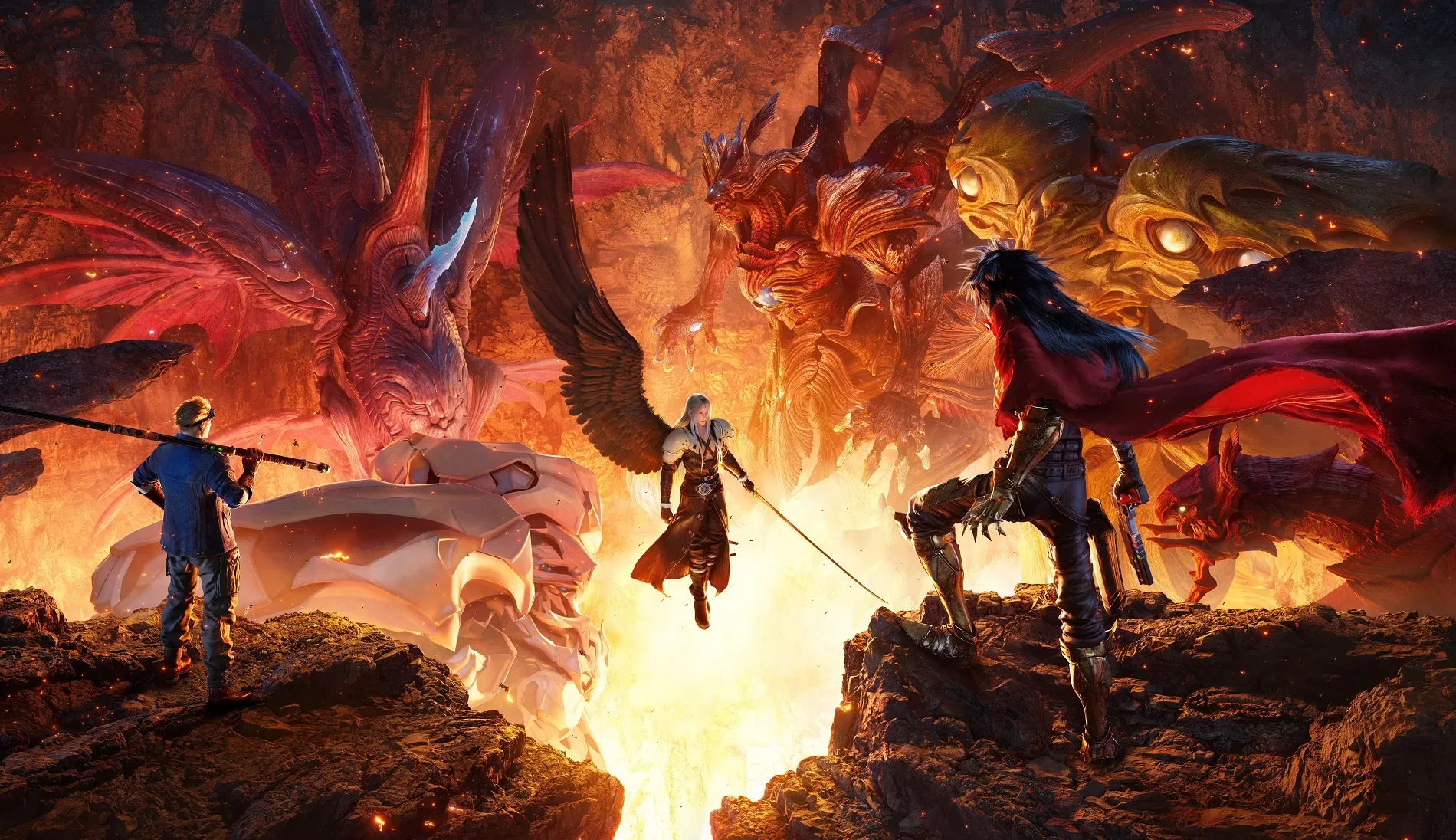
Final Fantasy VII Revelation is carrying an unusually heavyweight job title: conclusion to a remake trilogy, continuation of a story first told on PlayStation in 1997, and apparent launch point for whatever Square Enix wants Final Fantasy VII to become next. At PAX West 2026, game director Naoki Hamaguchi and battle director Teruki Endo offered a useful clue about the team’s approach to that daunting finale. They want players to encounter its big answers themselves rather than receive a tidy postgame explanation from the people who made it.
The presentation closed on a message that framed the climax as something belonging to each player, not something that should be interpreted for them by an outside voice. Hamaguchi expanded on that sentiment by pointing to the reunions, party relationships, and decisions built up across all three games. The intent, he indicated, is for those accumulated feelings to shape how an individual receives Revelation’s final stretch.
It is a very Final Fantasy answer to a very Final Fantasy question: emotionally direct, slightly mystical, and guaranteed to make fans stare harder at every trailer frame. It is also not necessarily a promise that Revelation will dodge explanation altogether. A personal ending can still contain concrete plot answers. The important distinction is that the developers seem to be prioritizing the player’s experience of the finale over prescribing one official emotional reading of it.
A trilogy designed to complicate memory
The original Final Fantasy VII has never been a story with a shortage of discussion. Its ending has been revisited, dissected, expanded, and argued over for decades. But the remake project began by making clear it was not interested in being a simple technical restoration of the 1997 RPG. Final Fantasy VII Remake revisited familiar events while changing their context and adding a self-aware layer about fate, expectation, and the burden of knowing a beloved story already exists.
That decision makes Revelation’s assignment more complicated than recreating a known conclusion at higher resolution. The trilogy has encouraged players to consider where its events might follow the original path, where they may depart from it, and whether those two ideas can coexist. The eventual result could be tightly faithful in its major outcomes while still taking a different road there. It could also use its new material to reposition what an ending means within the broader Final Fantasy VII universe.
Hamaguchi’s PAX West comments should therefore be read as a statement of creative intent rather than a spoiler-shaped answer. They do not confirm a particular twist. They do not establish that the ending will be deliberately obscure. And they do not settle the recurring fan debate over whether the trilogy is remaking, revising, continuing, or somehow doing all three with an oversized Buster Sword balanced on top.
What they do confirm is that the team understands the finale as the payoff to a long emotional journey. That matters because the remake games have devoted substantial time to companions and relationships, allowing bonds that were more compressed in the original release to take on fresh weight. A closing chapter built around reunions and resolve suggests that character investment, not only lore accounting, is central to how the creators want the finale to land.
Answers may arrive without every answer being labeled
Modern fandom often treats a final installment like an exam sheet: every mystery needs a numbered response, every timeline needs a diagram, and every mysterious bird needs a searchable database entry. Revelation may ultimately provide plenty of clarity, but Hamaguchi’s framing leaves room for a conclusion that asks players to process some of its meaning rather than wait for an authority figure to stamp “correct” on a single interpretation.
Related coverage includes Final Fantasy VII Revelation Team Wants Players to Discover Its Ending for Themselves.
That approach is especially notable for Final Fantasy VII, where nostalgia is inseparable from interpretation. Longtime players bring memories of the original game, later projects, and years of theories. Newer players may know the remake trilogy as their primary version of the story. A finale intended to be personally received has the potential to speak differently to both groups without declaring either experience less valid.
Earlier in 2026, Hamaguchi said the team was confident in the finished result and eager to see fans’ response to the story’s ending. That confidence does not reveal its contents, of course, but it does suggest the conclusion has progressed beyond broad conceptual talk. For a project whose name alone invites a thousand speculation videos before breakfast, the most responsible takeaway remains a modest one: the developers expect the reaction to the ending to be significant, and they are trying to protect the conditions under which players first meet it.
That also explains the emphasis on not having the finale “explained” by someone else. It can be understood as a plea for the ordinary spoiler etiquette that any narrative game deserves. It can also be understood more broadly: avoid letting reaction clips, simplified lore summaries, and aggressively confident theories substitute for the story itself. The internet is exceptionally quick at converting a complicated ending into one sentence and an arrow pointing at Sephiroth. Revelation’s creators appear to be asking fans to leave some room for the journey.
Advent Children remains part of the conversation
The lingering question is how widely Revelation will draw from the extended Final Fantasy VII catalog. Square Enix has built that catalog through projects including Dirge of Cerberus on PlayStation 2, Crisis Core on PSP, and the film Advent Children. Each has added characters, events, imagery, and connective tissue beyond the original game’s boundaries.
Hamaguchi recently addressed Advent Children in particular, saying its material has been incorporated into the remake series’ larger framework, including its ending. At the same time, he declined to say whether Revelation’s ending is positioned as a direct lead-in to the film. That distinction is important. Incorporation can mean thematic echoes, continuity awareness, reworked concepts, or selective references. It does not automatically mean the trilogy will end at a precise handoff point to the movie.
Fans hoping for an all-in, continuity-collecting finale therefore have a reason to remain attentive, but not a basis to call the result confirmed. The remake project has consistently shown a willingness to revisit known material on its own terms. If it engages with Advent Children or other compilation-era work, it may do so in a way that serves the trilogy’s specific dramatic needs rather than functioning as a checklist of callbacks.
That restraint is worth keeping in mind as theories pile up. A reference is not proof of a sequel. An incorporated element is not necessarily a timeline declaration. And a director declining to comment is not a secret decoder ring, however much social media might enjoy treating it as one.
Passing Final Fantasy VII forward
Hamaguchi also described an ambition to carry Final Fantasy VII to a new generation, expanding its future rather than preserving it only as a celebrated artifact from the past. That is perhaps the clearest reason Revelation may not be the final Final Fantasy VII game, even if it is the final chapter of this remake trilogy.
There is no announced follow-up in these comments, so fans should not mistake a broad franchise goal for a revealed project. Still, the language makes plain that Square Enix sees Final Fantasy VII as an evolving property with room to grow. The three-part remake may be a major endpoint for Cloud and the party’s present arc, while also being a foundation for stories or forms not yet disclosed.
That tension between closure and continuation is baked into the series’ current moment. Revelation must satisfy an audience carrying nearly 30 years of attachment while demonstrating that Final Fantasy VII can remain meaningful to players encountering these characters for the first time. It is a huge ask, even before anyone starts charting alternate worlds on a whiteboard.
For now, the practical news is refreshingly simple: Hamaguchi and Endo’s PAX West appearance reinforces that Revelation’s finale is meant to land as an experience, not merely an answer key. The story may be faithful, surprising, interpretive, connected to older Final Fantasy VII material, or several of those things at once. Until more is officially shown, the strongest preparation may be the least glamorous one: keep theories flexible, protect yourself from spoilers, and let the trilogy’s ending make its own first impression.
Players watching the broader strategy-game calendar can also see how other long-running series are reshaping their futures, including Civilization 7’s planned Arc of Tomorrow update. Final Fantasy VII’s next move is much more guarded, but its developers have made one thing clear: the destination is intended to feel earned by the people who take the trip.