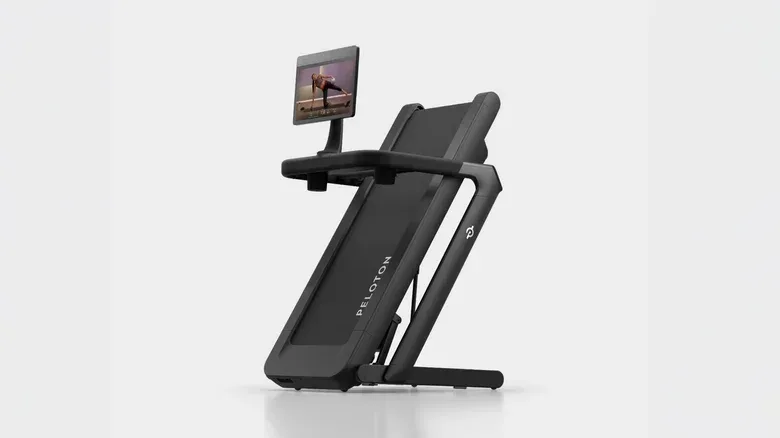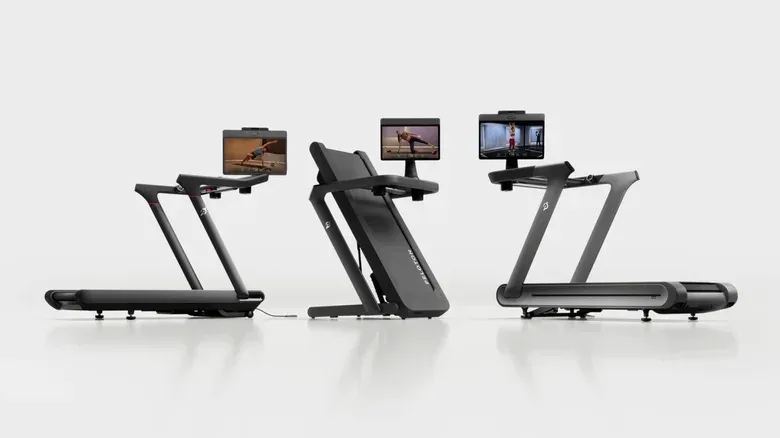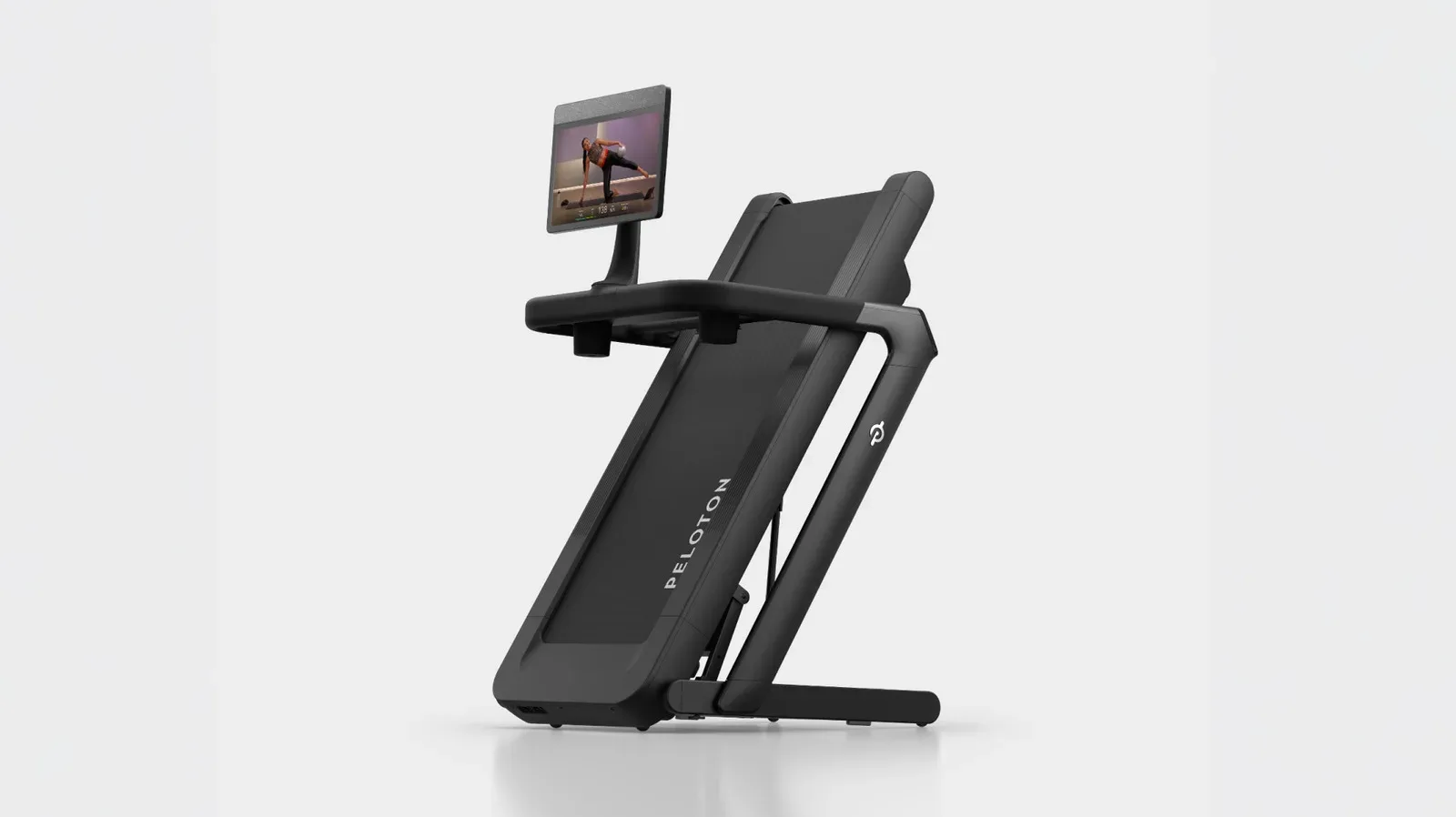
Peloton is making a more compact play for the home-fitness space with the Tread Flex, a $2,195 treadmill that is both its least expensive treadmill to date and its first model designed to fold upright. The new machine leads a three-model Tread refresh for fall 2026, joined by the $3,495 Tread Vision and the $6,695 Tread+ Vision.
The headline feature is not a new screen trick or an algorithmic score. It is floor space. The Tread Flex folds vertically to occupy roughly half the footprint of the company’s other treadmills, rolls on wheels for repositioning, and uses a two-step release intended to lower the running deck gradually. A locking pin is meant to keep the deck from opening while the unit is stored upright.
That is a decidedly practical feature set for people whose workout space also has to function as a living room, office, or somewhere a game console can still be reached without negotiating a permanent gym installation. Peloton’s original Tread launched at around $4,000 more than eight years ago, so the Flex represents a major shift in the price and space demands attached to the company’s treadmill hardware.
The Tread Flex is the accessibility-first model
The Flex is positioned as the entry point in a lineup otherwise packed with premium specifications. Its 21.5-inch Full HD pivoting display matches the size used on older Peloton treadmills, rather than the 23.8-inch display found on the Vision models. The pivoting panel remains important because it can be turned away from the belt for classes or workouts that do not take place directly on the treadmill.
There are trade-offs. The Flex does not include the built-in Sonos speakers fitted to its more expensive siblings, and it does not have a camera. That means it misses the computer-vision running-form analysis offered on the Tread Vision. But it retains access to Peloton IQ, the company’s software layer for training schedules, feedback, and coaching.
In practical terms, the Flex is not simply a stripped-down walking pad with a large subscription screen bolted on. It is intended to deliver the same broader coaching ecosystem while leaving out some hardware extras. Its individualized Pace targets use a 1-to-10 scale, while its heart-rate training includes Zone 2 work. Heart-rate zones are intensity ranges based on a person’s heart rate; Zone 2 is generally used here as a sustained, controlled training target rather than an all-out effort.
Peloton’s Pace recommendations will not be immediate guesses. The system needs data from 10 running workouts before it begins suggesting personalized pace-range changes. That threshold matters: owners should expect a calibration period before the feature can tailor advice to their recent performances.
The company says the Tread Flex outputs 70 dB at 12.5 mph at maximum speed. It is worth reading that claim precisely. The measurement is for the machine itself without someone running on it, so it cannot by itself describe the real noise a household might experience once footsteps and impact are part of the equation. Folding helps with storage, but it does not eliminate the need to consider where a treadmill will be used.
ReRuns aims to bring outdoor routes indoors
All three new Tread models are set to receive ReRuns, a feature that moves a run recorded through the Peloton app or an Apple Watch onto the treadmill. The machine can then reproduce elements of the route, including changes in elevation.
The distinction is useful. ReRuns is not described as a virtual tour of a route or a simulation that recreates every outdoor condition. Its stated purpose is to map the recorded run to the Tread and mimic elements such as elevation. For runners who use both outdoor tracking and indoor sessions, it could make the transition between those routines more continuous: record a route once, then revisit its climbing and descending profile on a later treadmill session.
It is also a clear example of Peloton treating the treadmill as connected fitness hardware rather than a standalone appliance. The value of the feature depends on having compatible recorded activity in the Peloton app or through Apple Watch, and on whether reproducing a familiar route’s elevation is useful to a runner’s routine.
Tread Vision adds a camera to the coaching loop
The Tread Vision moves the lineup toward camera-based analysis. Peloton describes it as its first computer vision-enabled treadmill. Computer vision is software that interprets information from camera imagery; in this case, the goal is to observe aspects of a runner’s movement and use them for feedback.
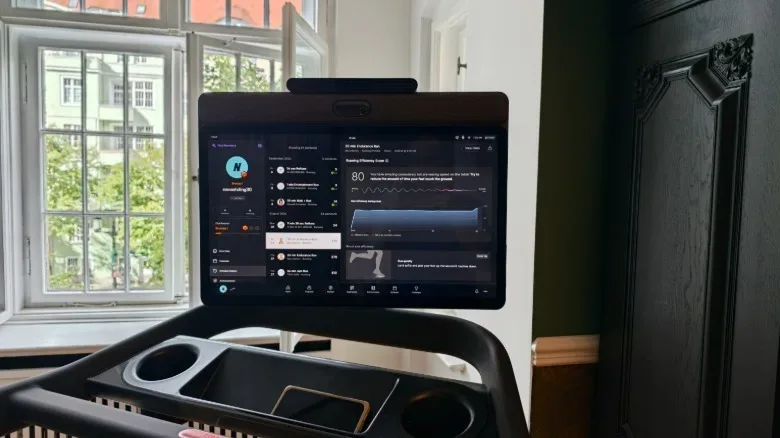
The camera is designed to assess running form, deliver feedback after a run, and carry that guidance into later sessions through cues at the beginning of the next run. Peloton says the analysis generates an efficiency score and tracks vertical oscillation, cadence, and stride length. The feature was developed with a biomechanics group specializing in running and injury prevention.
Those terms deserve unpacking without overselling what they mean. Vertical oscillation describes up-and-down movement during running. Cadence is the rate of steps, and stride length is the distance covered per stride. Peloton intends to combine such measurements into an efficiency score and personalized coaching pointers. An efficiency score is therefore a software-generated assessment based on the movement data it captures, not a universal declaration that one runner has a single objectively perfect form.
The company says the same run-analysis capability will also come to the existing Cross-Training Tread+, which already includes a camera. For prospective buyers, this creates a sharp dividing line in the new range: the Flex focuses on foldability and core coaching access, while the Vision is for users who specifically want form-focused data and feedback.
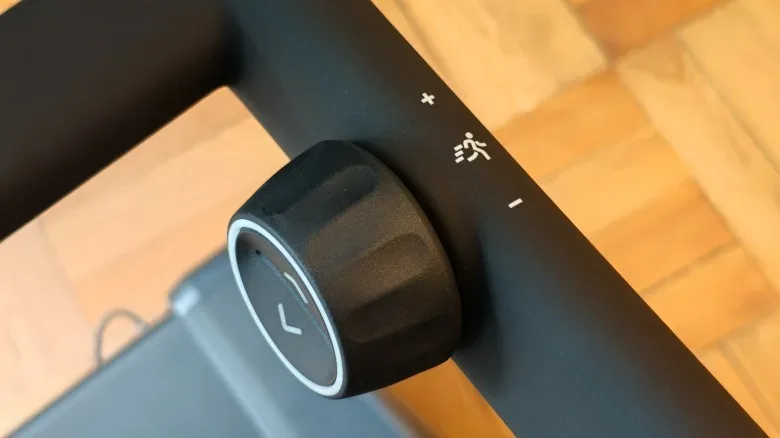
Beyond the camera, the Tread Vision adds a cooling fan, a phone tray, instant speed and incline controls called Jump Buttons, and revised deck cushioning using new dampeners. The Jump Buttons are a small but potentially meaningful usability addition: instead of repeatedly stepping through adjustments, users can make immediate changes to speed and incline settings. The cushioning claim is aimed at a gentler running experience, though the exact feel will necessarily vary from runner to runner.
The Tread+ Vision is built around its deck and Sled Mode
At $6,695, the Tread+ Vision is aimed at the far more specialized end of the home-treadmill market. Its defining piece of hardware is a slat-belt deck with a ball-bearing system intended for impact protection. A slat belt uses a series of individual slats rather than a conventional continuous belt, and Peloton presents this arrangement as premium technology that is uncommon in home machines.
The Tread+ Vision is also the only one of the three models with Sled Mode. Despite the name, this is not an arctic expedition simulator. It is designed to imitate the pushing motion used with weighted sleds in cross-training and Hyrox competition contexts. The treadmill provides software-controlled resistance from 30 to 300 pounds against the slat belt, and the user pushes the track against that resistance.
That framing explains why Sled Mode is limited to the flagship model. It relies on the Tread+ Vision’s specific deck approach and seeks to make a treadmill perform a different kind of conditioning task from ordinary running or incline walking. It may be compelling for users whose training already includes sled pushes, but it is not a must-have feature for every person looking to run indoors.
Which model’s features matter most?
The new names make the lineup sound more complicated than the main buying logic actually is. Each model serves a fairly distinct purpose:
- Tread Flex: the $2,195 foldable choice for people prioritizing storage, mobility, a lower entry price, a 21.5-inch pivoting Full HD display, and Peloton IQ access.
- Tread Vision: the $3,495 option for people who want a larger 23.8-inch display, a built-in camera for computer-vision form analysis, new cushioning, a cooling fan, phone tray, and Jump Buttons.
- Tread+ Vision: the $6,695 premium model, adding the slat-belt deck, ball-bearing system, and exclusive Sled Mode with 30-to-300-pound software-controlled resistance.
Across the range, ReRuns and the wider coaching platform help establish a shared software baseline. The key decisions then become physical: how much room is available, whether camera-derived form feedback is desired, and whether the Tread+ Vision’s specialized deck and resistance work have a clear place in a buyer’s training.
The Flex may be the model with the broadest practical appeal precisely because it asks the least of a home. Its folding deck, wheels, controlled lowering mechanism, and storage lock address the logistical friction that can prevent bulky equipment from fitting into a routine at all. The Vision models pursue measurement, cushioning, and more elaborate hardware; the Flex’s pitch is that a treadmill can be connected and coached without permanently claiming the room.
Whoop connection arrives in the Peloton app
Peloton also says direct Whoop account connections are available in the Peloton app beginning September 22. Whoop is a screenless fitness wearable platform, and the new connection broadens the ways Peloton users can bring wearable-account data into its app environment.
For users considering the Tread family, this update reinforces the larger strategy behind the new hardware. The treadmill is one piece of a network that includes recorded runs, Apple Watch support for ReRuns, Peloton’s coaching software, and now Whoop account connectivity. As with any connected-fitness setup, the useful question is not just which individual specification sounds most advanced. It is whether the storage design, training data, screen, and feedback tools suit the routine someone will actually maintain.
Peloton is clearly offering three answers to that question in fall 2026. The Tread Flex makes the strongest case that the answer can start with a folded deck and a little more free floor.
For another look at how consumer technology becomes more useful when it reduces everyday friction rather than merely adding features, see this report on a proposed iPhone security approach.