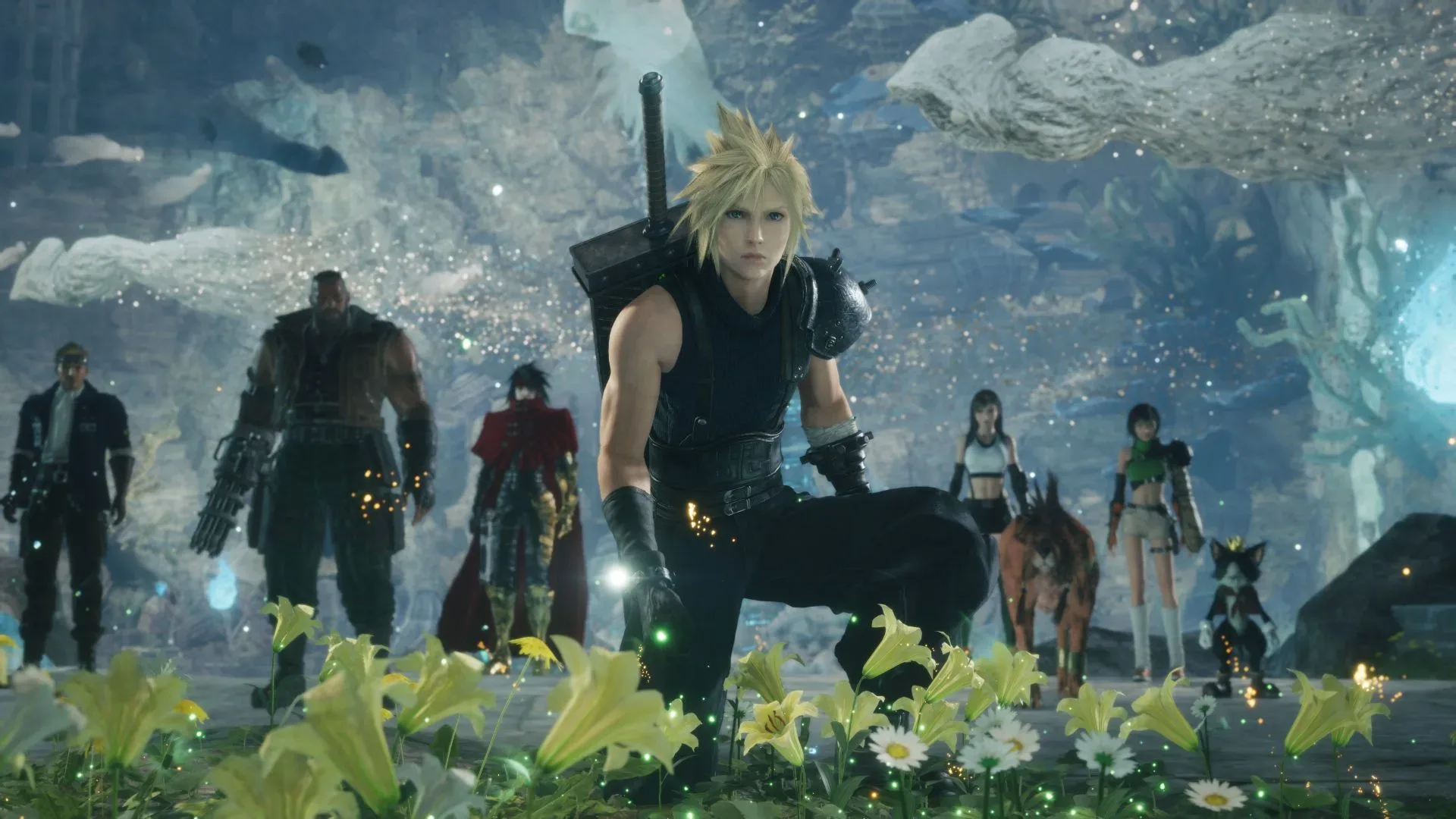
Final Fantasy 7 Revelation is preparing to give players more help finding their way through its world—but it may also let the direction-averse turn down the volume on that help. Director Naoki Hamaguchi has said the trilogy finale will feature more on-screen guidance than its predecessors, intended to make the experience more approachable for people who are less familiar with open-world games. At the same time, Square Enix is considering options to let players customize how that guidance appears.
That is a small statement with potentially enormous implications for an RPG expected to contain side quests, exploration, and a world that gradually reveals more places and activities. In a game designed to occupy dozens of hours, the difference between a helpful nudge and an overbearing instruction can be the difference between “I am on an adventure” and “I am being escorted through an adventure by a very enthusiastic arrow.”
What Square Enix has confirmed
Hamaguchi explained that Revelation includes extra on-screen guidance so players unfamiliar with open-world design can progress without becoming lost. The intended flow is not simply a straight line from objective to objective: following the guidance is meant to support exploration as the world opens up, introducing additional locations and things to do along the way.
Crucially, Hamaguchi also said the team is considering options that would allow players to customize how this guidance is presented. No specific settings, interface elements, or levels of control have been confirmed. That means players should not assume the game will include any particular feature—such as fully hiding objective markers, changing minimap behavior, or disabling prompts—until the developer provides details.
Still, the acknowledgement matters. It recognizes that players approach a large role-playing game with radically different expectations. One person may have a limited evening and want a clear route to the next story beat. Another may want to spot an interesting path, take it, and deal with the consequences later, preferably after opening seven chests that contained crafting components and one chest that contained a suspiciously emotional sword.
Why “on-screen guidance” is broader than a waypoint
On-screen guidance is a broad term. At its simplest, it can mean a marker showing where a current objective is located. But it can also describe prompts, route indicators, map icons, reminders, contextual instructions, or other signals that guide a player toward progress. The available information does not identify which of these Revelation will use more heavily, so the phrase should be read as a general commitment to clearer navigation rather than a confirmation of a particular user-interface system.
That distinction is important because not all assistance changes a game in the same way. A destination marker can help a player avoid wasting time retracing old ground. A suggested route can reduce uncertainty further by telling them how to reach that destination. Prompts that appear too frequently can make discovery feel pre-solved. Conversely, guidance that is too subtle can leave players unsure whether they missed a clue, chose the wrong route, or ran into a quest that requires something they have not yet unlocked.
Revelation’s stated goal seems to be reducing that uncertainty for less experienced open-world players while preserving the world’s gradual expansion. That is a sensible problem to solve in a game with side content. Optional activities are only inviting if players can understand that they are available and make an informed choice to pursue them. A world can be huge, beautiful, and packed with things to do; it can also be a logistical goblin if its signposting makes players feel as though they need to submit a missing-person report for the main quest.
Related coverage includes Final Fantasy 7 Revelation Plans More Guidance, With Customization Under Consideration.
Customization could serve both kinds of player
The potential customization is arguably the more interesting part of Hamaguchi’s comments. Guidance is not merely an accessibility question or a difficulty question. It is also a pacing preference.
For players who want a streamlined campaign, prominent direction can protect limited playtime. It lowers the chance of spending a session circling an area, looking for the one entrance, switch, path, or conversation that advances the story. That does not necessarily mean those players want the game made easier; they may simply want to spend their time making combat decisions, following character arcs, and choosing which activities are worth doing rather than wrestling with geography.
For players who value self-directed exploration, fewer prompts can preserve the pleasure of noticing landmarks, interpreting the environment, and wandering into something unexpected. The value of an open area is not solely measured by its size or by the number of activities placed on it. It also comes from the feeling that a player made a discovery rather than obediently arriving at a location that had been highlighted for them since breakfast.
A flexible system can accommodate both approaches without insisting that one is the “correct” way to play. If Square Enix follows through with meaningful presentation controls, a first playthrough could prioritize clarity and momentum, while a later run could use less overt direction for a more exploratory rhythm. Hamaguchi has previously indicated that completing everything in the adventure will take multiple runs, making the prospect of different navigation preferences across playthroughs particularly relevant.
A finale has a lot of players to account for
Revelation is positioned as the conclusion to the Final Fantasy 7 remake trilogy. That role carries an unusually broad set of player needs. Some fans will arrive deeply familiar with the earlier games and eager to search every available corner. Others may be primarily invested in reaching the closing chapters of this reimagined story. Some will be veterans of expansive RPGs; others may be drawn in by the characters and spectacle while having far less patience for open-world navigation conventions.
The series’ three-game scope has itself been described by Hamaguchi as an industry outlier, a point explored in our look at his comments on the remake project’s scale. In that context, interface flexibility is not trivial polish. It can be part of respecting the different ways people will meet the finale: with time to luxuriate in every detour, with a goal of seeing the central story efficiently, or with a mixture of the two.
The previously released games establish why players may care about this balance. Revelation follows Final Fantasy 7 Remake and Final Fantasy 7 Rebirth, and the new game is expected to include substantial exploration and optional content. The scale implied by that structure gives guidance systems an outsized role. A minor irritation repeated across a long RPG stops being minor with impressive speed. Likewise, a feature that saves a few moments of confusion at a time can meaningfully improve the overall experience.
Guidance is not the same as removing challenge
It is easy to treat navigation assistance as “hand-holding,” but that phrase can flatten several different design questions into one argument. Knowing where an objective is located does not automatically answer how to win a battle, how to prepare a party, which side activity to undertake, or how to manage time in a large game. It mainly helps clarify the next available destination or action.
In a lengthy RPG, navigation friction can be especially awkward because it may not test the skills the game otherwise asks of players. If the dramatic heart of a quest is a character moment or a demanding encounter, getting stuck because the route to the next scene was unclear can feel disconnected from the challenge players came for. On the other hand, some players genuinely enjoy navigation as part of the experience. They may see route-finding and environmental observation as texture rather than friction.
That is why optionality is more promising than a single philosophy imposed on everyone. The best implementation will depend on details Square Enix has not shared: what can be adjusted, whether settings can be changed during play, and how guidance interacts with optional exploration. Until those answers arrive, the confirmed takeaway is modest but welcome: Revelation plans clearer assistance by default and the team is actively considering ways to let players tailor it.
How this fits with Revelation’s broader pacing tools
Navigation is not the only area where Revelation appears to be addressing the time commitment of a long RPG. The game has also been described as allowing characters to level automatically and enabling players to move through the campaign more quickly. Taken together with the new guidance plans, that suggests an effort to offer routes through the game for players who want less friction from progression and travel.
None of that means exploration or side content is being dismissed. Hamaguchi’s explanation explicitly connects guidance to discovering more of the world as it opens. Rather, the emerging picture is one of letting players decide how much of their time should go toward locating the next objective versus engaging with the content once they get there.
For now, the phrase to watch is “considering options.” It is not a finished feature list, and it should not be mistaken for a guarantee of fully customizable exploration settings. But it is an encouraging sign that the team sees the issue clearly. Revelation has to land a trilogy-ending story while supporting a large world and a potentially enormous range of player commitment. Giving people a choice between a gentle trail of breadcrumbs and a more self-guided trek may be one of the most practical ways to make that world work for more people.