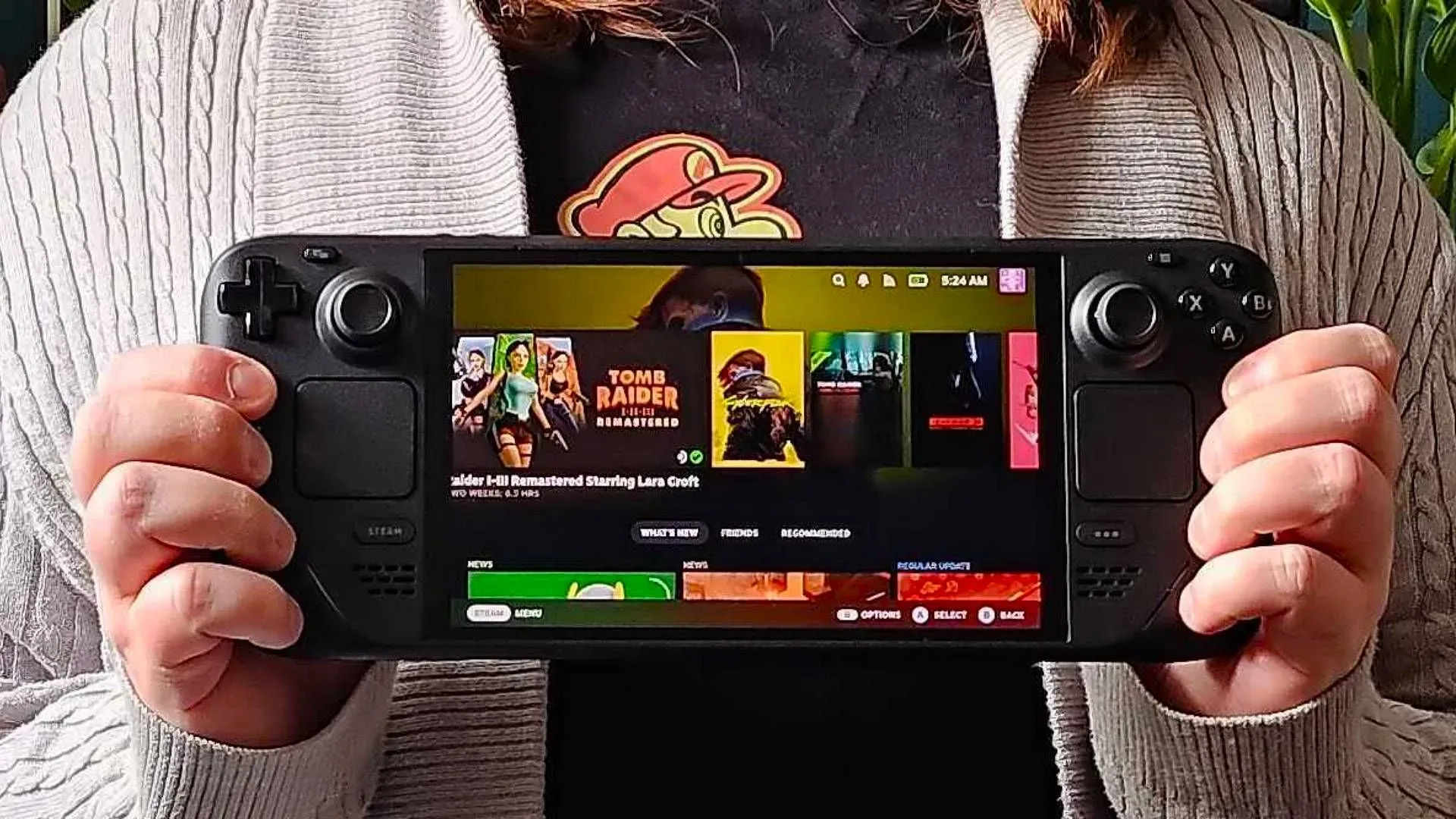
Valve is not describing a future Steam Deck as cancelled, delayed, or sent to live on a farm with the old launch-day servers. But the company is also offering no reason to expect a Steam Deck 2 reveal around the next corner.
Pierre-Loup Griffais, an engineer at Valve, has reiterated that the company’s basic approach to a follow-up handheld remains intact: a new model needs to provide a plainly meaningful jump in performance, and it needs to arrive under conditions that allow Valve to make the product it wants to make. That is a reassuring answer for anyone worried that component constraints have scuttled the project entirely. It is not, however, a release window.
“We want to make sure there’s a very delineated performance improvement for something like a future Steam Deck,” Griffais said.
The important wording is less about a specific component or a particular year than it is about the threshold Valve appears to have set for itself. A successor cannot simply be newer. It has to be convincingly better while preserving the user-experience and product goals Valve has in mind.
What Valve actually said
When asked whether shortages had changed Valve’s thinking around Steam Deck 2, Griffais’ answer was “not really.” He said Valve is still looking at a future Deck through the same lens, adding that the timing comes down to “looking at the current conditions” and determining how and when it can deliver such a device.
That makes two points reasonably clear. First, Valve has not indicated that shortages, memory pricing, fabrication constraints, or demand tied to AI data centres have caused it to abandon the idea of another Steam Deck. Second, those wider conditions remain part of the calculation. There is a substantial difference between saying a product is possible and saying that it is ready to announce, manufacture, and sell at a price that fits the company’s goals.
Griffais also said the goals around user experience and the product Valve is trying to build remain similar. That is a useful bit of continuity for current Deck owners. Valve is not framing a prospective follow-up as a retreat from the handheld’s existing direction. Instead, it is describing a sequel that needs to justify itself on both technical and practical grounds.
“Delineated performance improvement” is the key phrase
In this context, a delineated performance improvement means a difference players can readily identify, not merely a minor uplift buried in a specification sheet. Valve has not defined a target, named a processor, or promised particular frame rates. Any attempt to turn Griffais’ remarks into those details would be guesswork.
Related coverage includes Valve Says Steam Deck 2 Plans Still Depend on the Right Conditions.
Still, the principle is straightforward. A new handheld needs enough added capability to make its case against the existing device. For players, that could matter in the form of stronger performance in more demanding games, greater room for future releases, or a smoother experience at the settings they prefer. Those are explanations of why performance matters, not promises about Steam Deck 2 features.
The phrasing also suggests Valve is wary of a replacement cycle based solely on novelty. Handheld PC buyers do not just compare a new model with its predecessor; they weigh the likely cost, the games they already play, their existing accessories, and whether their current system still does the job. A small bump can be technically real while feeling economically unconvincing. Valve’s stated standard appears to be aimed at avoiding precisely that sort of awkward upgrade pitch.
Why market conditions are more than corporate weather talk
“Current conditions” is necessarily broad language, but it has clear relevance to portable PC hardware. A handheld relies on a collection of components rather than one magical pocket-sized goblin: processing hardware, memory, storage, display technology, battery-related design decisions, and manufacturing capacity all influence what can be built and what it costs.
RAM, or random-access memory, is the fast working memory a system uses while software is running. Price and supply pressure around memory can affect the economics of devices that use it. Fabrication backlogs refer to limited capacity or delays in the processes used to manufacture semiconductor components. Neither term, by itself, proves that a particular product has been held up. Together, they illustrate why a hardware maker may wait until performance, supply, and price line up more favourably.
AI data-centre demand has also been raised as part of the broader component landscape. The relevant takeaway is not that Valve has attributed a specific Steam Deck 2 delay to AI. It has not done that here. Rather, Griffais’ comments leave room for external conditions to shape the timing of a device even while the underlying plan remains unchanged.
That is a more cautious position than setting a calendar date years ahead and hoping silicon, supply, and cost behave themselves. It may disappoint anyone eager to replace their handheld immediately, but it is consistent with Valve’s stated desire to deliver a clear advancement at an appropriate price point.
What this means for people waiting to buy
For prospective buyers, this is not a reason to assume that a Steam Deck 2 is imminent. Valve has supplied no launch date, announcement date, specification list, or pricing information. The company’s comments confirm an approach, not a timetable.
It also does not mean that a current Steam Deck suddenly has an expiration date stamped on its back. A hypothetical successor will need a meaningful performance advantage before Valve believes it should arrive. That standard is about the next device’s justification, not a declaration that the present hardware is obsolete.
The practical decision therefore remains personal. Someone who wants a handheld now should assess the hardware available now rather than make a purchase around an unannounced product. Someone happy with an existing Deck has no new official reason to rush into a replacement plan. And someone who specifically wants Valve’s next-generation handheld should recognize that patience is still the only confirmed feature on offer.
Valve’s handheld work is also part of a broader field that includes other portable systems and different approaches to gaming on the move. For another look at handheld design, the Multisystem Pocket 2’s Game Gear-style FPGA shell shows how varied the portable space can be—even though an FPGA-focused retro device serves a very different purpose from a modern PC handheld.
Existing pricing makes the value question harder, not easier
The current Steam Deck OLED range reportedly starts at just under $800. That context helps explain why Valve may be especially careful about a successor’s positioning. A newer device with more capable internals could be appealing on paper, but a higher price would change who can realistically consider it.
Griffais did not discuss a Steam Deck 2 price, so there is no basis to predict one. Yet his emphasis on both a major performance distinction and the right conditions naturally places price alongside technical capability. Performance gains require a hardware foundation; a successful consumer device also needs a price that its intended audience can accept.
This is where the phrase “approachable” becomes important as a general purchasing concept. It does not necessarily mean cheap, and Valve has not attached a price target to a future model. It means a buyer needs to be able to see the proposition: what the hardware does, why it is better than the alternative, and why the cost is worth paying. A clear performance leap may be one half of that case. Achievable market conditions are the other.
No roadmap, but no retreat either
Valve’s position is measured rather than dramatic. The company is continuing with similar product and user-experience goals. It wants a distinct performance increase for a future Steam Deck. It is watching the conditions under which it could provide that device.
That does not settle when Steam Deck 2 will happen. It does make one reading less persuasive: that component pressure has forced Valve to give up on a next-generation handheld. Griffais’ remarks point the other way, while stopping well short of an announcement.
For now, the Steam Deck 2 remains a future-facing project defined by a standard rather than a schedule. Valve appears unwilling to put out a sequel merely because handhelds are expected to receive sequels. Until it can pair a substantial enough upgrade with circumstances that support the intended product, the next Deck stays in the category of “planned someday,” the most powerful and least benchmarkable setting in all of hardware.