For players who treat a 100% Steam completion record as a small digital medal of honor, post-launch achievements can be an oddly deflating complication. A game may be finished in full, only for a later expansion, event, or mode to add fresh requirements and turn that clean percentage into a new job. Steam’s new Achievement Sets system is designed to make that situation more legible—and, in the case of DLC, avoid counting content a player does not own against the game’s overall completion display.
The feature is live in the Steam Client beta. It gives developers a way to organize achievements into purposeful collections rather than presenting every achievement for a title as one undifferentiated pile. Most importantly, Steam distinguishes between Base Game Achievement Sets and DLC Achievement Sets, with the two categories shown separately on the redesigned achievements page.
The change is a quality-of-life update rather than a new achievement system for players to opt into themselves. Developers must update their games and define the collections they want to use. Steam says a growing number of titles already support the feature, but support will therefore vary from game to game—especially while the function remains in beta.
What an Achievement Set is meant to solve
An achievement is a platform-level goal attached to a game, often marking progress, a challenge, an optional activity, or a particular style of play. Until now, players commonly encountered a game’s achievements as a single total. That can be simple, but it does not always communicate what kind of content each objective belongs to.
Achievement Sets introduce a second layer of organization. A developer can create a collection with a defined purpose, then place related achievements inside it. Steam specifically identifies several potential uses:
- Separating single-player achievements from multiplayer achievements.
- Creating distinct collections for limited-time or seasonal activities, such as a Halloween event.
- Keeping base-game goals separate from achievements connected to downloadable content.
That sounds like an interface refinement, but it changes the meaning of progress in a helpful way. Finishing a campaign’s goals is not necessarily the same thing as finishing every multiplayer challenge. Neither is the same as completing an expansion released later. Sets allow those achievements to be presented as related, but not identical, kinds of completion.
For a PC game with a long update life, the distinction could be especially useful. A player may want to see whether they completed the core release while leaving competitive modes, seasonal events, or extra content as separate goals. The feature does not remove the achievements; it makes their boundaries visible.
Base game progress and DLC progress are now visually distinct
Steam has divided collections into two formal types. Base Game Achievement Sets contain the game’s core achievements and use blue progress bars and blue trophy presentation on the achievements page. DLC Achievement Sets are presented in purple.
The color coding is straightforward, but it addresses a real source of confusion: whether an unearned achievement belongs to the game a person bought or to an add-on they have not purchased. Under the new setup, DLC sets do not appear in a player’s overall game progress until that player has access to the specific DLC associated with them. In practical terms, an expansion’s achievement list should not lower a player’s completion display simply because the expansion exists.
That is the headline benefit for achievement hunters. A player who has completed the base game can retain a 100% result for that base content without being compelled to buy every future DLC merely to preserve it. The DLC remains its own completion track once it is accessible, which is a clearer reflection of what the player can actually pursue.
It is worth drawing a careful line around what has been confirmed. Steam is introducing a structure that lets developers separate achievements and protect base-game completion from DLC a player does not have access to. It does not mean every existing game will instantly receive perfectly curated categories, nor does it establish that every future type of added content will be handled identically. Developers are responsible for implementing sets in their own games.
A completed set can remain completed
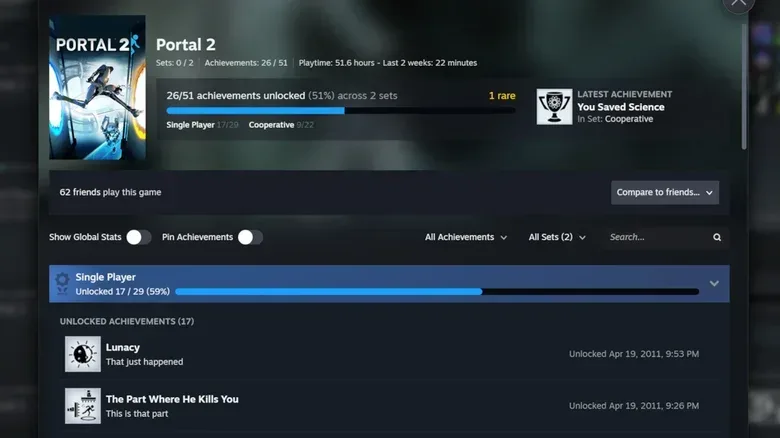
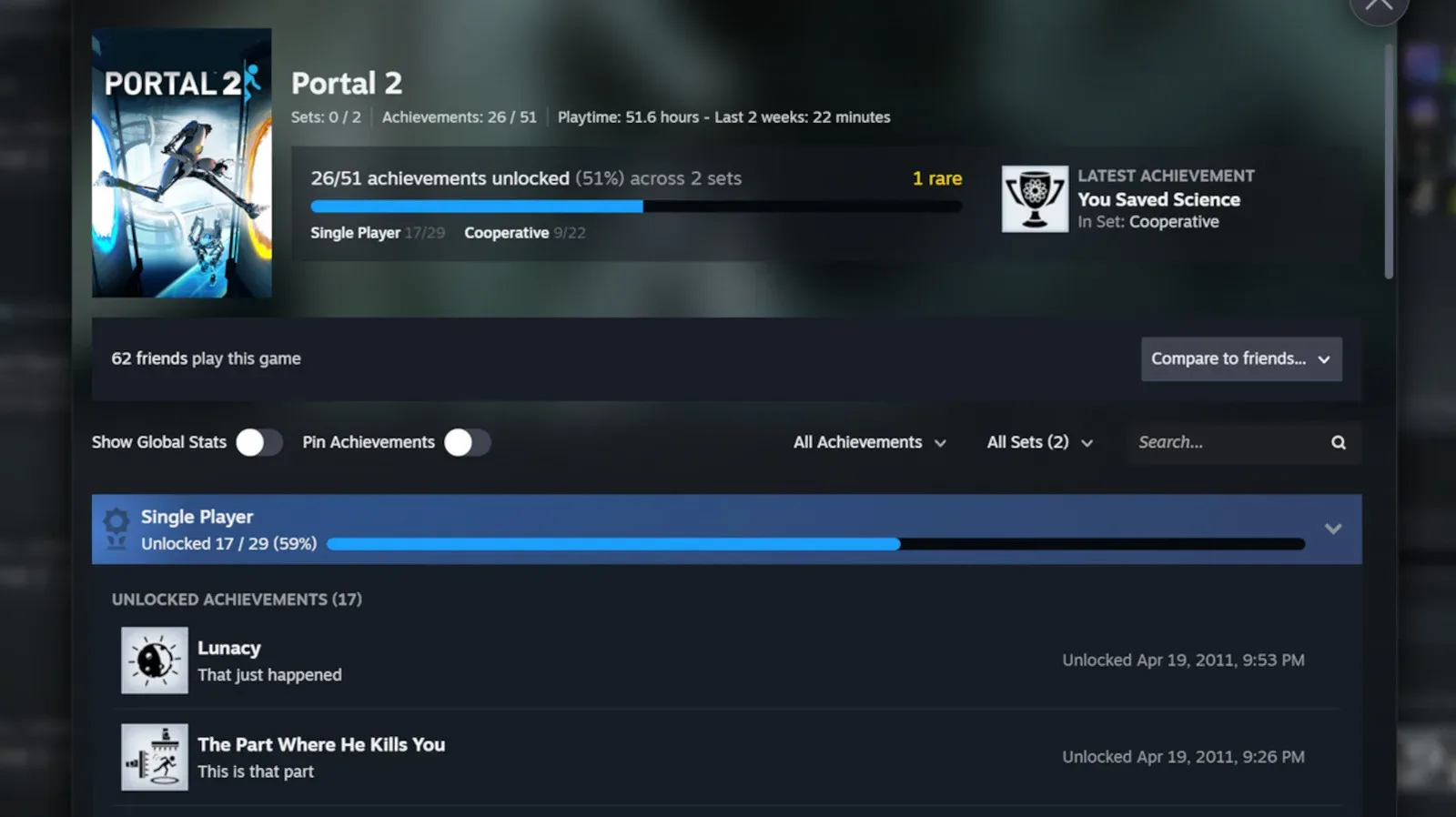
Achievement Sets also change how Steam handles later additions to an existing collection. Each set has its own progress bar, and completing all achievements in it earns a “set complete” trophy that can be displayed on a Steam profile.
Crucially, Steam says progress can remain at 100% even if a developer adds further achievements to that set later. For players, that offers a measure of permanence: completing a collection is recognized as an accomplishment rather than a status that must always be reopened by later updates.
This is distinct from saying new achievements disappear or cannot be earned. The new additions can still give a game more to do. The difference is that Steam can preserve the earlier completed state of the set instead of rewriting a player’s record as incomplete. That is a more respectful model for a platform where games may grow through patches, expansions, and events long after their original release.
It may also help developers experiment with optional additions without making every update feel like an involuntary expansion of a player’s backlog. A seasonal collection, for example, can stand as its own group rather than blending into every other objective associated with the game.
The achievements page is being rebuilt around sets
Steam is redesigning its achievements page to accommodate the new organization. When players browse unlocked achievements from their profile, they will see achievements grouped in collections, with individual progress bars for each set. The layout is intended to make both the categories and a player’s advancement through them easier to read.
The updated page also expands comparison tools. Players will be able to compare achievement progress with as many as three friends, including rare achievements earned and completed sets.
“Rare achievements” are achievements that comparatively few players have unlocked. In a friend comparison, they can offer a more interesting signal than raw totals alone: two people could have broadly similar progress, while one has completed unusual challenges or content that the other has not. Bringing completed sets into the same comparison screen adds further context, since it shows not only individual unlocks but also whether someone has finished a defined achievement collection.
Why this matters beyond the completion percentage
A percentage is simple on its face, but it often compresses very different player experiences into one number. A person who completed a game’s central campaign and a person who earned every achievement across years of downloadable content, multiplayer updates, and events may both be described in terms of “completion,” even though their paths are very different.
Achievement Sets do not erase that difference, but they give Steam the vocabulary to show it. Base-game completion can be tracked as base-game completion. DLC can remain DLC. Multiplayer and seasonal objectives can be identified as their own collections where a developer chooses to organize them that way.
That could be valuable for players deciding what to tackle next. Instead of scanning a long list with no clear division, they can potentially identify a finished campaign set, an untouched multiplayer set, or a DLC set that becomes relevant only after obtaining the add-on. It is also more useful for anyone who wants to share a profile accomplishment: a set-complete trophy tells visitors what was completed, not merely that a percentage happened to hit a particular threshold.
There is a related practical benefit for games that continue to evolve. Long-running support can be good news for a community, yet it can make completion tracking messy when new objectives are bundled into one permanent total. Separating those objectives does not diminish the value of new content. It simply prevents a later addition from retroactively changing what a player had already completed.
What players should expect during the beta
The immediate limitation is implementation. Achievement Sets are available through the Steam Client beta, but developers need to update their games to create and assign sets. Players should not assume that an achievement page will look different for every title, or that a title with DLC will necessarily have its achievements separated right away.
Where a game has adopted the system, the new presentation should make the structure clear: blue for base-game achievements and their progress, purple for DLC achievements and progress. DLC collections will not enter the overall game progress display until the relevant content is accessible to the player.
For completion-focused Steam users, that is the core takeaway. The platform is moving away from treating every post-launch achievement as an automatic amendment to the same record. Developers still decide how to organize their games, but the tools now exist to acknowledge that a base game, an expansion, a multiplayer mode, and a seasonal event can be separate achievements in the meaningful sense—not just separate icons in one enormous list.
It is a modest-looking feature with an unusually player-friendly implication: finishing a game can remain finishing a game, even after that game keeps growing. For another example of how ongoing PC game support can reshape a title’s scope, see our look at Warhammer 40,000: Boltgun 2’s larger retro-shooter campaign.